
Product Management
Product management is the practice of strategically driving the development, market launch, and continual improvement of a company's products. It is a discipline, not a job title, and the most common way it fails is by becoming a feature factory.
What Is Product Management?
Product management is the discipline of deciding what to build, why it matters, and how to know if it worked. It is not the same as shipping features on schedule, though the two are frequently confused, including inside companies that believe they are doing the former.
The discipline is distributed. A product manager is a role, but the work spans product owners, designers, and engineering leaders. Organizations without anyone holding the title still do product management. They just do it by accident, and usually badly.
Product Management vs. Project Management vs. Product Ownership
These three get conflated constantly, and the confusion has real organizational cost.
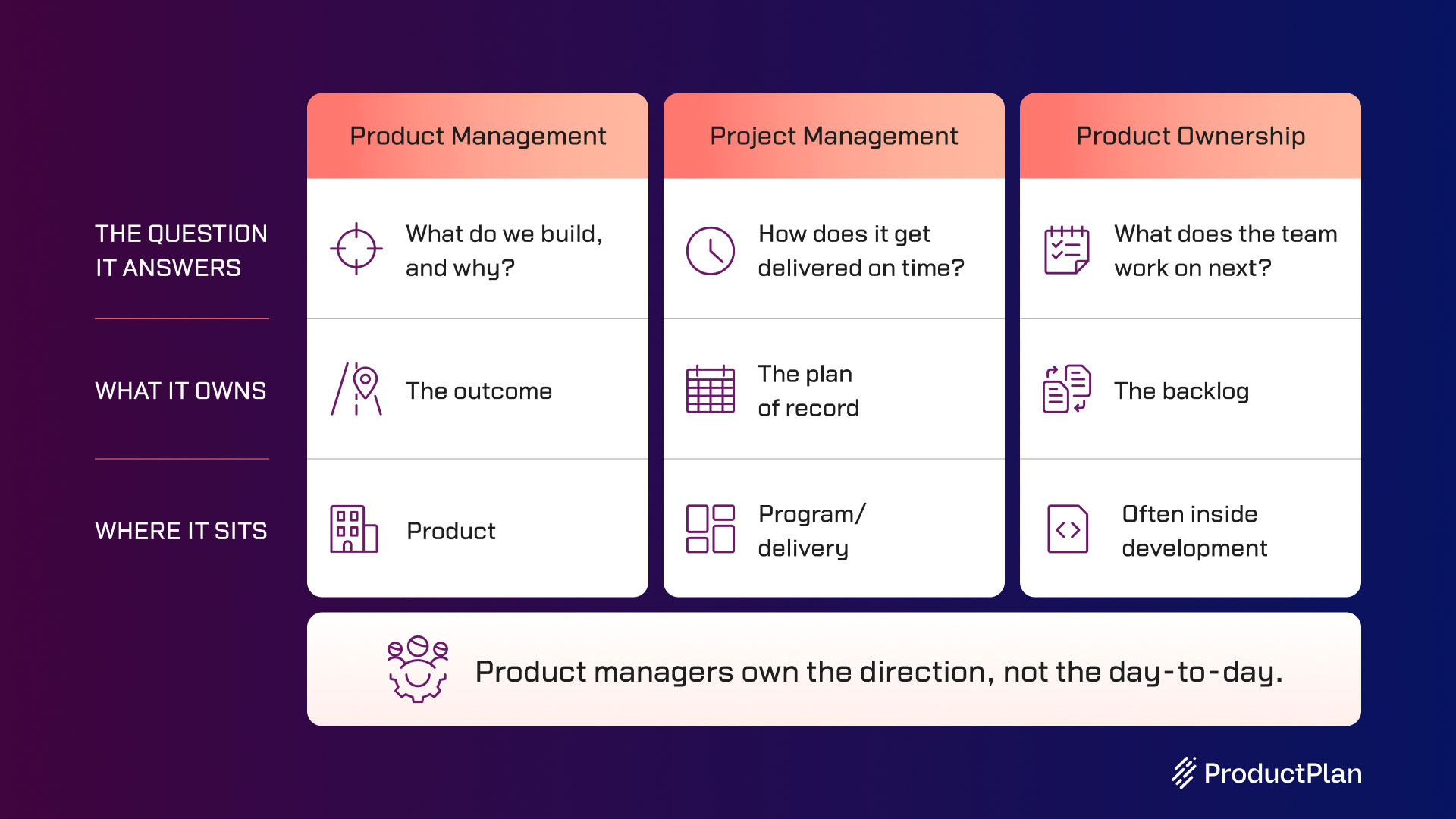
Product management decides what to build and why. It owns the outcome.
Project management decides how the work gets delivered on time. It owns the plan of record.
Product ownership translates strategy into tactical work for the development team, primarily through the product backlog. In agile organizations, product owners often sit inside development rather than product.
The most consequential misconception is that product managers own the day-to-day details of development. In most companies they do not. They own the direction, and they are accountable for whether that direction was right, which is a much harder thing to be accountable for and much easier to quietly stop doing.
What Does Product Management Involve?
Conducting research. Understanding the market, the competition, and the specific problems real users have. Decisions made without this are guesses with a roadmap attached.
Prioritizing. Assessing the relative value of every potential feature, initiative, and piece of technical debt, then choosing. Prioritization is the core of the discipline, and it is mostly the willingness to say no.
Communicating the plan. Building a strategy, usually expressed as a product roadmap, and defending it to executives, investors, and engineering. A plan nobody understands is not a plan.
Acting on evidence. Learning from what the product taught you after it shipped, and letting that change what you do next.
Why Does Product Management Fail?
The dominant failure mode has a name: the feature factory. The term comes from John Cutler, a contributing author at ProductPlan, who used it to describe organizations more interested in completing story points than in learning what users actually wanted.
A feature factory measures itself by output. Features shipped, releases delivered, story points burned down. Every one of those is easy to count and none of them tells you whether the product got better. A team can hit every deadline for four consecutive quarters and be no closer to a product anyone wants.
The failure is rarely visible from inside, because a feature factory looks exactly like a productive team. The roadmap is full. The velocity is high. The stakeholders are getting what they asked for. What is missing is the question that defines the discipline: did this work, and how do we know.
Product management is the function that is supposed to ask that question. When it stops asking, the title survives and the discipline does not.
How Is AI Changing Product Management?
AI is shifting where product managers spend their hours, and the shift is away from synthesis and toward judgment.
The tasks automating fastest are the ones that used to fill the calendar: reading through feedback, tagging themes, assembling the status update, building the deck that explains the plan. What AI does not do is decide which problem is worth solving, or defend that decision to an executive who wants something else.
This raises the stakes rather than lowering them. A team that was already a feature factory now becomes a faster one. AI compresses the distance between customer signal and roadmap decision, but only for teams that were listening to the signal in the first place. For everyone else, it just accelerates the wrong loop.
Additional Resources on Product Management
- The Ultimate Guide to Product Management
- What Is Product Development?
- The Ultimate Guide to Product Planning
- What Is a Product Management System?
- The State of Product Management 2026
Related terms: Product Manager / Product Owner / Feature Factory / Product Roadmap / Prioritization / Product Strategy / AI for Product Management
Your next roadmap starts here.


.svg)