
Roadmapping Guide to Omnichannel Retail Experiences
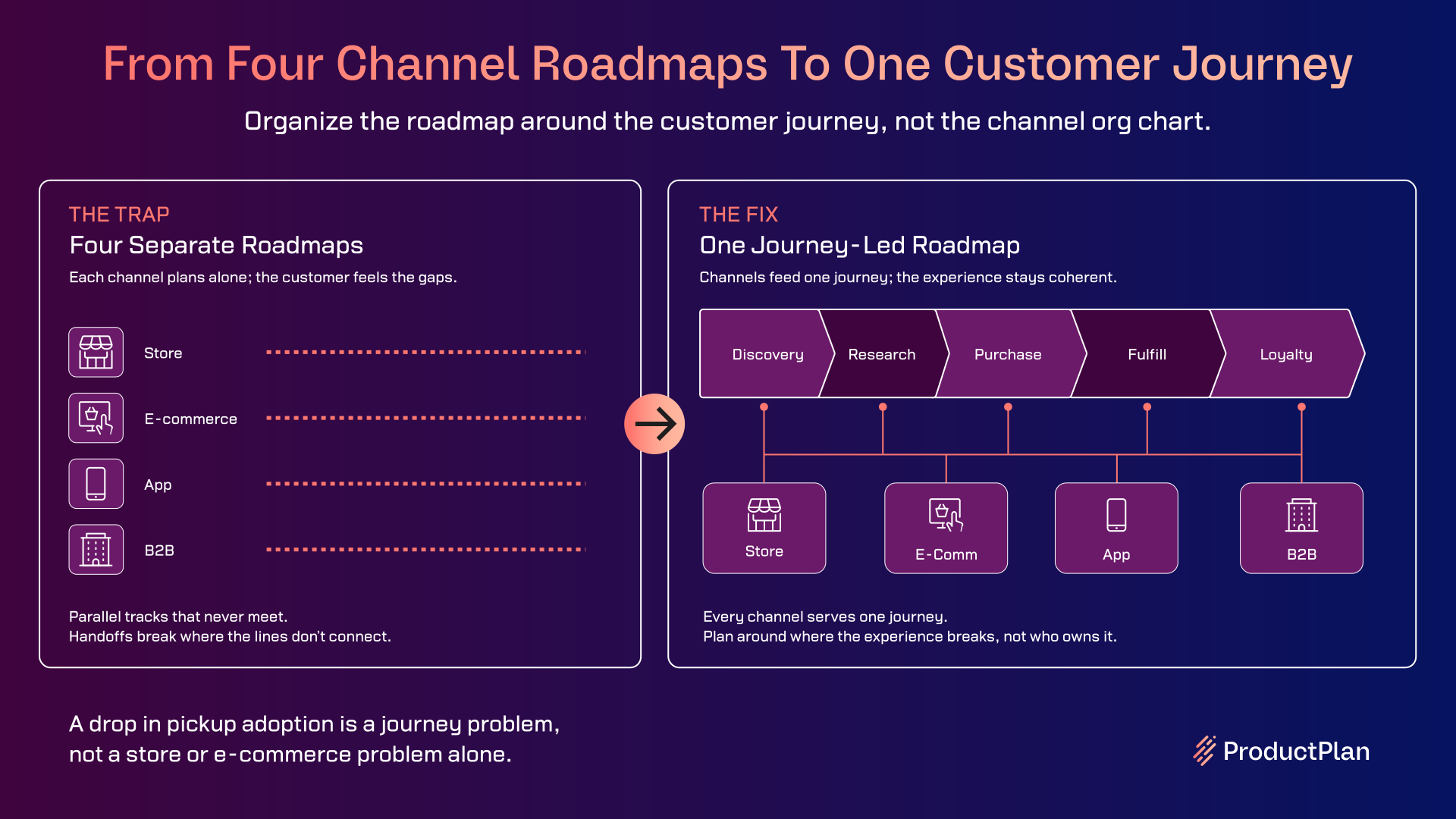
Building consistent omnichannel retail experiences requires more than improving individual channels. Product leaders need a way to connect store, e-commerce, app, and B2B touchpoints into one coherent customer journey.
Key Takeaways
- Omnichannel retail roadmapping means planning your product work so the customer experience stays coherent and customer-led across store, e-commerce, app, and B2B touchpoints, rather than running four separate roadmaps that just happen to share a brand.
- Your strongest roadmap options organize around customer journeys rather than your channel org chart, so your product work serves how customers actually move rather than how your internal team happens to be structured.
- Unifying the fragmented signal coming from your store teams, online analytics, app behavior, and B2B buyers is what keeps your roadmap honest over time, and it's the piece most retail product teams haven't put in place yet.
- According to ProductPlan's 2026 State of Product Management report, 40% of teams say their strategy, discovery, and roadmap work is spread across disconnected tools, likely mirroring the same fragmentation you're trying to eliminate for your customers.
- Sequencing your work by cross-channel customer impact, instead of by which channel shouts loudest, stops one touchpoint from racing ahead while the others fall out of sync.
The juggling act nobody tells you about
Running product for a retail or consumer-goods brand in 2026 means managing a level of channel complexity that would have been unusual a decade ago. For leaders in retail product management, every team has legitimate priorities:
- Store teams want better associate tools and digital shelf visibility.
- The e-commerce team has a feature backlog stretching to next year.
- The app team is building a loyalty experience that does not yet talk to the in-store POS.
- The B2B portal that wholesale buyers use is two releases behind everything else.
Every one of those teams has reasonable priorities from its own channel. Your customers, however, experience your brand as a single journey: researching on the app, checking stock on the website, buying in-store, tracking orders by email. When those channels fall out of sync, customers don't know which team was responsible. They just know the experience felt broken.
This is the defining product challenge you're facing in 2026: not building within a channel, but building across them. Retail product roadmapping now requires teams to coordinate decisions across digital and physical touchpoints, while still giving individual teams the clarity they need to execute.
Only 7% of specialty retailers have achieved true unified commerce maturity, according to Manhattan Associates research. The gap between the channels you have and the coherent experience your customers expect is where most retail product roadmaps fall short.
The difference between omnichannel leaders and laggards is not simply the number of channels they operate, but how effectively they connect the capabilities behind those channels into a unified customer experience.
The strategies in this guide are designed to help you close that gap, not by adding resources, but by organizing your roadmap differently.
What is omnichannel retail roadmapping?
Omnichannel retail roadmapping is the practice of planning your product work so the customer experience stays consistent and connected across all of your brand's touchpoints. It helps teams create stronger omnichannel retail experiences by aligning priorities across physical stores, e-commerce, mobile apps, and B2B channels. Rather than improving one channel in isolation while others drift out of sync, it gives you a shared way to decide what to build, when to build it, and how work across every retail channel contributes to a single customer experience.
Different roadmap structures support planning in different ways.
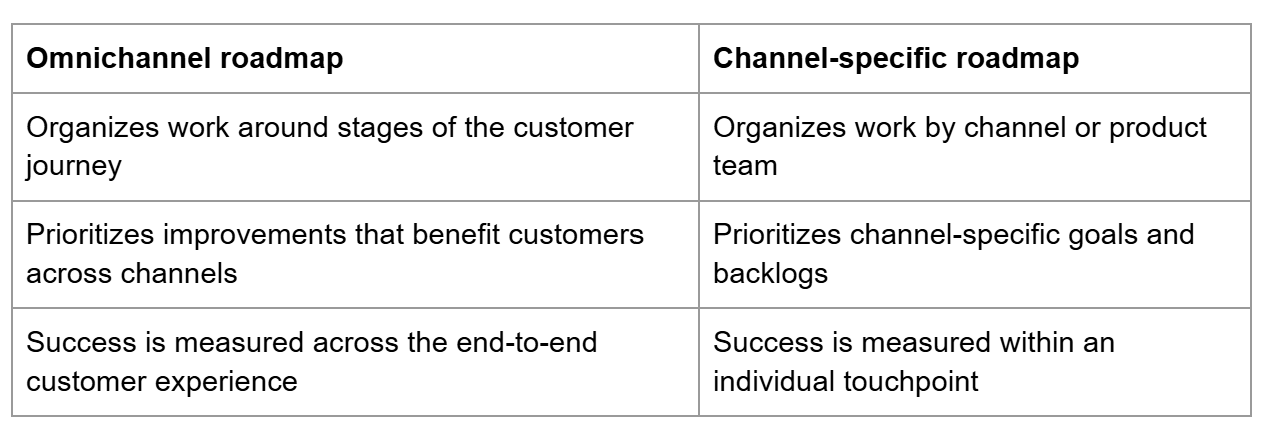
An omnichannel retail roadmap organizes work around customer journeys, while channel-specific roadmaps organize work around individual teams or touchpoints.
Those differences shape the questions product teams ask during planning. A channel-specific roadmap asks: What does this channel team need to build next? An omnichannel retail roadmap asks: Where in the customer journey is the experience breaking down, and which channel owns the work to fix it?
That shift changes who you bring into planning, what signal drives your prioritization, and how you sequence work. You measure success by the customer experience across the journey, with customers moving from online research to in-store purchase through a coherent experience at every handoff.
Retailers with strong omnichannel strategies grow revenue at 9.5% annually compared to 3.4% for weaker strategies, according to research cited across multiple 2026 retail industry analyses. The financial case for getting this right is structural, not incremental.
Why fragmented channels make omnichannel roadmapping difficult
Most retail product management teams are structured around individual channels. It's common for you to have separate teams owning:
- E-commerce
- Mobile apps
- In-store digital experiences
- B2B platforms
Each team has its own backlog, roadmap, stakeholders, and performance metrics. This structure gives you clear accountability within each channel, but it can also introduce inconsistency at the points where your customers move between them.
These organizational boundaries are often reinforced by the systems and processes behind them. Siloed systems, disconnected data, and channel-specific planning cycles make it hard for you to connect the signals you'd need to understand the full customer journey.
Your challenge is turning those fragmented signals into coordinated decisions about what to build, when to build it, and how each channel contributes to the overall customer experience.
The customer journey doesn't respect those boundaries. Your customers move fluidly between channels throughout their shopping journey, and use multiple touchpoints before making a purchase. They experience those interactions as one continuous relationship with your brand, not as separate experiences owned by different teams. When you plan those touchpoints separately, your customers encounter a brand that feels like multiple companies wearing the same logo.
ProductPlan's 2026 State of Product Management research found that 40% of teams say their strategy, discovery, and roadmap work happens across disconnected tools. When feedback from your store associates lives in a different system than your app reviews, and neither reaches the PM responsible for loyalty, your roadmap reflects what one channel sees rather than the journey as a whole.
Strategy 1: Organize the roadmap around customer journeys
The highest-leverage change you can make to your roadmapping process is to reorganize your omnichannel retail roadmap around the customer journey rather than your internal channel structure.
Roman Pichler, a leading product management expert and author of Strategize, has argued consistently that goal-oriented, outcome-based roadmaps outperform feature-based ones, because they shift the conversation from debating what to build to agreeing on what value to create. In your retail context, that outcome is the customer journey: the sequence of touchpoints a customer moves through from awareness to purchase to loyalty, rather than the features any one channel team wants to add.
Practically, this means mapping the customer journey first, then figuring out which channels contribute to each stage. A simplified retail journey looks like this:
- Discovery: Your customer finds the brand through search, social, or an app.
- Research: They explore products through your website, app, or store.
- Purchase: They complete a transaction through any available channel.
- Fulfillment: They receive their order through delivery, BOPIS, or in-store pickup.
- Loyalty and repurchase: They continue the relationship through your app, email, or store.
Each stage becomes a potential roadmap theme. Each channel contributes to one or more stages, and no single channel owns the full journey.
When you organize your roadmap this way, the friction points that matter most become visible in ways they aren't when each channel runs its own separate plan. A drop in BOPIS adoption is a journey problem, not an e-commerce problem or a store problem alone. It happens at the handoff between online purchase and in-store pickup, and fixing it means both teams need to act in sequence. A journey-organized roadmap makes that coordination visible and easier for you to plan.
Strategy 2: Unify signal from every channel before you prioritize
A roadmap organized around journeys is only as good as the signal informing it. For most retail product teams, that signal is fractured across systems: app store reviews live in one place, store associate feedback in another, NPS verbatims in a third tool, and B2B buyer requests sit in a CRM you rarely see.
This fragmentation isn't a coincidence. It reflects the same channel-siloed structure that fragments your roadmap in the first place. Fixing it means building a deliberate intake process that pulls signal from every channel into a single view before you prioritize anything. This helps you separate strategic opportunities from the constant stream of requests, ideas, and feedback competing for roadmap attention.
Store teams reveal physical touchpoint friction
Store teams and associates are a rich and underused source of signal about where the product experience breaks down at the physical touchpoint. Associate feedback about which digital tools create friction at checkout, or which product information gaps cause customers to abandon a purchase, is exactly the kind of qualitative signal that reveals journey problems invisible in web analytics.
E-commerce data reveals online journey gaps
E-commerce behavioral data shows where customers drop off, what they search for and cannot find, and how they move between product discovery and purchase intent. Combined with associate feedback, it reveals which online gaps are driving customers to ask store staff for help.
App engagement reveals loyalty opportunities
App engagement patterns show which features drive loyalty behavior and which are opened once and abandoned. They also reveal which notification and re-engagement patterns are building the customer relationship and which are creating noise.
B2B buyers reveal overlooked workflow challenges
B2B buyer signal is one of the most consistently overlooked sources in retail product planning. Wholesale buyers and retail partners interact with a brand's B2B portal under very different conditions than direct consumers. Their friction points, from bulk ordering workflows to account management and product catalog access, rarely surface in the consumer-facing analytics that dominate retail product planning.
A complete customer signal creates better prioritization
Customer impact is the most common basis for prioritization, cited by 58% of product teams in ProductPlan's 2026 State of Product Management research. But "customer impact" is only as broad as the customer signal feeding it. If you draw your customer signal mainly from e-commerce analytics, you risk defining "customer" as "online buyer" by default, building a roadmap that serves that segment at the expense of your store customer, your app user, and your B2B buyer.
Combining quantitative channel analytics with qualitative feedback from customers and frontline teams gives product leaders a more complete view of where experience gaps exist.
Strategy 3: Sequence work by cross-channel customer impact
Once your omnichannel retail roadmap is organized around journeys and fed by unified signal, the sequencing question changes. For retail product management teams, this means moving away from channel-based prioritization and toward decisions based on customer impact.
Instead of asking "what's the app team's highest priority?", you can ask: which journey stage, if improved, would create the most value across the most channels at once?
This shift changes how you evaluate roadmap opportunities, giving your team a clearer framework for deciding which initiatives deserve investment. A discovery-stage improvement, whether that's better search, more useful recommendations, or a more coherent link between app discovery and in-store availability, can influence every channel downstream. If your customer can't find the right product at discovery, no amount of investment in purchase or fulfillment can recover that lost opportunity.
The most effective omnichannel roadmaps prioritize improvements that:
- Affect multiple channels: the improvement creates value across the widest possible range of touchpoints.
- Address recurring journey friction: issues that show up across multiple sources of signal point to broader journey problems, not isolated channel issues.
- Have evidence from multiple teams and data sources: an issue that surfaces in app reviews, store feedback, and e-commerce drop-off data should take priority over one that shows up in only one channel's signal.
Resource and capacity constraints are the top cause of roadmap misalignment for 49% of teams, according to ProductPlan's 2026 report. With limited engineering capacity spread across multiple channels, sequencing by cross-channel impact stops your roadmap from being consumed by whichever channel stakeholder pushed hardest in the last planning meeting.
In practice, this means scoring each candidate initiative partly on how many channels it benefits. A BOPIS improvement that reduces friction for your store team, your e-commerce team, and your customer all at once should score higher than a feature that only moves one channel's metrics.
Strategy 4: Build cross-channel alignment into the planning cadence
Journey-organized roadmaps only stay honest with cross-functional participation. If the session that produces your prioritization decisions involves only the e-commerce PM and their immediate stakeholders, your roadmap will reflect e-commerce priorities no matter how it's organized on paper.
A practical structure brings representatives from each channel to the prioritization table, not to advocate for their own backlog, but to assess the signal from their channel and weigh in on whether a proposed initiative will actually work at their touchpoint.
For example, your e-commerce PM knows whether a proposed checkout improvement is feasible within the web stack. Your store product lead knows whether the associate tool your e-commerce team assumes will get the change is actually used the way they expect.
This doesn't need to happen weekly or even biweekly. A monthly prioritization conversation is often enough to keep you aligned. The session should:
- Review synthesized signal from all channels.
- Evaluate the roadmap against journey outcomes.
- Adjust sequencing based on new findings.
The goal is to keep your channels connected without adding coordination overhead that slows delivery. A shared roadmap helps ensure your omnichannel retail experiences remain consistent as teams introduce new features, update workflows, and respond to changing customer needs.
What this requires is a shared view: one roadmap that all your channel teams read, update, and plan against. When your e-commerce roadmap, your app roadmap, and your in-store roadmap exist as separate documents with separate update cycles, coordination happens at best in meetings and at worst not at all.
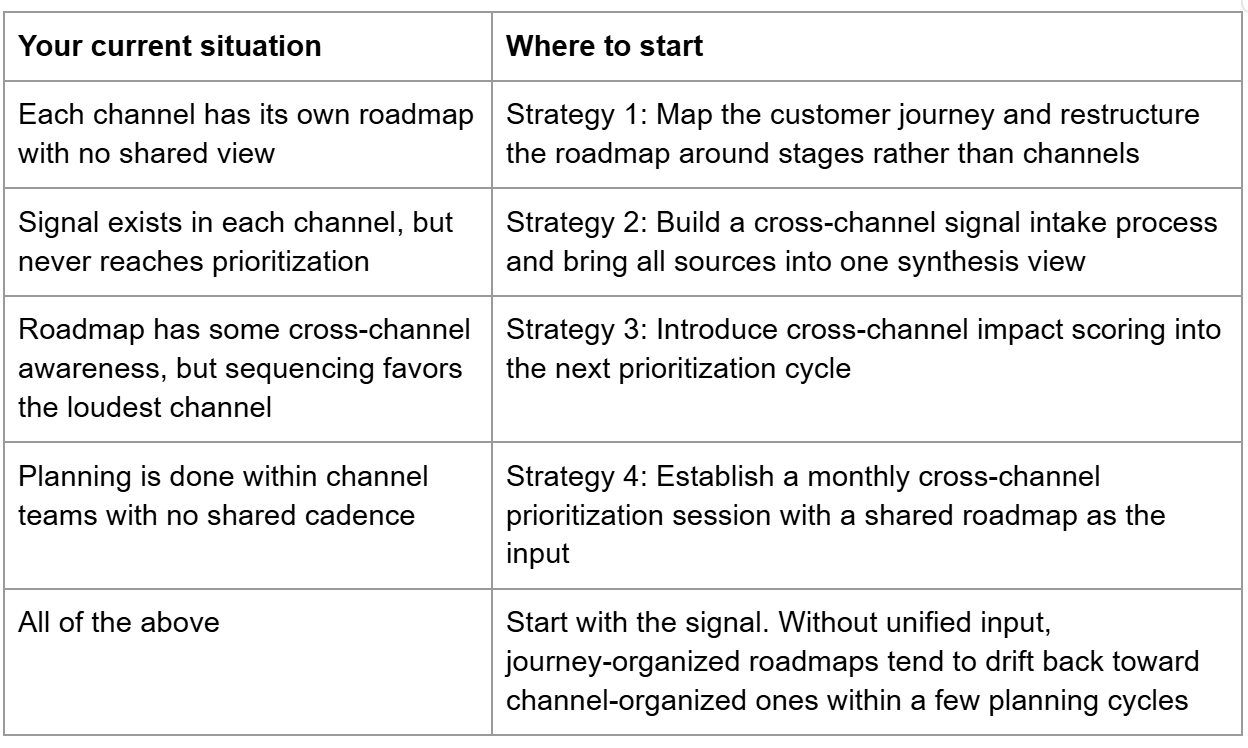
A decision-support guide: which omnichannel roadmap strategy to start with
The four strategies in this guide work together, but most retail product teams do not need to implement them all at once. The right starting point depends on where fragmentation is already affecting the roadmap process.
The infrastructure that makes it possible
Wherever you start, the same thread runs through all four strategies: none of them survive on good intentions alone. Mapping the journey, unifying signal, sequencing by cross-channel impact, keeping planning cadences aligned, all of it needs a system behind it, or it quietly drifts back to channel-siloed roadmaps within a few planning cycles.
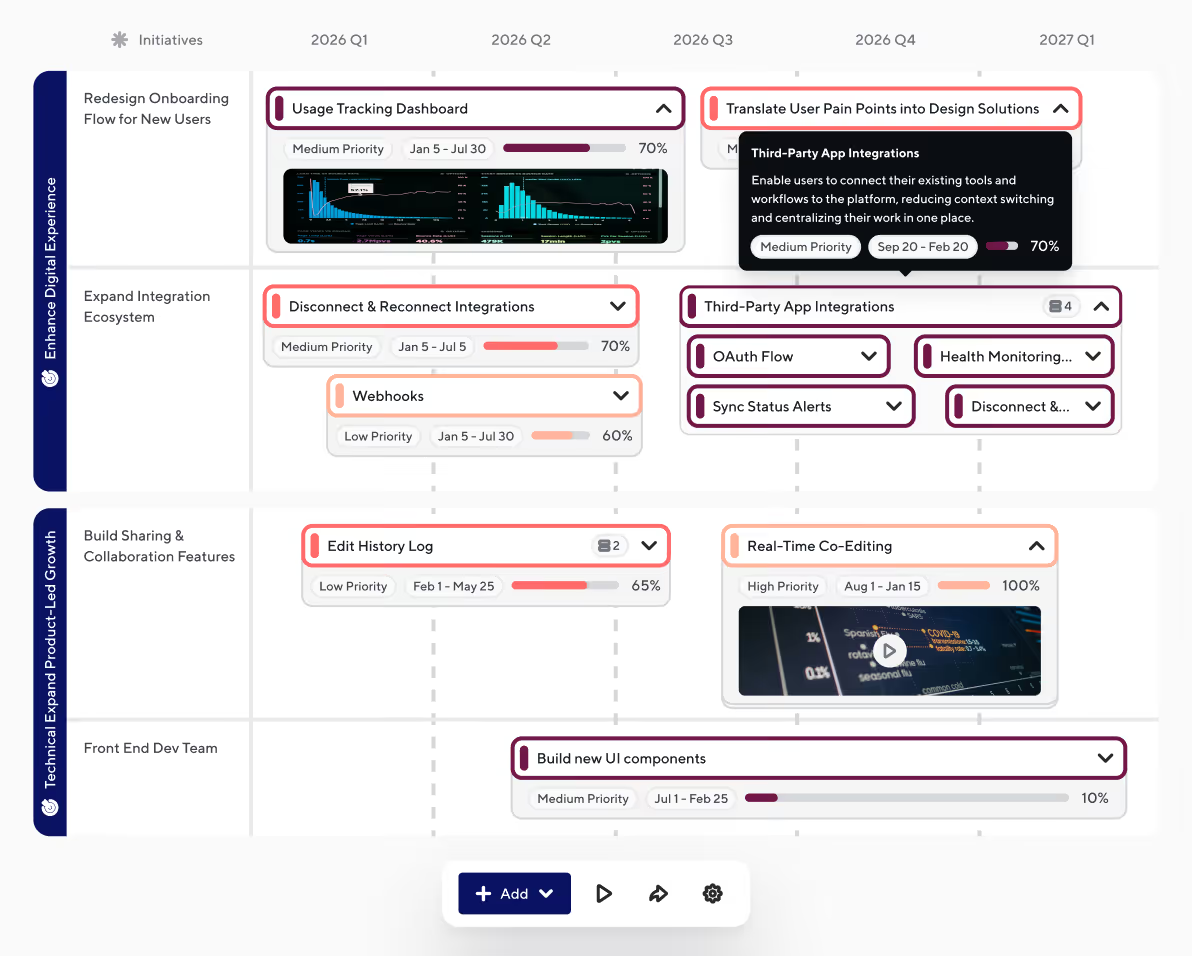
This is exactly the gap ProductPlan's Product Intelligence Platform is built to close. Instead of juggling four sources of signal and four separate roadmaps, you get one system that does the work these strategies ask of you.
Here's what that looks like in practice:
- Signal in one place: Store feedback, e-commerce surveys, app data, and B2B input flow into a single view instead of four separate ones.
- Automatic synthesis: Winware AI, ProductPlan's built-in synthesis engine, turns that signal into cross-channel themes for you, no more manually stitching together spreadsheets from four different teams.
- Traceable priorities: Every theme links directly to the roadmap decisions it informs, so when someone asks why a feature is prioritized, the evidence is right there.
- One roadmap, tailored views: Your channel PMs see their specific initiatives. Your leadership sees how each one contributes to the journey stages that matter most.
If your signal is fragmented and your roadmap is channel-siloed today, this is what gets you from an omnichannel strategy that lives in a slide deck to one that lives in your team's daily work.
One roadmap, one experience
The brands winning in 2026 are building more coherent omnichannel retail experiences by organizing product work around customer journeys rather than disconnected channel priorities.
That is a different kind of roadmap than most retail product teams are running today. It is also a more honest one, organized around how customers actually shop rather than how the internal org chart happens to be drawn.
If you want to see how ProductPlan helps retail and consumer-goods product teams connect multi-channel signal, synthesize it into cross-channel themes, and plan against one shared roadmap, book a demo, and we will show you what that looks like in practice.
Frequently asked questions
How is an omnichannel roadmap different from a traditional product roadmap?
A traditional product roadmap often organizes work around products, features, or internal teams. An omnichannel roadmap organizes work around customer outcomes and journey stages, showing how different channels contribute to a connected experience. This allows teams to prioritize improvements that solve customer problems across multiple touchpoints rather than optimizing one channel in isolation.
Who should be involved in omnichannel roadmap planning?
Omnichannel roadmap planning should include representatives from every channel that contributes to the customer journey, including e-commerce, mobile, stores, and B2B teams. These stakeholders are not there to defend their individual backlogs, but to provide context on customer signals, technical constraints, and opportunities within their area of ownership.
What metrics should you use to measure omnichannel roadmap success?
The right metrics depend on the journey stage being improved, but effective omnichannel measurement looks beyond individual channel performance. Product teams may track outcomes such as conversion across connected touchpoints, BOPIS adoption, customer retention, reduced friction between channels, or improvements in customer satisfaction across the full journey.
How often should you update an omnichannel roadmap?
The roadmap itself should evolve continuously as customer signals change, but the planning cadence does not need to create unnecessary overhead. Many teams benefit from a regular cross-channel prioritization review, such as a monthly session, where new insights are evaluated and sequencing decisions are adjusted.
How can you prioritize competing requests from different retail channels?
For teams practicing retail product management across multiple channels, prioritization should be based on customer impact, the breadth of channels affected, and the strength of supporting evidence. A request supported by signals from multiple channels and tied to a significant customer journey problem should typically take priority over an isolated improvement that benefits only one team's metrics.
Internal links
- ProductPlan's 2026 State of Product Management Report
- Managing and Tracking Feature Requests
- Understanding Quantitative vs Qualitative Product Data
- How to Make Sense of the Firehose of Ideas for Your Product
- 7 Strategies to Choose the Best Features for Your Product
External sources cited
- Manhattan Associates, 2026 Global Unified Commerce Benchmark for Specialty Retail (conducted by Incisiv) , only 7% of specialty retailers have achieved true unified commerce leadership.
- Roman Pichler, Strategize: Product Strategy and Product Roadmap Practices for the Digital Age (2nd ed.) and romanpichler.com , goal-oriented, outcome-based roadmapping; the GO Product Roadmap framework; shifting roadmap conversations from features to value creation.
- ScienceDirect, "Making omnichannel work: A dynamic capabilities roadmap for retail transformation" (March 2026) , capability aggregation, not adoption alone, distinguishes omnichannel leaders from laggards.
Ready to build with confidence?


.svg)