
Managing and Tracking Feature Requests: A System That Actually Works
There is a version of product management where requests come in at a manageable pace, get thoughtfully evaluated, and are answered with care. Unfortunately, most PMs do not live in that reality.
The real version looks more like Slack channels with pasted customer asks or email threads from stakeholders sharing an influx of product ideas picked up from a recent conference. Add a weekly sync where requests are mentioned verbally and never documented, and you have a system that almost guarantees something important gets dropped.
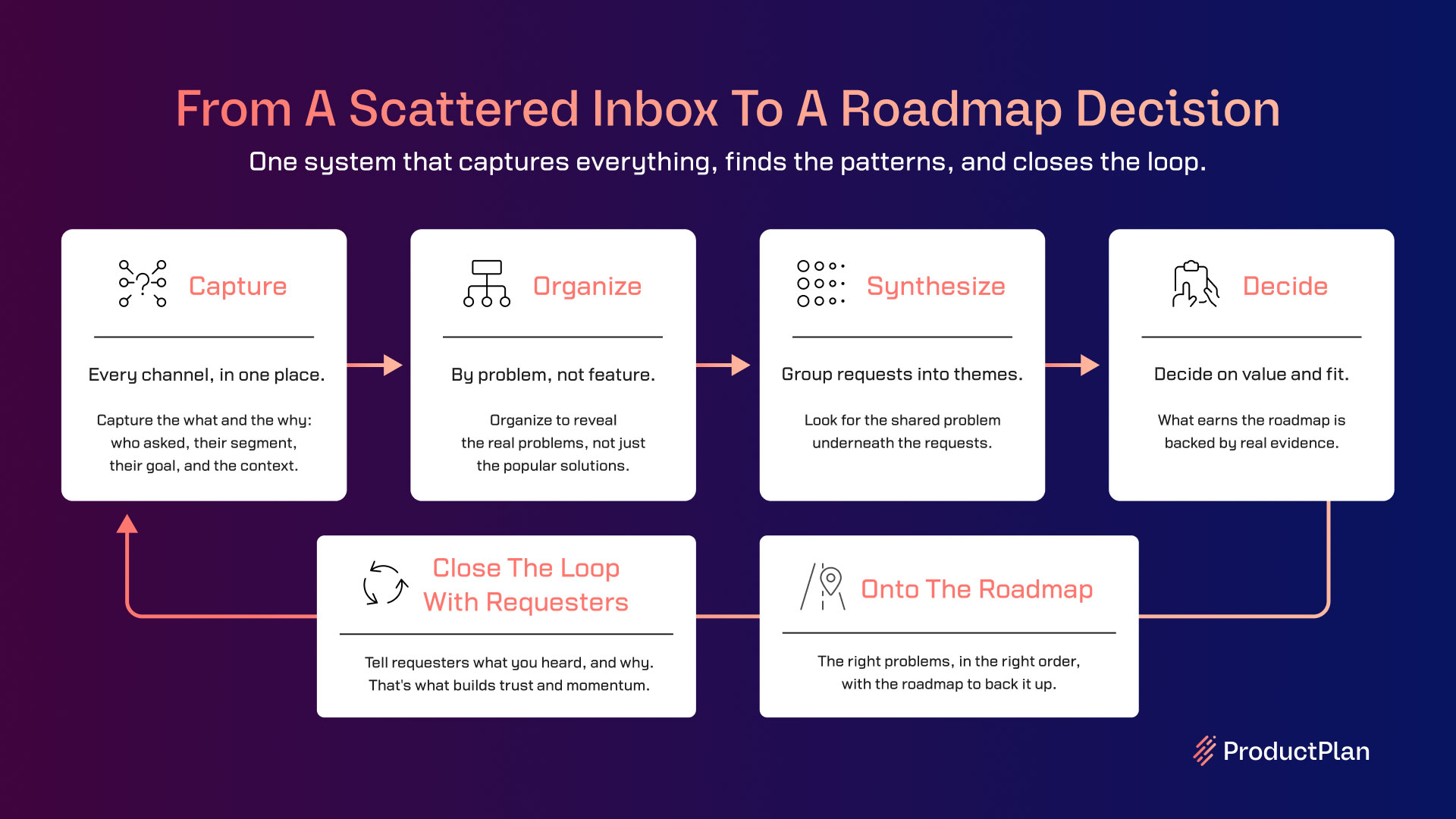
These days, the volume has only gone up. AI tools have made it easier for customers and sales teams to surface, escalate, or track requests without a corresponding increase in the product team's capacity to process them. The answer to this growing challenge is not a faster triage pace. The answer is a better system that captures everything, organizes it usefully, synthesizes it into themes, and closes the loop with the people who asked.
This guide provides that system, built for the PM who is prepared to move beyond reactive request management and start leveraging feedback as the foundational evidence base it was always intended to be.
Key Takeaways
- Properly tracking feature requests means capturing every request in one place, organizing them into patterns, and linking each to a clear status and a decision
- A single, centralized system beats the combination of shared inboxes, Slack channels, spreadsheets, and support tickets that most teams are still rely on
- Turning dozens of individual requests into a handful of clear themes can drive confident roadmap decisions
- Connecting tracked requests directly to customer evidence justifies product decisions and simplifies closing the feedback loop with requesters
Why most feature request tracking fail
To build a more effective system, we must examine why current methods fail. Product teams typically encounter three consistent breakdown points:
Treating feature requests as a data entry problem
Most teams treat feature requests as an inbox problem. A Slack channel fills up, a support queue overflows, a spreadsheet grows another tab. The team assumes that if they can just file it all in one place, they will have solved it. But capturing requests without organizing and synthesizing them is just a tidier version of the same chaos. Product teams need to analyze and identify patterns in the request data to address root cause issues rather than one-off tasks.
Misattributing volume of a request as priority of a request
Counting how many customers asked for the same feature is a useful data point, but a dangerous decision-making rule. One enterprise customer whose contract is up for renewal and two hundred free-tier users asking for the same thing represent very different signals, and raw vote counts can treat them identically. Managing feature requests demands a clear and objective framework for prioritization that removes the bias from the decision making process. Volume is the starting point for synthesis, not the end of it.
Lacking feedback loops lead to loss of trust with other stakeholders
A request that lands in a system and never surfaces again is a trust problem as much as a process problem. Customers who submit requests and hear nothing back eventually stop submitting them, and the team loses a channel that should be generating continuous, useful signals. Request management should enable product teams to provide visibility on status and progress to instill confidence with cross functional colleagues, customers, and stakeholders.
The framework detailed below is designed to bridge all three of these gaps.
A four-stage workflow for handling feature requests
Stage 1: Capture everything, from every channel, in one place
The first job of a feature request system is to make sure nothing falls through because it arrived in the wrong channel. Requests come from customer emails, support tickets, sales call notes, NPS verbatims, Slack threads, user interviews, and stakeholder meetings. A system that only captures requests submitted through a formal portal is missing most of the signal.
Every intake channel needs a path into the same central system. For sales calls, it means a standing field in whatever CRM the team uses, surfaced to the PM on a regular cadence. For user interviews, it means capturing requests in the same place as everything else rather than in a separate research folder.
The context that travels with each request matters as much as the request itself. A record that says "five enterprise accounts in financial services have all asked for CSV export because their compliance teams need to audit usage data, and two of them are up for renewal in Q3" is a decision-making input. Capture the what and the why together, including who asked, what segment they belong to, and what they said they were trying to accomplish.
Janna Bastow, co-founder of ProdPad and co-founder of Mind the Product, has argued for years that the most important shift a PM can make is to “think of objectives, not features”. That shift starts at capture: the question to record alongside every request is not just what the customer asked for, but what problem they were trying to solve when they asked for it.
Stage 2: Organize by problem, not by feature name
Once requests are in one place, the next job is to organize them in a way that makes synthesis possible. Organizing by feature name is fast but shallow. It tells you which proposed solutions are popular. It does not tell you which underlying problems are most widespread.
A more useful organizing principle is the job the customer was trying to do. "I need to generate a compliance report" and "I need to share data with a team that doesn't have access to the tool" and "I need to pull this into a spreadsheet for my manager" might all appear as the same "CSV export" request on the surface, but they represent three different problems with potentially three different best solutions. Organizing at the problem level is what makes the synthesis stage possible and what protects the team from building a feature that solves the most popular request without solving the underlying need.
Practically, this means tagging each request with a problem category, a customer segment, and a rough impact estimate which provides a directional sense of whether this problem affects a lot of customers a little, or a few customers a great deal.
Stage 3: Synthesize into themes
Synthesis is where individual requests become useful and it is the stage that separates teams with a genuine evidence base from teams that are just organized.
The goal of synthesis is to identify the problems that appear consistently across different customers, segments, and use cases. When an enterprise customer in financial services, a mid-market customer in retail, and two fast-growing startup accounts are all describing friction in the same area of the product in different words, that pattern is a signal worth acting on regardless of whether any one of them made the loudest request.
Teresa Torres, author of Continuous Discovery Habits, defines the goal of this kind of work as discovering opportunities rather than collecting solutions. As she frames it, “an opportunity is an unmet customer need”. The team's job is to identify which needs, if addressed, would move the outcome they are trying to achieve. Instead of beginning with a customer pain point and jumping straight to solutions, the approach that produces better decisions starts with a desired business outcome, and uses that outcome as a filter. Customer needs are infinite, but the outcome tells the team which needs to focus on. Synthesis is how you apply that filter to the requests already in the system.
In practice, synthesis looks like a regular review of the organized request backlog, looking for themes that are growing in frequency or intensity. It is a standing habit, run against the same system that captures requests in the first place, so the signal is always current.
Stage 4: Link each theme to a status and a decision
A feature request that sits in a system with no status attached is a request that has been captured but not managed. Every request needs a clear state: under consideration, in progress, shipped, declined, or deferred with a reason.
These statuses do two things. Internally, they give the product team a shared, current view of what is being acted on and what is not, which prevents duplicate evaluation and makes planning conversations faster. Externally, they are what make it possible to close the loop with the people who asked, which is the stage most teams skip and the one that costs the most trust.
Which feature tracking method fits your team
Not every team needs the same infrastructure. The right approach depends on request volume, team size, and how tightly connected the tracking system needs to be to the roadmap. Use this table to find the right starting point.
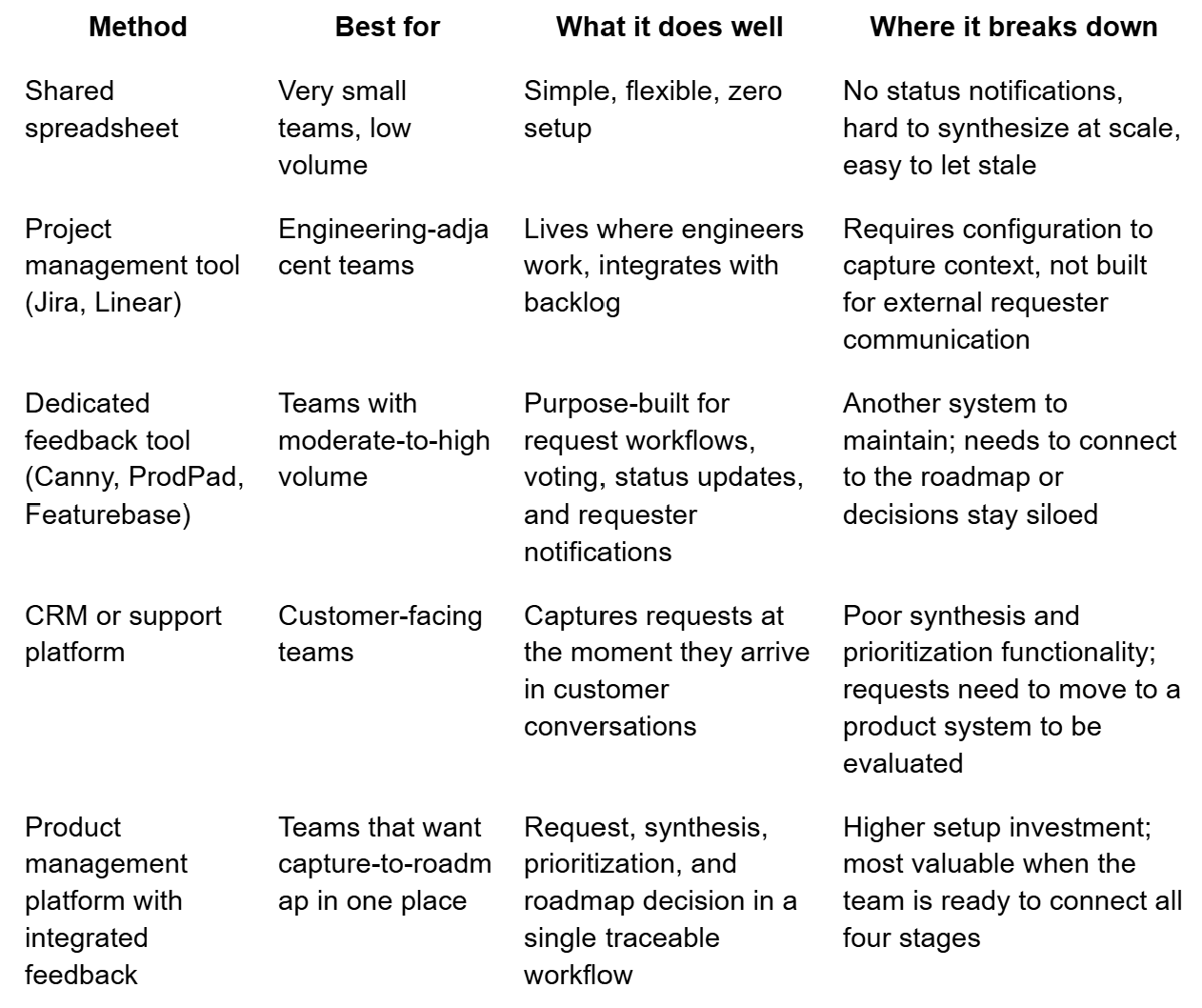
The biggest mistake teams make is picking a tool first and then forcing their workflow to match it. Instead, map out what you need: Where do users submit requests? Who reviews them? How do requests connect to your roadmap? Rather than a direct vendor recommendation, the table above serves as an initial benchmark for outlining that mapping.
Closing the loop with requesters
Closing the loop is the stage that most teams treat as optional and that customers experience as essential. A customer who submits a request and never hears interprets the outcome as a signal that their input did not matter and decays trust with the product team.
The mechanics of closing the loop are straightforward once statuses are in place. When a request moves to "in progress," the person who submitted it should hear about it. When a feature ships, everyone who asked for it should know. When a request is declined or deferred, the reason should be communicated briefly and honestly.
Teams that do this well can answer three questions at any moment: what is the total demand for this change, which customer segments want it, and what did we tell the people who asked. Those three questions are also the fastest way to check whether a tracking system is working. If you cannot answer all three for any given request, the system has a gap.
Building an infrastructure behind the feature management workflow
The workflow above is not difficult to run once. But, it becomes difficult at scale, when requests are arriving from multiple channels simultaneously. According to ProductPlan’s 2026 State of Product Management report, 40% of strategy, discovery, and roadmap work is currently siloed across disconnected tools. For these teams, the solution isn't a better spreadsheet, but a connected system that makes the path from customer request to roadmap decision fully traceable.
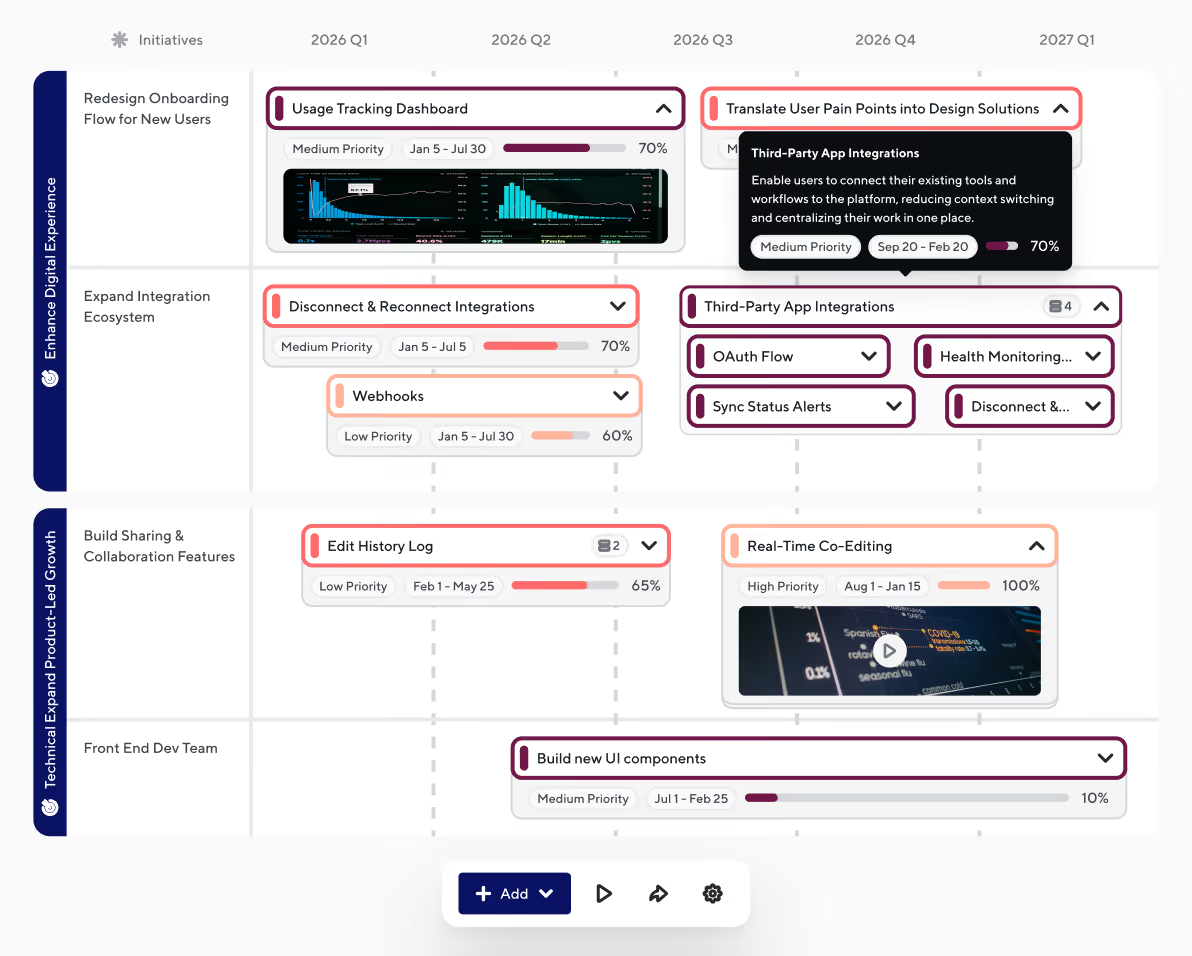
This is where the right infrastructure makes a meaningful difference. ProductPlan is built to close the gap between where customer signal arrives and where roadmap decisions are made. The platform connects feedback intake, prioritization scoring, and the roadmap in a single system, so the synthesis step does not depend on a PM manually reconciling three separate tools to understand why a given initiative is on the roadmap and what customer evidence supports it.
ProductPlan's Winware integration extends that capability with AI-assisted synthesis: pattern detection across a large volume of requests, automatic grouping by underlying problem, and surfacing of themes that manual review might miss in a high-volume environment. The output is still a human decision. The signal is cleaner, and the synthesis is faster.
Stop guessing your roadmap priorities. Book a demo today to see how ProductPlan connects customer signal, synthesis, and strategy in one traceable system.
Frequently asked questions
How do you track feature requests?
Capture every request in a single system with enough context to be useful who asked, what they were trying to accomplish, and which segment they belong to. Tag and group requests by the underlying problem rather than the feature name. Assign each group a clear status, and link it to the decision and evidence behind it so nothing is lost and every decision is traceable.
Where should feature requests be stored?
In one centralized system rather than scattered across spreadsheets, inboxes, and tickets. A single source of truth is what makes synthesis and follow-up possible; and it is what prevents important requests from disappearing into the gap between the channel where they arrived and the system where roadmap decisions are made. The right system depends on your team's size and workflow, but the principle is the same regardless of the tool: one place, with context attached to every request.
How do you turn feature requests into roadmap decisions?
Look for patterns across many requests rather than reacting to individual requests. Group requests by the underlying problem: what the customer was trying to accomplish, not just the feature they named. Weigh the themes that emerge against two criteria: customer impact and strategic alignment. Prioritize the problems that score well on both, and decline or defer the rest with a clear, honest reason.
How do you keep customers updated on their requests?
Maintain a visible status for each request or theme, and close the loop when decisions are made. When something ships, tell the people who asked for it. When something is declined or deferred, explain why briefly and honestly. Customers can accept a no when it comes with a reason. What erodes trust is silence, such as when a request enters a system and never surfaces again.
What is the difference between tracking feature requests and managing a product backlog?
Feature request tracking is about capturing and synthesizing external signals. Backlog management is about organizing and sequencing the work the team has committed to doing. The two are connected, synthesized request themes should inform what makes it onto the backlog, but they are not the same. Conflating them by dumping every feature request directly into the engineering backlog is one of the most common ways teams lose both the signal and the roadmap.
Internal links
- ProductPlan's 2026 State of Product Management Report
- How to Field Customer Feature Requests Without Overpromising
- 7 Strategies to Choose the Best Features for Your Product
- How to Make Sense of the Firehose of Ideas for Your Product
- How to Prioritize Your Product Backlog
External sources cited
- Janna Bastow, ProdPad , problem-first backlog philosophy, the shift from feature list to organized problem set, the agency trap, and the Now-Next-Later roadmap for managing intake over time.
- Teresa Torres, Product Talk , opportunity-first framing for synthesizing requests, the weekly discovery cadence, and starting from outcomes rather than feature names.
- Quackback, "Feature Request Tracking: The Complete Guide for Product Teams" (April 2026) , the questions a tracking system should be able to answer, and voting as demand data.
- Feeqd, "Feature Request Tracking Software: 8 Tools Compared" (April 2026) , workflow-first tool selection, and the risk of picking a tool before mapping the workflow.
- daily.dev, "10 Best Practices for Feature Request Tracking" (updated May 2026) , dedicated vs. general-purpose tool trade-offs, with Canny, Frill, and Featurebase as purpose-built alternatives.
-
Ready to build with confidence?


.svg)