
Frameworks for Managing Decentralized Product Teams

When product teams spread across business units, regions, or time zones, alignment rarely breaks all at once. It slips in small, defensible decisions. A regional team solves for the customer pain they hear most often. Another team reshuffles priorities after an executive request. A third sees the same objection surface in sales calls, but no one else has that context yet. None of these decisions are wrong. The problem is what happens when they stack up: the roadmap starts reflecting separate versions of the truth.
Managing decentralized product teams means giving teams real autonomy while keeping everyone anchored to the same strategy, decision rights, communication rhythm, and customer evidence. The goal is not more oversight. The goal is shared context strong enough that distributed teams can move independently without moving apart.
That matters more in 2026 because the coordination surface is expanding. ProductPlan's 2026 State of Product Management research found that confidence that teams outside product understand the product strategy averages just 3 out of 5, while alignment to company goals averages 3.5 out of 5. Nearly three quarters of product managers, 73%, expect the role to become more hybrid across product, design, and engineering. Decentralization can make that work faster and closer to the customer, but only when the operating model keeps strategy legible everywhere.
Key Takeaways
- Managing decentralized product teams means giving each team real autonomy while keeping everyone anchored to a shared, visible strategy and a single source of truth.
- Alignment comes from shared context, not constant oversight. Distributed teams need clear goals, transparent tradeoffs, and a durable view of why decisions were made.
- Lightweight frameworks for outcomes, decision rights, and communication prevent the drift that distance, time zones, and business-unit pressure can create.
- In ProductPlan's 2026 research, confidence that non-product teams understand the product strategy averages just 3 out of 5 — a gap that decentralization widens without structure.
- A shared evidence base keeps distributed teams making decisions from the same picture of the customer, so independence never becomes divergence.
- A shared evidence base keeps decentralized teams working from the same customer signal, so local autonomy does not become fragmented prioritization.
- The right framework depends on the source of your misalignment: unclear goals, slow decisions, fragmented communication, or disconnected customer evidence.
What makes managing decentralized product teams hard?
Decentralized product teams are hard to manage because autonomy increases the number of local decisions, while distance reduces the shared context behind those decisions. The teams are doing what they were designed to do: staying close to their customers, moving quickly, and making decisions without waiting for every answer to come from the center. But each team is also working from a slightly different view of the business. One may be closer to a regional customer need. Another may hear more from sales. Another may be carrying technical constraints the rest of the organization does not see. Without a visible strategy, explicit decision rights, and a regular communication rhythm, those local decisions can start to pull the portfolio in different directions.
The practical implication is that managing decentralized teams is less about overseeing every team decision and more about designing the shared context those teams operate inside. Marty Cagan has written that the defining difference between feature teams and empowered teams is that empowered teams share an outcome and a customer understanding, while feature teams share only a list of work to complete. The frameworks below help product leaders build that shared context at scale.
What frameworks help align autonomous product teams?
The most useful frameworks for decentralized teams operate at four layers: outcomes, decision rights, discovery, and communication cadence. Each layer addresses a different source of drift. The best choice depends on where your organization is feeling the friction right now, whether that is unclear goals, slow approvals, fragmented customer evidence, or too many meetings that do not resolve tradeoffs.
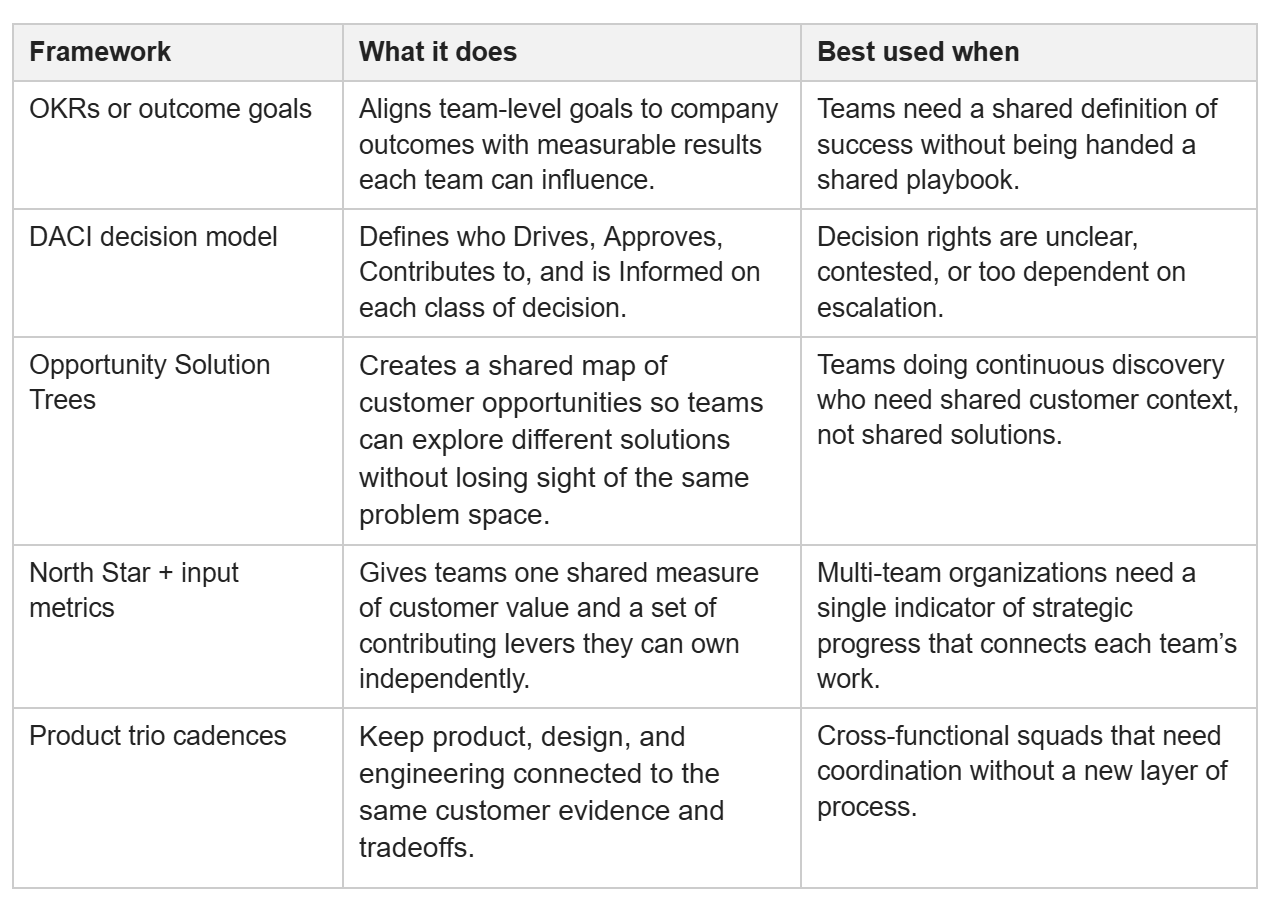
Use the table as a starting point, not a menu to adopt all at once. If teams disagree on what matters, start with outcomes. If they wait for permission or make conflicting calls, start with decision rights. If customer evidence is scattered, start with discovery and shared evidence. If everyone is informed but still misaligned, tighten the cadence around tradeoffs, not status updates. For great training on developing teams around outcomes over outputs, we love the work of Josh Seiden, author of Outcomes Over Outputs.
How do you use an outcome framework for decentralized teams?
An outcome framework keeps decentralized teams aligned by assigning each team a clear customer or business result, then connecting local roadmap choices back to that result. It gives teams freedom over how they solve the problem while making the expected impact visible across the portfolio.
For a VP or Director of Product, this is often the first framework to put in place because it moves the conversation away from activity. A decentralized team can ship quickly and still move the wrong metric. An outcome framework asks each team to state the result it owns, the leading indicators it will watch, and the evidence it will use to decide whether a roadmap bet is working.
For example, one team may own reducing onboarding drop-off for mid-market customers, another may own improving renewal risk signals for enterprise accounts, and another may own decreasing manual work in an operations workflow. Each team can decide what to build, but the product leader can still see whether the portfolio is serving the broader strategy.
ProductPlan’s 2026 research found that customer impact and business value are the most common bases for prioritization, cited by 58% and 49% of teams, respectively. An outcome framework gives those priorities a sharper operating shape, so “customer impact” becomes a specific measurable result rather than a phrase everyone supports in theory.
How do you set clear decision rights across decentralized teams?
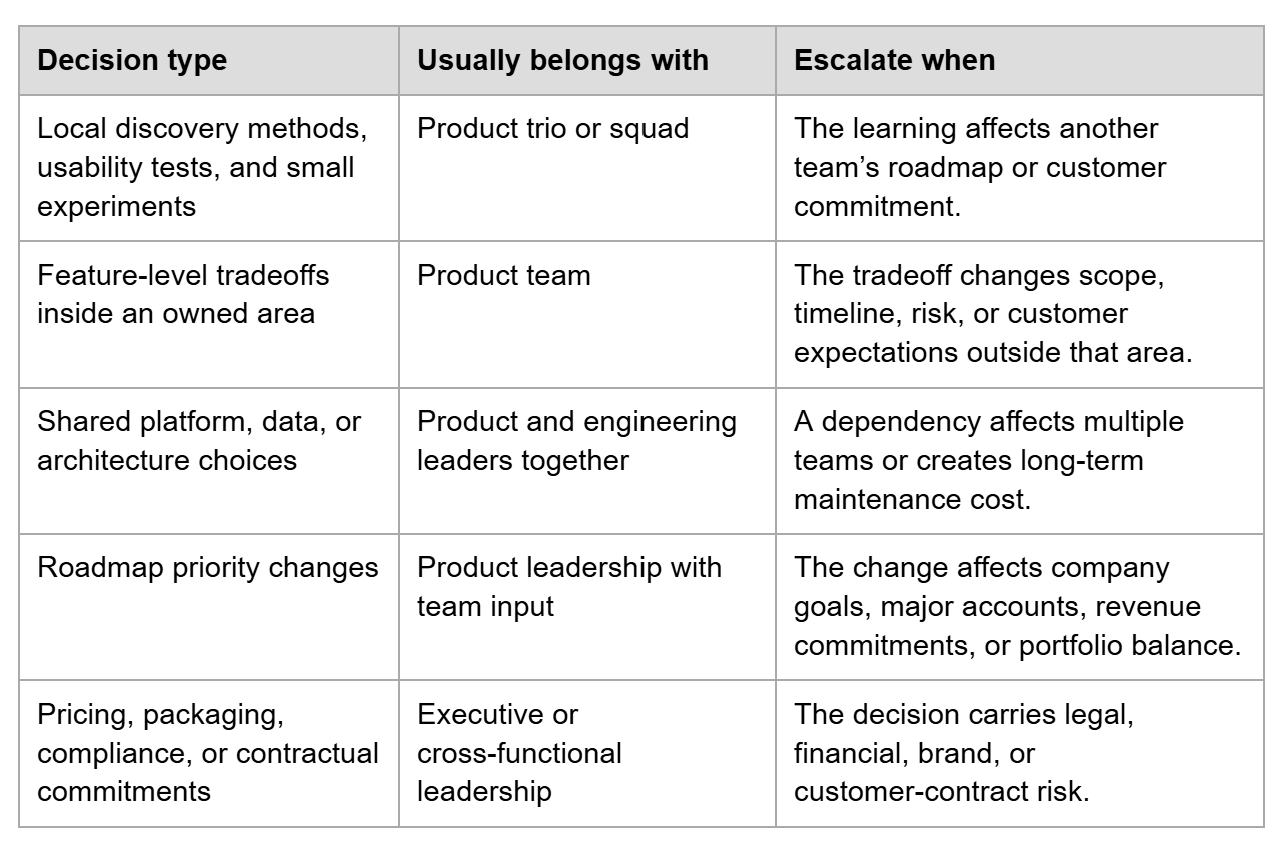
Clear decision rights give decentralized product teams room to move without leaving ownership up for interpretation. The goal is to make recurring decisions easier to place: which calls belong with the team, which need cross-functional input, which require leadership approval, and which simply need to be communicated. That clarity prevents two common problems at once: local teams waiting for permission they do not need, and leaders discovering major tradeoffs after the work is already in motion.
A useful starting point is to sort decisions by reversibility and scope. Reversible, locally contained decisions should usually stay with the team. That might include which discovery method to use in this sprint, how to structure a research session, or whether to test a small workflow change with a specific customer segment. Cross-team or harder-to-reverse decisions need more explicit ownership. Deprecating a shared component, changing a data model another team depends on, shifting a customer commitment, or moving a strategic roadmap priority should have a clear driver, required contributors, and an agreed approval path.
The model does not need to be heavy. For recurring decision types, define the owner, the required contributors, the escalation trigger, and the documentation expectation. You can use DACI, RACI, or RAPID, but the acronym matters less than whether people know where a decision lives. Once the model is clear, publish it in the same place teams go for roadmap context and reference it during onboarding. A decision-rights document only works if teams use it before a decision gets messy.
Ken Norton’s “Don’t Ship the Org Chart” is useful context for this work because it encourages product leaders to organize ownership around customer experiences rather than internal seams. That lens matters in decentralized product teams. When ownership follows the way customers experience the product, decision rights get clearer, and fewer decisions need to cross unnecessary boundaries.
How do you keep the product strategy understood everywhere?
Strategy clarity is partly a message problem and partly a usage problem. Teams may understand the strategy when they read it, hear it presented, or see it in a planning deck. The harder test comes later, when they have to apply it to the small decisions they make every week: which customer complaint to prioritize, whether to build a quick fix or a durable solution, how to explain a tradeoff to engineering, or when to push back on a stakeholder request. For decentralized product teams, strategy has to live in the places where those decisions happen.
Three practices help:
- First, translate the strategy into team-level outcomes. A strategy that sounds clear in an executive planning session can become abstract by the time it reaches a squad working in another region or business unit. Each team should be able to explain what the strategy means for the customer problem they own, the outcome they are accountable for, and the tradeoffs they should make when priorities compete.
- Second, make the evidence behind the strategy visible. Teams are more likely to stay aligned when they can see why a priority matters, not only that it exists. ProductPlan’s 2026 State of Product Management report shows how fragile this alignment can be: confidence that teams outside product understand the product strategy averages only 3 out of 5, while alignment to company goals averages 3.5 out of 5. A shared view of customer evidence, roadmap decisions, and business outcomes gives teams a common reference point when local signals start to compete.
- Third, build strategy reinforcement into the team rhythm. A monthly thirty-minute sync across product leads can help if it focuses on how strategy is being applied, not just what each team shipped. Ask where the strategy made a decision easier, where teams interpreted it differently, and where new customer evidence may require a sharper call from leadership. That kind of discussion keeps strategy alive in the work without turning alignment into another reporting exercise.
Roman Pichler’s 2026 product strategy framework is helpful here because it connects vision, product strategy, roadmap, and backlog in one hierarchy. For decentralized teams, that hierarchy becomes a practical guardrail: teams can move quickly inside their own roadmap while still seeing the line back to the product vision and company outcomes that make the work matter.
What communication cadence works best for decentralized product teams?
The best communication cadence gives each channel a clear job. Use async updates for facts, live conversations for decisions and tradeoffs, monthly reviews for learning across teams, and quarterly planning to revisit strategy. When every meeting has a purpose, decentralized teams spend less time reporting on work and more time making the calls that keep work aligned.
Teams often overcorrect in one of two directions. Some add meetings until everyone is technically informed but too tired to think clearly. Others move everything async and discover too late that written updates rarely resolve real tension. The better pattern is to give each communication channel a distinct job.
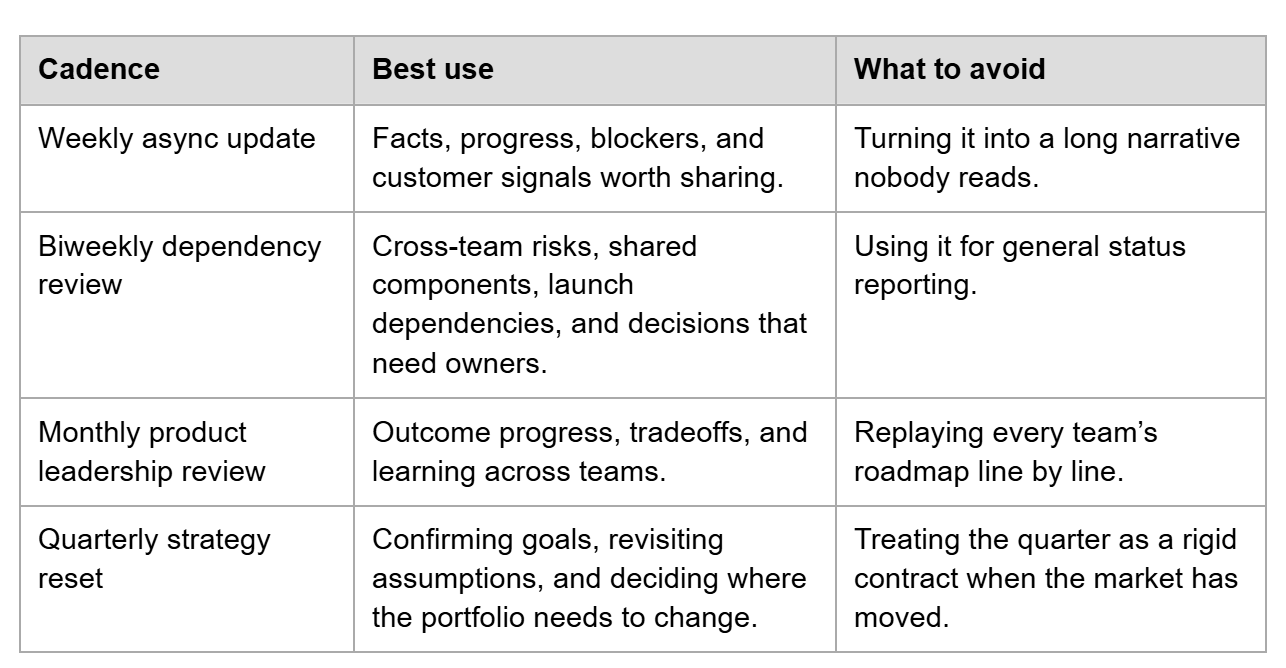
The cadence also needs a source of truth. A weekly update helps only if people can find the roadmap, the rationale, the decision log, and the customer evidence behind the work. When those pieces live in separate tools, the update becomes a pointer to more fragmentation.
How do you keep decentralized teams working from the same customer evidence?
A shared evidence base gives decentralized product teams access to the same customer signal, synthesized themes, decision history, and roadmap rationale. It helps prevent teams from using isolated anecdotes to justify competing priorities, and it makes product decisions easier to defend across the organization.
This is the practical heart of product intelligence. Capturing customer feedback is no longer the hardest part for most teams. The harder work is synthesizing signals from sales calls, support tickets, surveys, CRM notes, research interviews, and usage data into a decision people can trust. That challenge gets sharper when teams are decentralized because every team can end up with its own partial truth.
ProductPlan’s 2026 research found that 40% of teams say strategy, discovery, roadmaps, and launch plans live across multiple tools with limited or no integration, while only about 22% have everything in one system. For decentralized product teams, that fragmentation creates real risk. A team in one region may hear a pattern in customer calls, another may see something different in support tickets, and the organization may have no clear way to reconcile the signals.
ProductPlan helps close that gap by giving teams one shared view of product strategy, roadmaps, priorities, and customer evidence. As a Product Intelligence Platform, ProductPlan brings roadmapping and product decisions into the same connected workspace, while Winware AI synthesizes unstructured customer signals from sources like sales calls, surveys, support tickets, and CRM notes into structured insights that teams can trace back to real customer quotes.
How do you balance autonomy and alignment in practice?
Balancing autonomy with alignment starts with a simple leadership choice: define the outcomes and constraints clearly, then give teams room to decide how to get there. Decentralized product teams do not need every decision routed through the center. They need to know what they own, which tradeoffs require input, and where to find the strategy and evidence behind the work.
That balance depends on a shared operating system. Teams can move quickly when they understand the customer problem they are solving, the outcome they are accountable for, and how their roadmap connects to company priorities. When a team only has a feature list, autonomy becomes much harder to manage because the reasoning behind the work is missing.
This is why the roadmap matters beyond planning. In a decentralized organization, the roadmap becomes a shared reference point for what is being built, why it matters, what evidence supports it, and how local work connects to the broader strategy. ProductPlan’s 2026 research shows why that shared view matters: 73% of PMs expect the role to become more hybrid across product, design, and engineering, which means more people are shaping product decisions from more places.
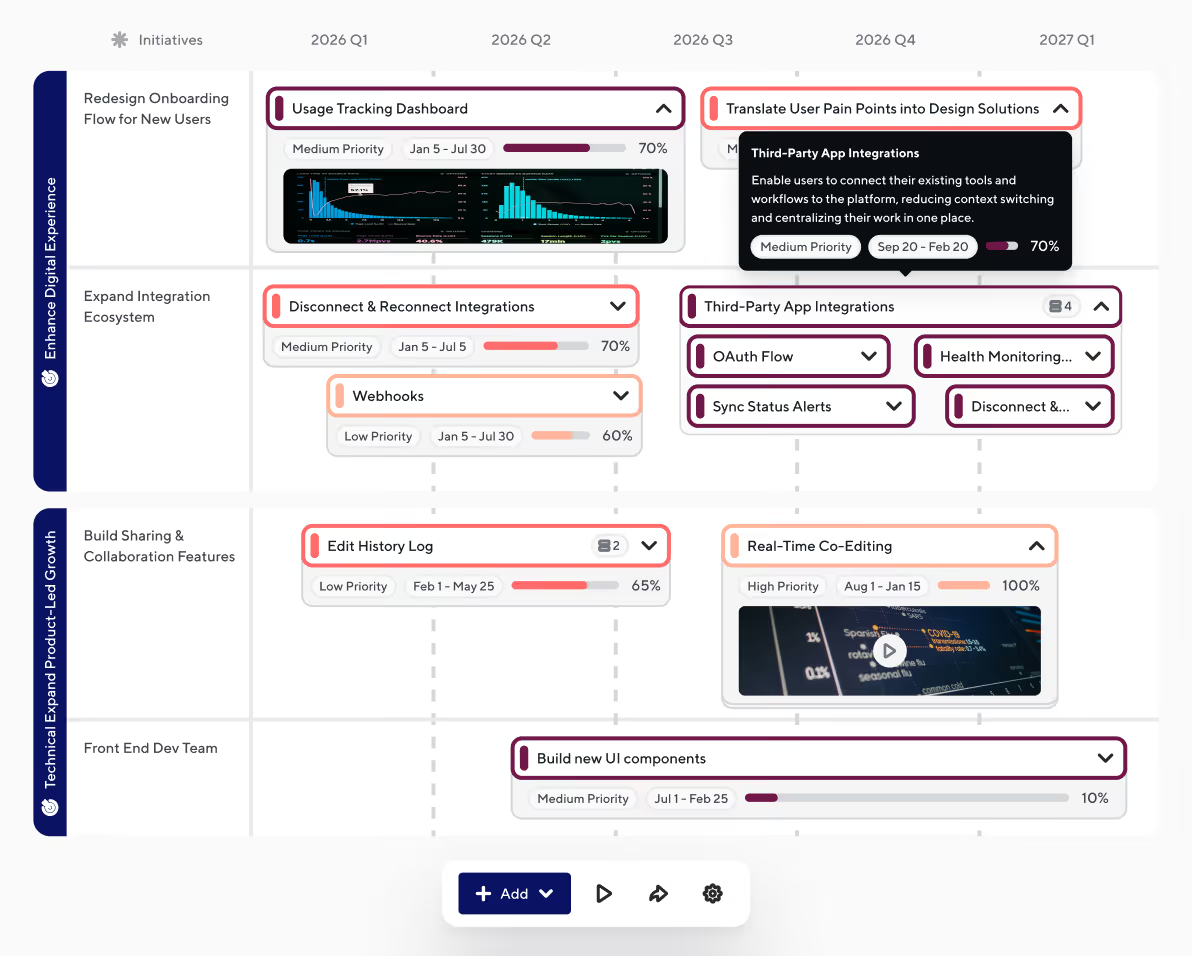
ProductPlan is built for that kind of coordination. As a Product Intelligence Platform, it gives teams a single live view of the roadmap that different stakeholders can navigate at the right level of detail. Product teams can drill into the work, executives can see how roadmap bets connect to company strategy, and integrations with Jira and Azure DevOps let engineering stay in its system of record while the broader organization keeps a clear view of what is on the roadmap and why it matters.
The strongest decentralized product organizations rarely feel perfectly tidy. They feel connected. Teams can move at local speed, but the reasoning behind their decisions still rolls up into one strategy that the business can understand.
Frequently asked questions
What is a decentralized product team?
A decentralized product team is a product organization where multiple teams operate with real autonomy, often across locations, time zones, product lines, or business units. Each team can make many of its own decisions, but it still needs to work within a shared strategy and decision system.
How do you keep decentralized teams aligned?
Anchor them to shared outcomes and a single visible source of truth, define decision rights explicitly, and build alignment into a recurring rhythm rather than relying on periodic all-hands presentations. Alignment should come from shared context and transparent rationale, rather than constant oversight.
What frameworks help manage distributed product teams?
Outcome-based goal frameworks like OKRs, explicit decision-rights models like DACI, discovery frameworks like Opportunity Solution Trees, and a regular cross-team communication cadence are the most effective options. The right choice depends on team maturity, the nature of decisions being made, and how much the strategy needs to travel across organizational layers.
How do you balance autonomy and alignment?
Give teams freedom over how they reach agreed outcomes, while keeping the outcomes, strategy, constraints, and customer evidence shared. That balance lets teams move quickly without turning independence into divergence.
How often should decentralized product teams revisit alignment?
Most decentralized product teams need a light weekly alignment update, a biweekly dependency review, a monthly outcome review, and a quarterly strategy reset. The cadence should be adjusted when the market, company goals, or portfolio tradeoffs change materially.
Build a product system that travels well
Decentralized teams can be a tremendous advantage when they are close to customers, accountable for outcomes, and trusted to move. The work for product leaders is to build the management system that lets that autonomy travel well across distance. Clear goals, explicit decision rights, a useful communication cadence, and shared customer evidence give teams the context they need to move independently while still building one product story.
ProductPlan helps product organizations keep that story visible. With shared roadmaps, portfolio views, prioritization, and Winware AI-powered customer signal synthesis, your teams can connect local decisions to the strategy and evidence behind them. Book a demo to see how ProductPlan helps decentralized teams stay aligned around decisions they can defend.
Related reading
- The Ultimate Guide to Product Strategy
- Product Portfolio Management
- The Ultimate Guide to Product Roadmaps
- ProductPlan's 2026 State of Product Management report
Sources
- ProductPlan, 2026 State of Product Management report — proprietary data on prioritization bases, tool fragmentation, and alignment challenges.
- Marty Cagan, "Empowered Product Teams" — Silicon Valley Product Group, on outcomes over output.
- Marty Cagan, "Product vs Feature Teams" — Silicon Valley Product Group.
- Roman Pichler, "The Product Strategy Framework: A Revised Guide" — romanpichler.com, 2026, on connecting vision, strategy, roadmap, and backlog.
- Ken Norton, "Don't Ship the Org Chart, Part 2" — bringthedonuts.com.
- Teresa Torres, "Opportunity Solution Trees: Visualize Your Discovery to Stay Aligned and Drive Outcomes" — Product Talk.
- Atlassian, "Unlocking the secrets to outstanding teamwork in 2025" — Work Life by Atlassian (2025 State of Teams report). (Competitor source, attributed as such.)
- Atlassian, "DACI: A Decision-Making Framework" — Atlassian Team Playbook. (Competitor source, attributed as such.)
Ready to build with confidence?


.svg)