
How to Build a Product-Led Growth Roadmap That Drives Real Adoption
.jpg)
You are balancing more growth ideas, feature requests, and stakeholder expectations than your team can realistically ship, and you are shipping faster than ever, because AI has compressed engineering timelines. In that environment, leadership expects the roadmap to drive adoption and growth, not just deliver new features.
The hard part is deciding which roadmap items will actually help users reach value faster and keep coming back. That is the tension at the heart of product-led growth. The model works beautifully when the product delivers value early and users flow through the funnel. It stalls when the roadmap fills with features that feel urgent but do not improve the factors turning signups into retained, expanding accounts.
Most teams know activation matters. Fewer have defined what activation looks like for their product, and fewer still have organized their roadmap around it. This guide is a practical answer to that problem: what a PLG roadmap is, why it has become a leadership priority, how it is built, and how to keep it honest as your users and your market shift beneath you.
Key Takeaways
- A product-led growth roadmap organizes product work around the in-product moments where users first experience real value, so activation and expansion become the engine that carries the business forward — not a side effect of it.
- The strongest PLG roadmaps anchor to a single activation metric and sequence every initiative by its likely effect on that metric, filtering a long backlog down to the work that actually matters.
- Most PLG companies invest in the motion but skip the measurement, only about 34% actively track activation, the very metric that predicts whether users reach value (ProductLed). A roadmap organized around activation closes that gap.
- According to ProductPlan's 2026 State of Product Management report, 40% of teams say strategy, discovery, and roadmaps live across disconnected tools. That fragmentation quietly breaks the PLG feedback loop that growth depends on.
- Treating the roadmap as a continuous decision system—rather than a quarterly artifact—lets product-led teams adapt as quickly as their users do, and gives leadership a defensible, evidence-based story at every planning conversation.
What is a product-led growth roadmap?
A product-led growth roadmap is a prioritized plan that sequences product work around the in-product experiences users value. That appreciation translates into client activation, retention, and expansion, all of which drive revenue without the need to depend on a sales team.
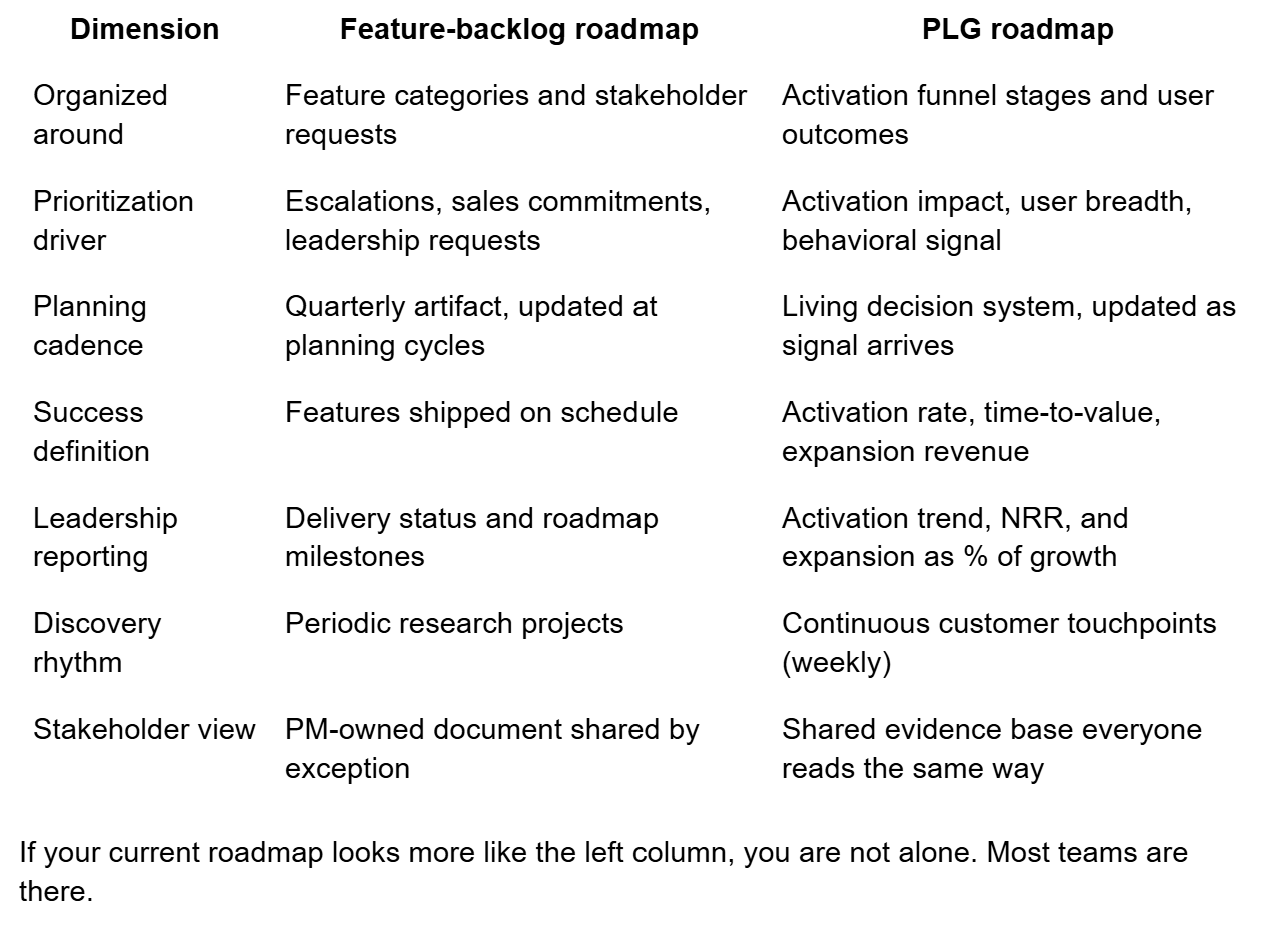
Where a traditional roadmap often organizes work around feature delivery tied to sales commitments and quarterly planning cycles, a PLG roadmap treats the user's journey as the primary growth channel.
The underlying logic is straightforward: if the product delivers value fast and reliably, users convert, stay, and expand. If it doesn’t, no amount of outbound selling or marketing spend compensates for the friction. The roadmap is the plan for eliminating that friction systematically.
Why PLG roadmaps are now a leadership priority, not just a product discipline
The conversation around product-led growth roadmaps has moved from the product team's Slack channel to the board agenda.
And that’s because there’s a proven business case for organizing your roadmap around product-led growth. OpenView’s research found that PLG companies are twice as likely as sales-led companies to achieve 100%+ year-over-year revenue growth, and product-led businesses are valued more than 30% higher than the public-market SaaS index.
Cursor, the AI code editor, shows why PLG is no longer just a self-serve acquisition model. The product spread first through individual developers, then expanded into larger teams and enterprise accounts as usage created clear buying signals. By the time Cursor reached $2 billion in annualized revenue in February 2026, its growth story was not simply “no sales team.” It was a product-led motion strong enough to create demand before sales had to formalize it.
The competitive pressure is equally real. In 2026, roughly 58% of B2B SaaS companies run some form of PLG motion, and 91% plan to increase that investment. While AI-powered tooling is helping all SaaS companies across, the teams that will compound are the ones that have built a decision system behind their roadmap.
A PLG roadmap anchored to an activation metric gives you a defensible, evidence-based answer every time leadership asks why priorities have shifted. It provides a shared lens that engineering, finance, and the executive team can all understand.
PLG roadmap vs. traditional roadmap: a practical comparison
The clearest way to diagnose whether your current roadmap is serving a PLG motion is to compare it against what a feature-backlog roadmap typically looks like. Use the table below as a self-diagnostic before reading further. You could also use it in strategy meetings to explain to leadership why the roadmap needs to be rebuilt around activation rather than features.
What changes when the roadmap is organized around activation?
A PLG roadmap starts with the question: “What does a user need to do to experience the core value of our product?” Once that answer is clear, the roadmap becomes a plan for removing friction from that path.
That shift changes the prioritization conversation. Instead of asking internally which features matter most, the team asks which initiatives are most likely to help users reach value faster, use the product more deeply, and bring others into the experience.
This doesn’t mean PLG teams ignore stakeholders or abandon planning. It means the roadmap has a clear filter for saying yes, no, and not yet, with evidence that product, sales, finance, and leadership can all understand.
Start with one activation metric
The single most important structural choice in a PLG roadmap is the activation metric. This is the specific action or set of actions inside your product that reliably predicts whether a new user will retain, convert, and expand.
Slack famously describes its activation metric as the point at which a team has exchanged 2,000 messages, which can be a matter of hours for a large team. The metric can be defined through cohort analysis, showing the point at which team members retain at meaningfully higher rates than those who do not.
Your activation metric will be:
- Specific to your product and your users
- Based on a comparison of retained cohorts against churned cohorts
Look for the behavioral difference between those cohorts in the first two weeks of adoption. What did retained users do that churned users didn’t? The answer is usually one clear behavior, or a tightly connected set of behaviors.
Once you have the metric, the roadmap question changes. Instead of "what should we build?" it becomes "what is preventing users from reaching this moment quickly, and what would make that journey faster and more reliable?"
The stakes of getting this right are significant. According to SaasMag's 2026 PLG analysis, between 40% and 60% of free users in a typical PLG funnel never reach the activation milestone at all, explore briefly, and churn silently without ever experiencing core value. Every one of them represents acquisition spend that produced no path to revenue. And yet only 34% of PLG companies actively track activation as a metric.
How to build a PLG roadmap: a step-by-step process
Step 1: Define and validate your activation metric
Before organizing the roadmap, you need to know what you are organizing around. Pull cohort data on retained versus churned users and identify the in-product behavior that separates them. State it concretely: not "user gets value" but "user completes three exports within the first seven days" or "user invites a second team member in the first session." Validate it with qualitative interviews so you understand the why alongside the what.
Step 2: Map the activation funnel
Starting from signup, trace every step a new user takes to reach your activation event. Note where users drop off, where they slow down, and where confusion appears in support tickets, session recordings, and customer interviews. This map becomes the structural skeleton of your roadmap. Each significant friction point is a candidate initiative.
Step 3: Gather continuous customer signal
The data you need to prioritize well does not all live in your analytics platform. User interviews, support themes, NPS verbatims, sales call recordings, and behavioral event data together paint a fuller picture of where the activation path is breaking. Teresa Torres, author of Continuous Discovery Habits, recommends weekly customer touchpoints as the rhythm that keeps product decisions grounded in evidence rather than assumption. Discovery at this cadence ensures the signal arriving in your backlog reflects what users are experiencing now, not what they said six months ago.
Step 4: Score and sequence by activation impact
Score each potential roadmap item, from onboarding improvements to feature changes, by its likely effect on the metric. A simple framework would be: how many users does this friction point affect, how severe is the drop-off, and how confident are you that the proposed solution will resolve it? Work first on the initiatives that affect the most users at the earliest point in the activation journey. Friction early in the funnel compounds.
Step 5: Layer in expansion and retention bets
Once the path to activation is clear and improving, the roadmap expands to include the features and experiences that drive depth of usage, team adoption, and expansion. These are sequenced second, not because they matter less, but because they only compound when the activation experience is solid. Elena Verna, one of the leading practitioners of PLG growth, frames this as an escalator: user-level value leads to team-level adoption, which opens the door to company-level expansion.
Step 6: Turn new signal into roadmap decisions
A practical cadence is a light weekly review of activation funnel data, a monthly prioritization conversation to adjust sequencing, and a quarterly reset to revisit the activation metric and broader strategic bets. That rhythm gives the team room to learn without turning the roadmap into a constantly shifting list of reactions. It also creates space to ask whether the activation metric still reflects how today’s users reach value, or whether the product and market have shifted enough to update it.
How to prioritize when everything feels urgent
Even with a clear activation metric, urgent requests will still arrive. A major prospect may need a feature, leadership may ask for a new growth bet, or an existing customer may escalate a blocker. The goal is not to ignore those inputs, but to evaluate them through the same activation filter.
When a new request comes in, ask:
- Does this help more users reach the activation event?
- Does it reduce friction before users experience value?
- Does it deepen the behavior that predicts retention or expansion?
- Is there evidence from funnel data, support patterns, customer interviews, or cohort behavior?
- What would move down the roadmap if this moved up?
ProductPlan’s 2026 State of Product Management report found that over 60% of teams cite leadership escalations or new directives as the main reason priorities change frequently. For PLG teams, the activation metric gives those conversations a clearer standard: not whether the request feels urgent, but whether it improves the path to adoption.
Adapting the PLG roadmap for a hybrid go-to-market model
Most SaaS companies with 250 to 2,000 employees are not running a purely self-serve model. They are often combining self-serve adoption for individual users and small teams with sales-assisted expansion for larger accounts.
In that context, the roadmap needs two connected lanes:
- Activation lane: Improves the early product experience so users reach value faster.
- Expansion lane: Builds the collaborative, administrative, security, reporting, or integration features that help active users bring more of their team or company into the product. This lane can also surface product-qualified accounts where usage suggests a sales conversation would be timely and relevant.
That second lane is where product data becomes especially important. Mixpanel’s 2026 State of Digital Analytics report identifies in-product signals, including feature adoption and time-to-value, as key inputs for recognizing which accounts are ready for a sales conversation.
The point is not to choose between PLG and sales. In a hybrid model, the roadmap should show how product usage creates qualified demand, and how sales helps expand that demand into larger customer relationships.
Common mistakes that derail PLG roadmaps
Optimizing for signups rather than activation. New user volume looks good in a dashboard and feels like progress. But a user who signs up and does not reach the activation event is a churned user in waiting. The roadmap should spend more time on the steps after signup than on acquiring more users to put through a leaky funnel.
Treating the roadmap as a feature commitment rather than a decision system. When the roadmap is a list of promises to stakeholders, every change requires a political negotiation. When it is a continuously updated set of prioritized bets grounded in user evidence, changes are a natural response to new information. PLG teams move faster when the roadmap carries the second meaning.
Letting the backlog crowd out the moments that matter. This is the core tension named at the top of this article. The solution is not a smaller backlog, it’s a clearer filter. When activation impact is the primary scoring criterion, the backlog sorts into a smaller set of high-confidence bets and a larger set of ideas that need stronger evidence.
Disconnecting discovery from the roadmap. Signal that never reaches the prioritization process is wasted. If your team does customer interviews but the findings live in a research folder rather than informing the next planning conversation, you have the cost of discovery without the benefit. ProductPlan's 2026 research found that 40% of teams report their strategy, discovery, and roadmap living in disconnected tools. That fragmentation is exactly the condition that produces reactive roadmaps and missed activation opportunities.
Measuring success after launch rather than defining it before. PLG teams ship features and then scramble to identify the right metrics. The more effective approach is to define, before building, which activation or expansion behavior a given feature is meant to improve – and by how much. That definition creates the evidence base for future prioritization decisions.
How to report PLG roadmap progress to leadership
A PLG roadmap should help leadership see how product work connects to adoption and revenue. Instead of reporting only what shipped, show whether the roadmap is helping more users reach value, reach it faster, and expand their use over time.
Use a simple monthly view with three metrics:

Presented together, these metrics shift the roadmap conversation from delivery status to business impact. Leadership can still see what shipped, but the deeper question becomes whether those releases improved the path from signup to activation, retention, and expansion.
What infrastructure supports a healthy PLG roadmap?
A PLG roadmap depends on connected signal. Product analytics may show where users drop off, but customer interviews, support themes, sales conversations, and feedback surveys explain why that friction exists. The roadmap is stronger when those inputs feed one prioritization process instead of living in separate tools.
Connect customer signal to roadmap decisions
That connection is often missing. ProductPlan’s 2026 State of Product Management report found that 40% of teams say strategy, discovery, roadmaps, and launch plans live across multiple tools with limited or no integration. For PLG teams, that fragmentation can break the feedback loop between what users experience and what the roadmap prioritizes.
The right infrastructure should help teams trace a clear path from customer signal to roadmap decision. Product leaders should be able to see which evidence supports each initiative, share roadmap views at the right level of detail for each stakeholder, and keep execution tools like Jira or Azure DevOps aligned with the roadmap.
Make activation and expansion visible to every stakeholder
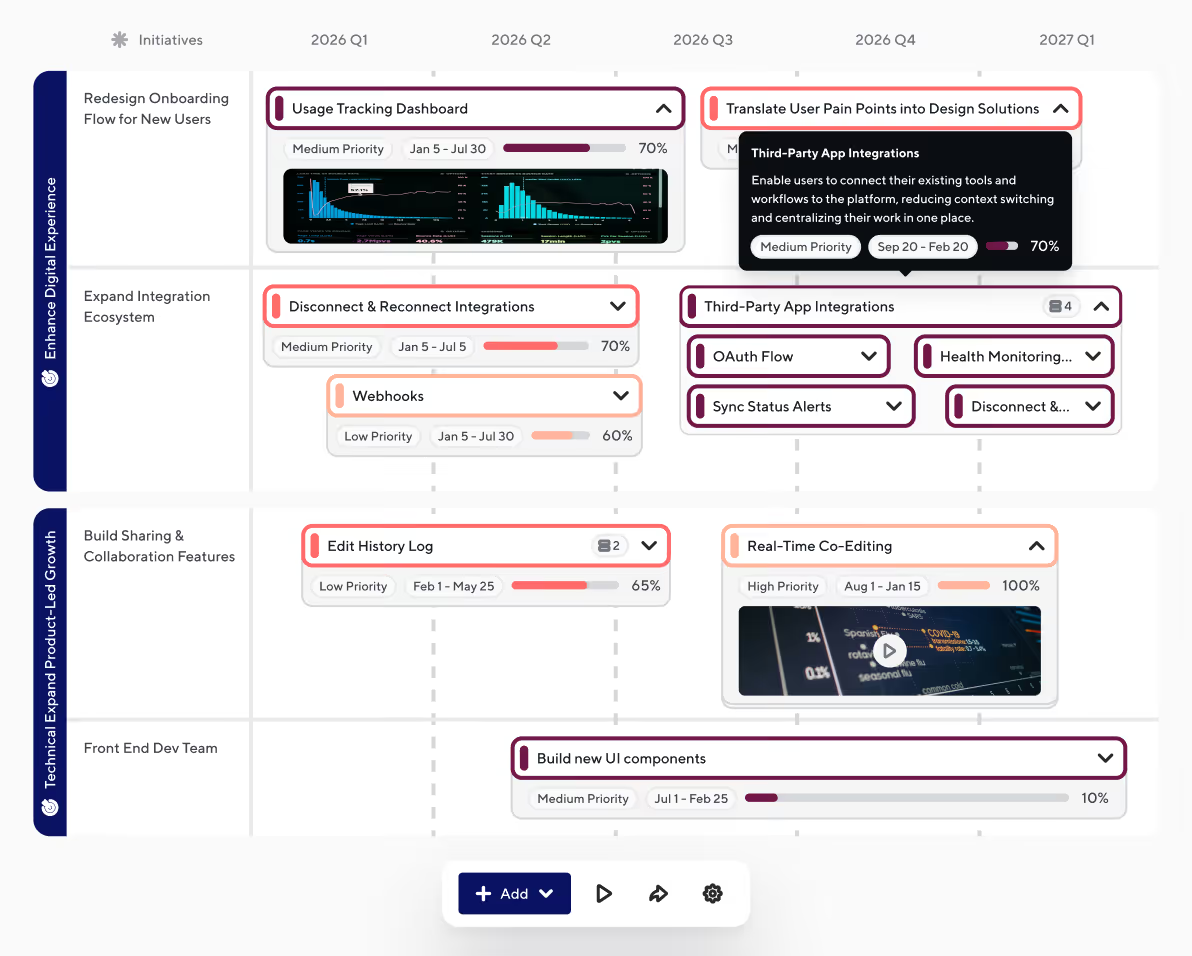
For hybrid teams, connected infrastructure also helps show how activation work supports expansion. Product, sales, and leadership can see how roadmap lanes connect to adoption, product-qualified accounts, and revenue goals without relying on manual updates or scattered context.
Is this PLG roadmap approach right for your team?
This approach works best for SaaS teams where users can try, adopt, or expand their use of the product before a formal sales conversation. That includes self-serve products and hybrid go-to-market models where product usage helps create qualified demand for sales.
It may need adaptation if enterprise sales cycles, implementation timelines, procurement, or stakeholder committees control adoption. In those cases, activation still matters, but the activation event may happen later and may involve an account, team, or workflow rather than an individual user.
The common thread is evidence. If your team can connect product behavior to retention, expansion, or purchase readiness, a PLG roadmap gives you a clearer way to prioritize the work most likely to drive adoption.
Frequently asked questions
What is a product-led growth roadmap?
A product-led growth roadmap is a prioritized plan that sequences product work around the in-product experiences where users reach real value, so that activation, retention, and expansion drive revenue. It differs from a traditional roadmap in that user behavior, rather than stakeholder commitments, determines sequencing. Also, the plan is updated continuously as behavioral signal arrives.
How is a PLG roadmap different from a traditional roadmap?
A traditional roadmap often prioritizes feature delivery tied to sales commitments and quarterly planning cycles. A PLG roadmap prioritizes the in-product experiences that help users reach value quickly and expand on their own. The practical difference shows up in how priorities are set, how often the plan is updated, and how success is measured: that is, activation rate and expansion revenue rather than features shipped.
What metric should a PLG roadmap focus on?
Most product-led teams anchor their roadmap to a single activation metric: the specific in-product action or set of actions that reliably predicts whether a new user will retain and expand. Identifying this metric requires cohort analysis comparing retained and churned users in the early product experience. The activation event is product-specific and cannot be borrowed from another company's playbook.
How often should you update a PLG roadmap?
Product-led teams treat the roadmap as a continuous decision system, not a quarterly artifact. A practical rhythm is a light weekly review of activation funnel data, a monthly planning conversation that adjusts sequencing, and a quarterly reset that re-evaluates the activation metric and broader strategic bets.
How do you adapt a PLG roadmap for a hybrid sales motion?
In a hybrid model, the roadmap carries two lanes: an activation lane that optimizes the self-serve user experience, and an expansion lane that converts high-usage accounts into sales-qualified conversations. Product-qualified leads (users whose in-product behavior signals purchase readiness) are the bridge between the two, and both lanes feed a single NRR story for leadership.
What tools help build a product-led growth roadmap?
The most effective setup connects customer signal, prioritization, and the roadmap in one place. ProductPlan's 2026 State of Product Management report found that 40% of teams lose continuity when these live in disconnected tools. Platforms that keep discovery evidence traceable to roadmap decisions give PLG teams the fastest path from insight to action.
From backlog noise to a growth story leadership can follow
A product-led growth roadmap helps teams move from competing requests to a clearer growth story. When the roadmap is anchored to activation, informed by customer signal, and connected to expansion, every priority has a stronger reason to exist.
That clarity matters when capacity is limited and expectations are high. It gives product leaders a more defensible way to explain what moves forward, what waits, and how each decision supports adoption, retention, and revenue.
If you’re ready to see what that system looks like in practice, we would love to show you. Book a demo with ProductPlan and see how product-led teams connect customer signal, prioritization, and roadmap in one place.
Related reading
- What is Product Adoption?
- Introducing Product Discovery
- From Awareness to Adoption: Keys to a Successful Feature Launch
Sources
- ProductPlan, 2026 State of Product Management Report
- Mixpanel, 2026 State of Digital Analytics
- ProductLed, Product-Led Growth Benchmarks
- SaaSMag, "PLG in 2026: Product-Led Growth Evolves Into Full-Stack GTM"
- Elena Verna
- Teresa Torres, Continuous Discovery Habits
- Jesus Requena, via Growth Unhinged
- Perspective AI, "2026 Product Discovery Trends: What 300 Teams Changed"
Ready to build with confidence?


.svg)