
Structuring Feature Rollouts to Maximize Product Adoption
For two decades, low adoption looked like a build problem, as if the next feature would finally be the one people used. The 2026 data says otherwise. Recent benchmarks put median feature adoption at roughly 6%, which makes rollout strategy an important part of the product work itself. Planning how a feature is introduced, activated, and measured gives teams a better chance of turning a release into sustained use.
Key Takeaways
- Structuring a rollout for adoption means planning the release, the discovery moment, and the measurement together, before launch.
- Release velocity has increased, making it more important to give customers enough context and support to understand and adopt new capabilities.
- Median feature adoption sits around 6%, and roughly 94% of features are barely touched, so a structured rollout of an average feature can out-adopt a brilliant one dumped into a changelog.
- Activation is the single most predictive early lever, and it is usually owned by no one.
- In ProductPlan’s 2026 report, confidence in measuring business impact averages just 3 out of 5, which is the gap a measured rollout closes.
What does it mean to structure a feature rollout for adoption?
It means treating a launch as a plan for how people will come to rely on the feature, rather than as the moment the code goes live. Three things get designed together from the start: how the feature is released, how you help people discover and understand it, and how you will know it is working. When those move as one, adoption becomes the natural result of the rollout instead of a hope pinned to it.
The stakes have grown sharper. Feature velocity is high, leadership wants proof of impact, and yet confidence in measuring that impact sits at the midpoint, an average of 3 out of 5 in ProductPlan’s 2026 research. A structured rollout is how a team turns that uncertainty into evidence, so shipping and knowing become the same motion.
Why is adoption harder in 2026, not easier?
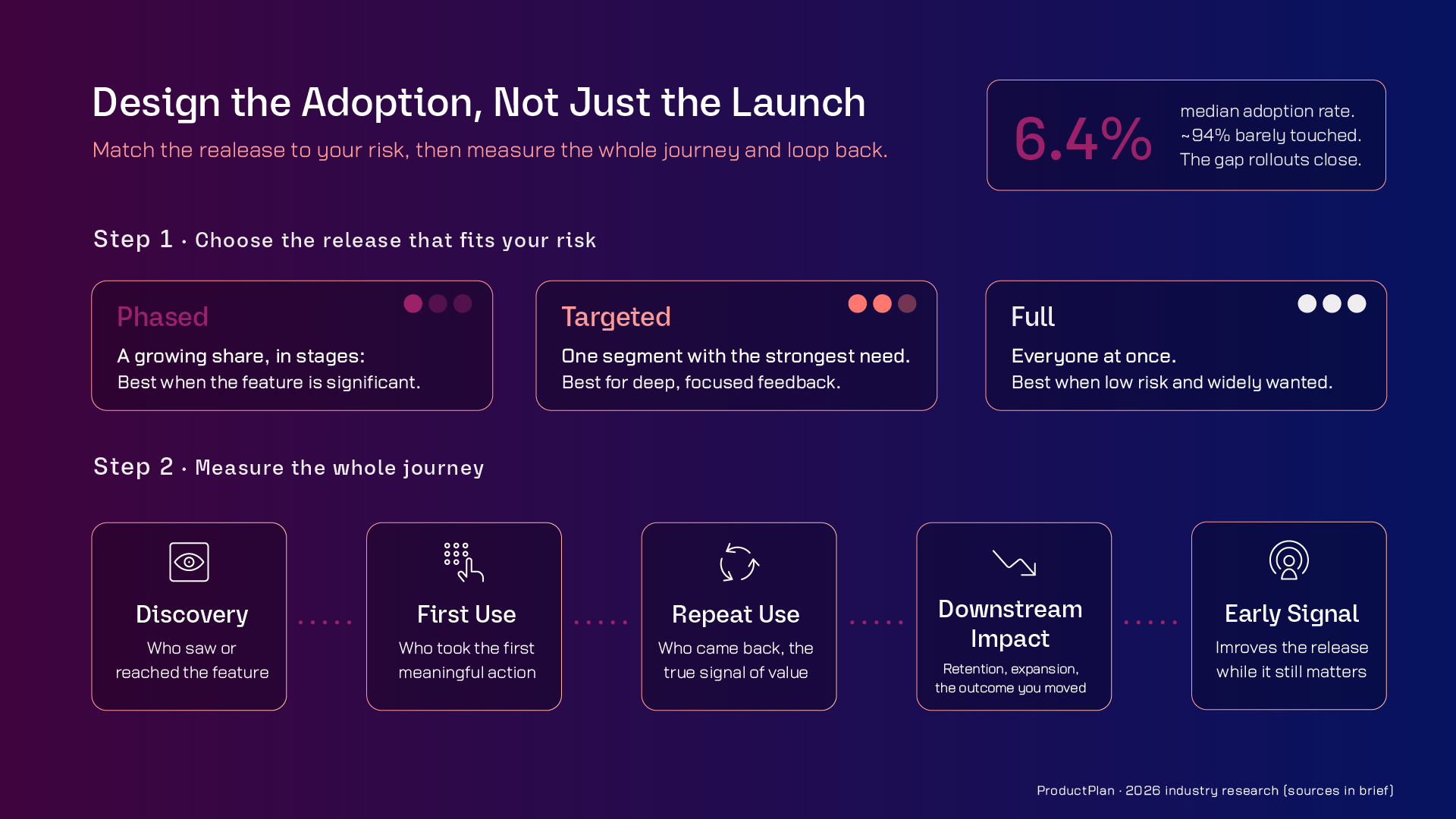
Because velocity and adoption have started to diverge. Pendo’s benchmarking found that median feature adoption is only 6.4%, that even top products reach about 15.6%, and that roughly 6% of features drive 80% of clicks while the rest go barely touched. Shipping more, on its own, tends to lower your average rather than raise it.
AI has widened the gap. Instruqt and SlashData’s State of Developer Adoption 2026 found that 92% of software companies report at least one significant adoption challenge, and that a quarter cannot keep their enablement content accurate against weekly releases. Tyler Crumpler of Instruqt framed it precisely: organizations have less time than ever to help customers understand, evaluate, and adopt new capabilities before the next wave arrives. Elena Verna, now Head of Growth at Lovable, describes a related shift, spending 95% of her energy on growth innovation rather than optimization, because in the AI era product-market fit has become perishable. In that environment, the rollout, not the roadmap, is where adoption is won or lost.
What are the main rollout approaches, and when do you use each?
There is no single right way to release. The craft is matching the approach to the risk you carry and the learning you need.
Most meaningful features benefit from a phased or targeted start, because those approaches buy signal while the stakes are still small. A full release is a sound choice when you already hold the evidence to back it.
What should you actually measure?
Measure the journey, not a single number, so you can see whether a feature became part of the customer’s work. Four stages tell the story: discovery, first use, repeat use, and downstream impact on retention or value.
Activation deserves particular attention. Amplitude’s B2B benchmarks from late 2025 found that 69% of products with strong early activation were also strong at three-month retention, while strong acquisition did not show the same relationship with retention. More signups do not produce adoption. A deliberate activation moment does. That single finding is why rollout structure, not top-of-funnel volume, is the real growth work, and why activation deserves a clear owner rather than falling between product and marketing.
How do you act on adoption signal after launch?
Treat launch as the opening of a loop. Early signal from a phased or targeted rollout is a gift, because it arrives while you can still act on it. High discovery with low repeat use points at the first-use moment, where a quick early win turns a trial into a habit. Low discovery means people cannot find the feature, and the introduction needs to move closer to the moment of need.
Here is a move worth making this week. Take your last three shipped features and calculate their real adoption against your active-user base. Anything under about 6 to 7% is at or below the median, which means it is not yet a win. Put the lowest performer behind a staged rollout with an activation checkpoint, an in-product guide to first value, and you will have both a baseline and a live experiment by Friday. ProductPlan and Winware AI keep that post-launch signal flowing back in as evidence, tied to the customers it came from, so what you learn from one rollout informs the next idea on your roadmap.
Build adoption into the rollout
When the median feature reaches 6% of users and releases arrive faster than customers can absorb, shipping more is not the answer. Designing the rollout is. Plan the release, the discovery moment, and the measurement as one act, give activation an owner, and keep watching the signal so you can improve while it still matters.
See how ProductPlan and Winware AI capture post-launch signal and feed it back into your roadmap. Book a demo, and we will show you how to close the loop.
Frequently Asked Questions
Product adoption is the process by which users discover a feature, start using it, and continue to rely on it, moving from first exposure to habitual, value-driven use.
Plan the release, the communication, and the measurement together before launch, often phasing the rollout so you can learn from early users and adjust before reaching everyone.
Phased rollouts to a growing audience, targeted rollouts to specific segments, and full releases, each suited to a different level of risk and learning need.
Track discovery, first use, repeat use, and downstream impact, and watch activation most closely, since it is the strongest early predictor of whether a feature will stick.
Your next roadmap starts here.


.svg)