
Resource Allocation Frameworks for Agencies Shifting to a Productized Service Model
Moving from project-based work to a productized service model can give agencies more predictable revenue and a clearer way to scale repeatable expertise. There is a trap, however, worth naming before you start. A monthly retainer that still meters human hours behind the scenes is an hourly model in a subscription wrapper, and in 2026 AI turns that into a margin trap. The firms that win break the link between price and labor entirely.
Key Takeaways
- A productized service model packages repeatable expertise into a standardized, often subscription-based offering with a defined outcome.
- Recurring revenue is not the same as productization. A retainer that still bills against effort behaves like the hourly model it replaced.
- AI makes effort-based pricing a trap, because the better your team gets, the fewer hours you can bill for the same result.
- High-growth agencies run fewer retainers, not more, which shows the lever is a productized scope, not a recurring invoice.
- In ProductPlan’s 2026 report, 49% of teams named resource and capacity constraints the top cause of misalignment, a pressure productizing firms feel acutely.
What is a productized service model, really?
A productized service packages repeatable expertise into a standardized, often subscription-based offering, so revenue becomes recurring and delivery becomes predictable. The important word is packaged. You sell a defined outcome with a known shape and a known price, rather than scoping each engagement from scratch and billing the hours it consumes.
The distinction matters because many firms adopt the subscription and keep the hourly mindset underneath it. They move clients to a retainer, then staff and price it by effort as before. That is recurring revenue without productization, and it inherits the very fragility the shift was meant to escape. A true productized service decouples what the client pays from how long the work takes, which is the only version that holds up as AI compresses the hours.
Why is a retainer alone a margin trap in 2026?
AI is changing the relationship between time, output, and value in professional services. SPI Research’s 2026 Professional Services Maturity Benchmark, reported through Deltek, found average billable utilization fell to 66.4% in 2025, the lowest in the survey’s sixteen-year history, against a 75% target. In the same period, GenAI was used on 27.1% of projects, a 40% jump in a year. Read together, those two numbers describe a business whose billing base is shrinking as its efficiency rises.
AI is changing the economics of time-based pricing. When a team can deliver the same quality of work in fewer hours, an agency that bills primarily for time may capture less revenue from the very efficiency it worked to create. That creates pressure to rethink what clients are paying for and to price more of the value around the outcome, expertise, and results delivered. Brian Kessman of Lodestar Agency Consulting argues that agencies create more durable value when they package expertise around solutions rather than around units of time. Lis Anderson, founder of the consultancy AMBITIOUS, adds the pricing consequence in Forbes: finishing in two days rather than three reflects expertise, not less value, so client pricing should be decoupled from time entirely. As one industry editor put it, AI is making time a poorer proxy for value.
What does the counterintuitive data say about retainers?
That recurring billing is not the goal on its own. Retainers have become the norm, with industry benchmarks showing 78% of agencies now using them as their primary model, up from 64% in 2023, and fewer than 15% of top agencies billing purely by the hour. Yet the same research surfaces a striking finding: fast-growing agencies run 16% fewer retainers while completing 24% more projects than average firms.
The lesson is that productized scope, not the recurring invoice, drives the growth. A retainer that wraps open-ended effort still exposes you to the margin trap. A productized offer, priced to a defined outcome, lets AI-driven efficiency flow to margin rather than erode revenue, whether it is billed monthly or per engagement. Recurring revenue is a delivery convenience. Productization is the business model.
What frameworks help you allocate people and budget?
Three frameworks, used together, turn allocation from a weekly scramble into a deliberate plan.
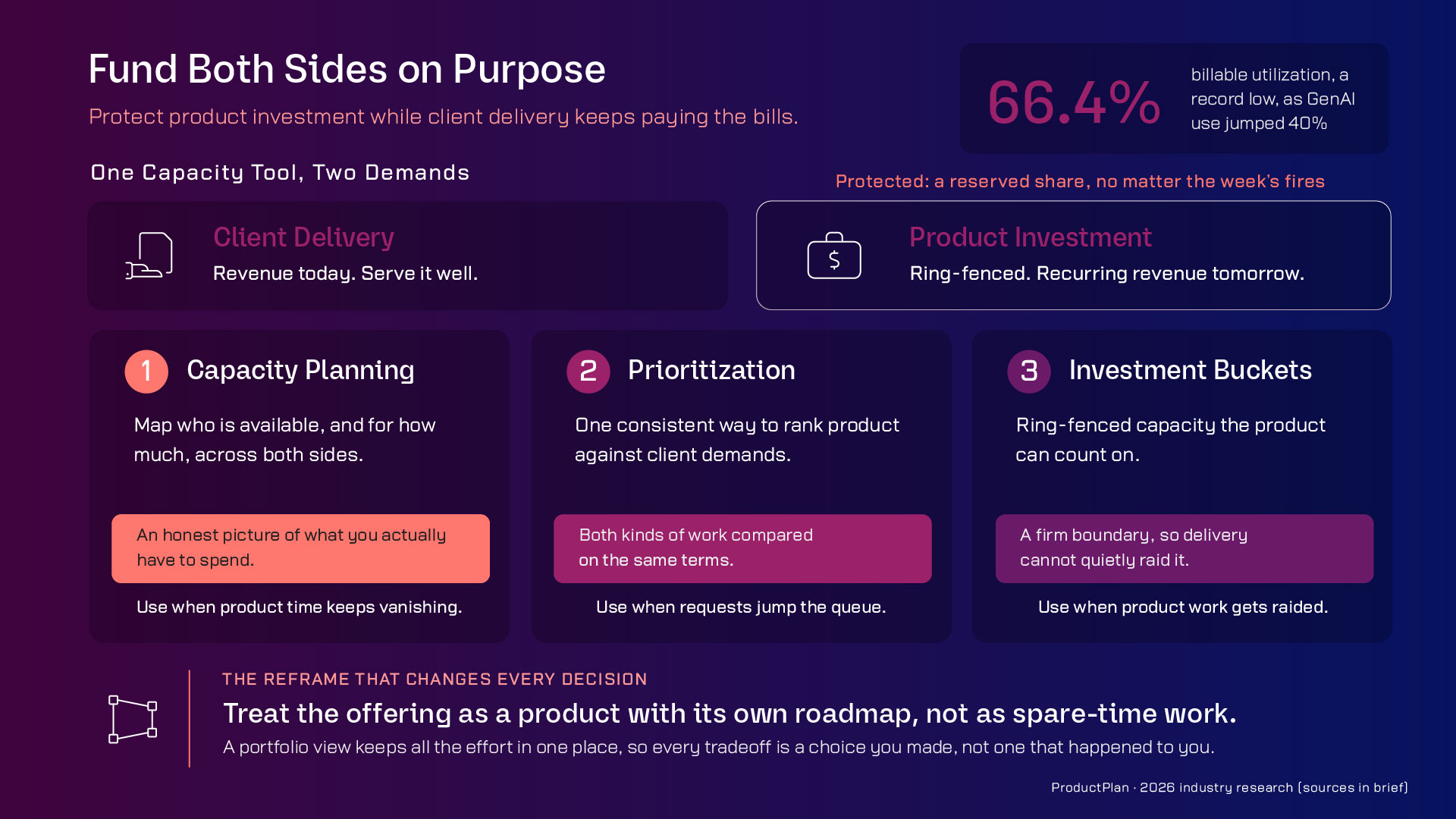
Capacity planning gives you an honest read on what you actually have. A consistent prioritization method lets product and client work be weighed on the same terms. Investment buckets then protect the offer with a firm boundary, so a defined share of the team builds the product regardless of the week’s fires. With 49% of teams citing capacity constraints as their top source of misalignment, that protected boundary is what keeps the transition from dissolving into firefighting.
What is the one move to make this week?
Run a one-SKU pilot. Take your single most-repeated engagement and rewrite it as a fixed-scope, fixed-price productized offer with a defined outcome and deliverable. Then adopt Lis Anderson’s resourcing hour: keep time tracking internal only, as a capacity and margin instrument, and remove it from anything the client sees or pays against. You are not re-orging the firm. You are shipping one productized offer that proves the model, and you can have it defined in days.
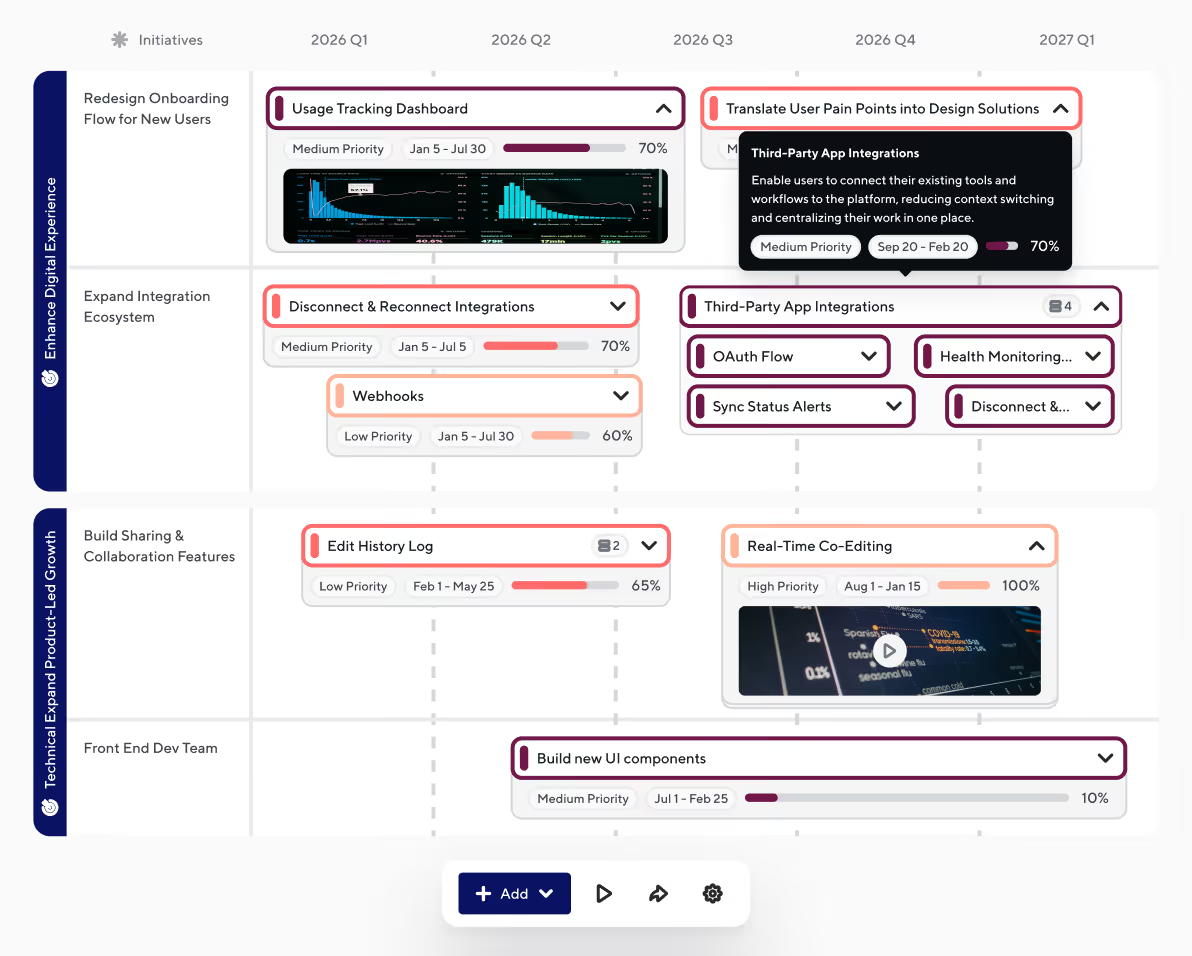
A portfolio view can help as that pilot grows by showing how people and investment are distributed across client delivery and the productized offer. ProductPlan gives teams a shared view of that work so resource tradeoffs are easier to see and manage.
Frequently Asked Questions
It is a model where a firm packages repeatable expertise into a standardized, often subscription-based offering, so revenue becomes recurring and delivery becomes more predictable than custom project work.
A retainer that still meters effort behind the scenes prices the work by the hour under a subscription label, so it inherits the margin fragility that AI-driven efficiency now exposes.
Use explicit capacity planning, a consistent prioritization method, and protected investment buckets for the productized offer, so both delivery and product development get deliberate funding.
Ring-fence a portion of capacity, make tradeoffs visible with a portfolio view, and treat the offering as a product with its own roadmap rather than as spare-time work.
Your next roadmap starts here.


.svg)