
Inside the New ProductPlan Ideas Experience | ProductPlan
Build with Certainty With the Reimagined ProductPlan Ideas Experience
By Adrian Bryant, Director of Product Management
Every product leader knows the feeling of holding more input than any one person could reasonably weigh, and still needing to choose a direction the whole organization can trust. The new ProductPlan Ideas experience is built to give you that confidence, turning everyday feedback into evidence, and evidence into decisions you can stand behind with certainty.
Key Takeaways
- The new Ideas experience helps you decide what to build next with confidence, backed by evidence and data you can see and share.
- Every idea is built from signals, atomic pieces of real customer evidence captured in your customers' own words.
- Feedback flows in three easy ways: import a spreadsheet of past requests, add items by hand, or collect fresh input through a redesigned feedback form.
- Feedback forms and research surveys now share one unified builder, so you can choose the right instrument for the research at hand.
- A clean, searchable, sortable table keeps thousands of ideas easy to manage, at the product level or across your whole portfolio.
- A powerful layer of AI is on the way to merge similar ideas, and route new signals,, always with you in control.
What is the new ProductPlan Ideas experience?
It is a thoughtful rebuild of how product teams collect and act on customer feedback, living in the same place where you prioritize and build your roadmap. The model is refreshingly simple. Feedback arrives, becomes a signal, signals gather into ideas, and ideas carry their evidence forward to the roadmap.
"The hardest part of product is always figuring out what to build next," said Steven Cohn, CEO of ProductPlan, on the launch webinar. "You have a firehose of inbound information and opinions, and we want to make it really easy to organize, streamline, and then prioritize all that feedback." It is powerful, and it is genuinely usable, which is exactly what one customer, a Chief Product Officer at a Silicon Valley SaaS company recognized the moment she saw the new interface: "This is so much better."
Why does choosing what to build next carry so much weight?
Because great input arrives from every direction, and every voice believes its request matters. Customers, prospects, sales, success, and executives all bring ideas worth respecting, and product leaders carry all of it while still choosing a path the whole organization can rally behind. That is real responsibility, and it deserves tools that make it feel manageable.
Discovery is also a weekly rhythm rather than a quarterly event. You are triaging feedback, reviewing evidence, and deciding what comes next on an ongoing basis, so you deserve a home that welcomes you back each week and keeps that thinking in one place. The new experience gives you a calm, structured space for that work, so a decision becomes something you feel sure about, grounded in evidence rather than in the loudest voice in the room.
Imagine being able to tell your leadership team why something is being prioritized, where it came from, and directly read, in the voice of the customer, how they want it to function. Our new ideas experience helps product leaders defend “why we chose this versus that,” based on data. It also provides a real-time transparent interface to point loud voices too, and an easy place for them to leave feedback in multiple ways if they want something prioritized. This is how teams will be able to get to a place where they can say, “the feature we just shipped was backed by 23 signals from 14 different customers.” That is the kind of certainty this experience is designed to give you, and it starts with getting feedback flowing.
How do I get feedback and ideas into the system?
You have three welcoming on-ramps, so the page becomes useful right away:
- Import existing data. Bring a spreadsheet of past requests in as ideas or as signals, using a downloadable CSV template that validates your file and shows the detected count before you begin.
- Add manually. Create an idea or a signal by hand whenever evidence shows up outside a form.
- Create a feedback form. Collect new input from customers and stakeholders, where every submission becomes a signal.
Import lands your data in the right product automatically, based on the product you are working in, so the historical requests you have been keeping in spreadsheets finally have a home that works for you.
What is a signal, and what can I do with it?
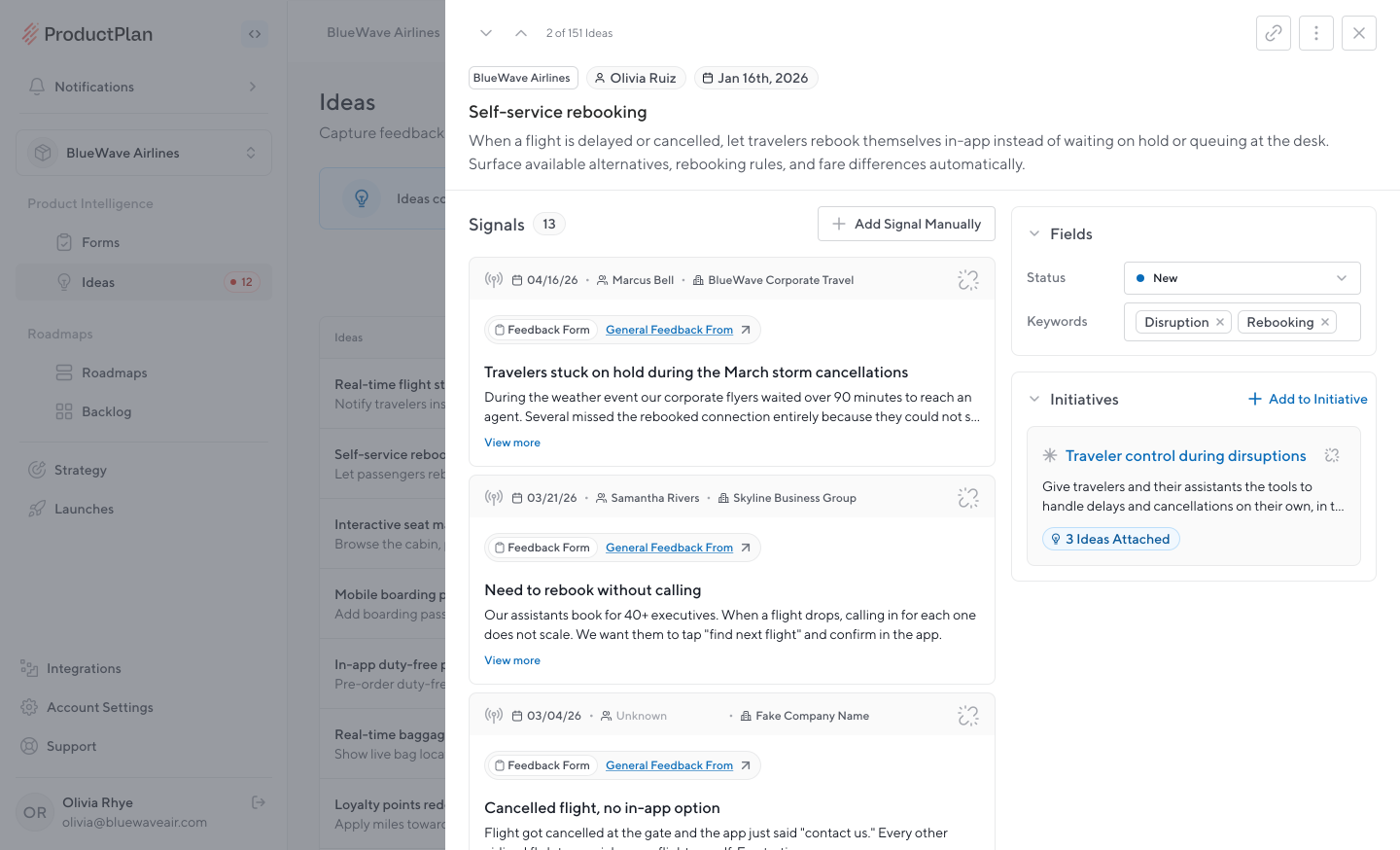
A signal is one atomic piece of evidence from a customer or stakeholder, the smallest building block that every idea rests on. Signals give you the ability to say something powerful and specific in any room, replacing a hunch with countable evidence about who needs what and why.
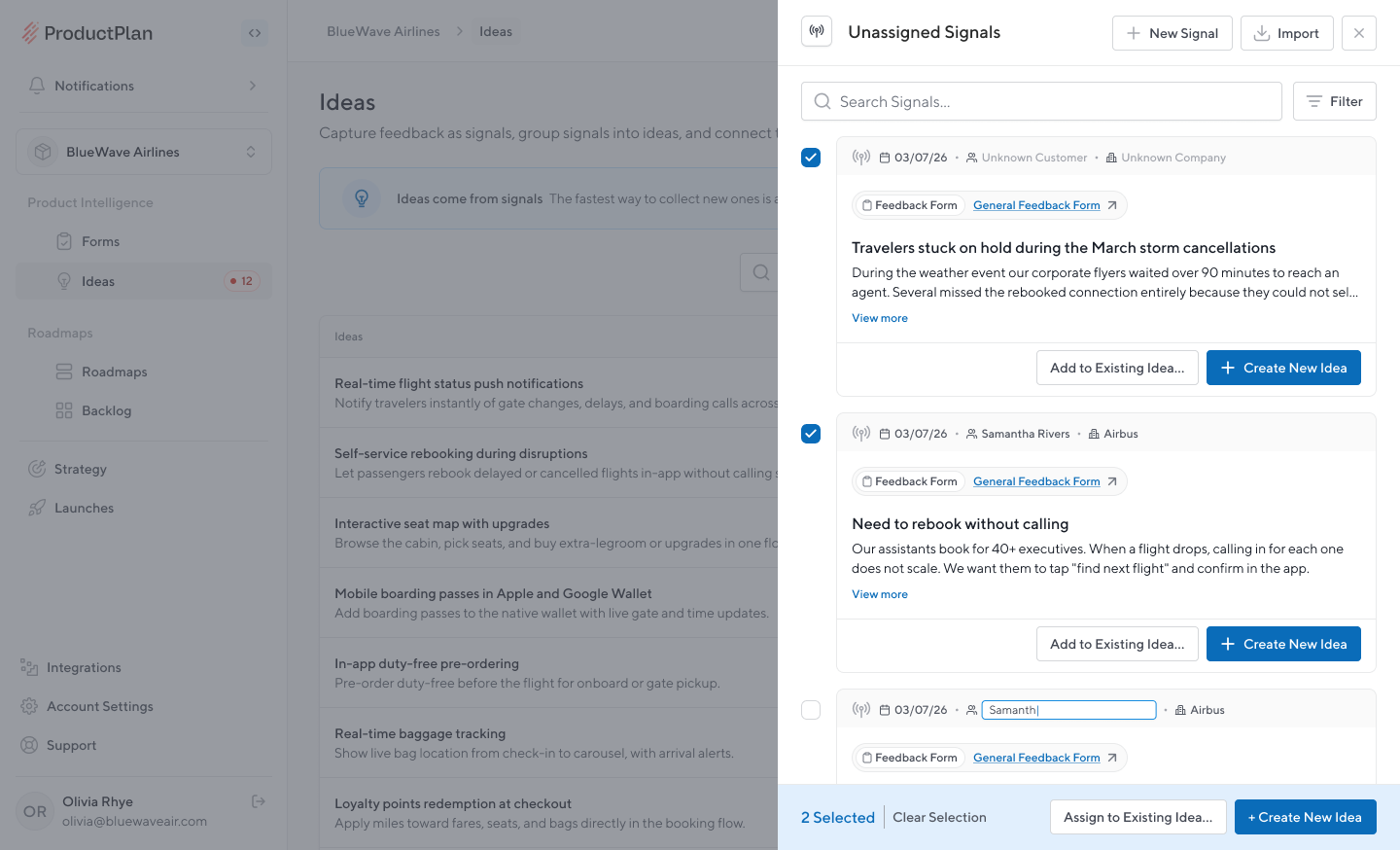
New signals arrive in the Unassigned Signals drawer, a friendly staging area with a counter so you always know how much is waiting for your attention. From there, triage is quick and satisfying:
- Create a fresh idea from a single signal, or bulk-select several to start an idea together.
- Attach signals to an existing idea by searching for it.
- Tag each signal with a customer and a company for easy filtering and reporting.
- Detach a signal at any time to return it to the drawer, ready to attach somewhere new.
- Review every signal's customer, company, source, and date alongside the original words, so the voice of the customer stays close.
"We really believe in the voice of the customer," said Adrian Bryant, Director of Product Management. "Being able to point back to the exact words or the exact pain points your customer talked about is really powerful in making those decisions." Because a signal is captured once and reusable, that same piece of evidence can support an idea today and enrich a persona, a competitor view, or a customer profile as the broader Product Intelligence vision grows.
What is the new feedback form, and how is it different from a survey?
Feedback forms and research surveys now share one unified builder so you choose the right instrument for the research at hand and build it the same easy way. You filter between the two types on the dashboard, pick a template or start from scratch, and set the product the form belongs to.
Choose a feedback form as your always-on intake:
- Continuous and open-ended, with no cap on submissions and no expiration date.
- Starts with a required title and description, so every signal is clear.
- Supports text questions, multi-choice with single or multiple selection and an Other option, and a rating scale to gauge how big a pain point really is.
- Reorder questions with drag and drop, mark each required or optional, and preview it live as you build.
- Shares through a clean, modern, unbranded page and a public link or embed code, with a simple reCAPTCHA check in place of email verification.
Choose a research survey for a focused, dedicated study:
- Time-bound discovery or validation, ideal for testing a prototype or exploring a specific pain point.
- Adds screener questions and conditional logic to reach the right respondents.
- Includes content testing on live URLs, prototypes, images, and video.
- Brings an AI moderator that asks adaptive follow-up questions to draw out the why behind a response.
- Lets you recruit professional respondents or survey your own audience, with an AI summary of the results.
How does it stay easy to manage with thousands of ideas?
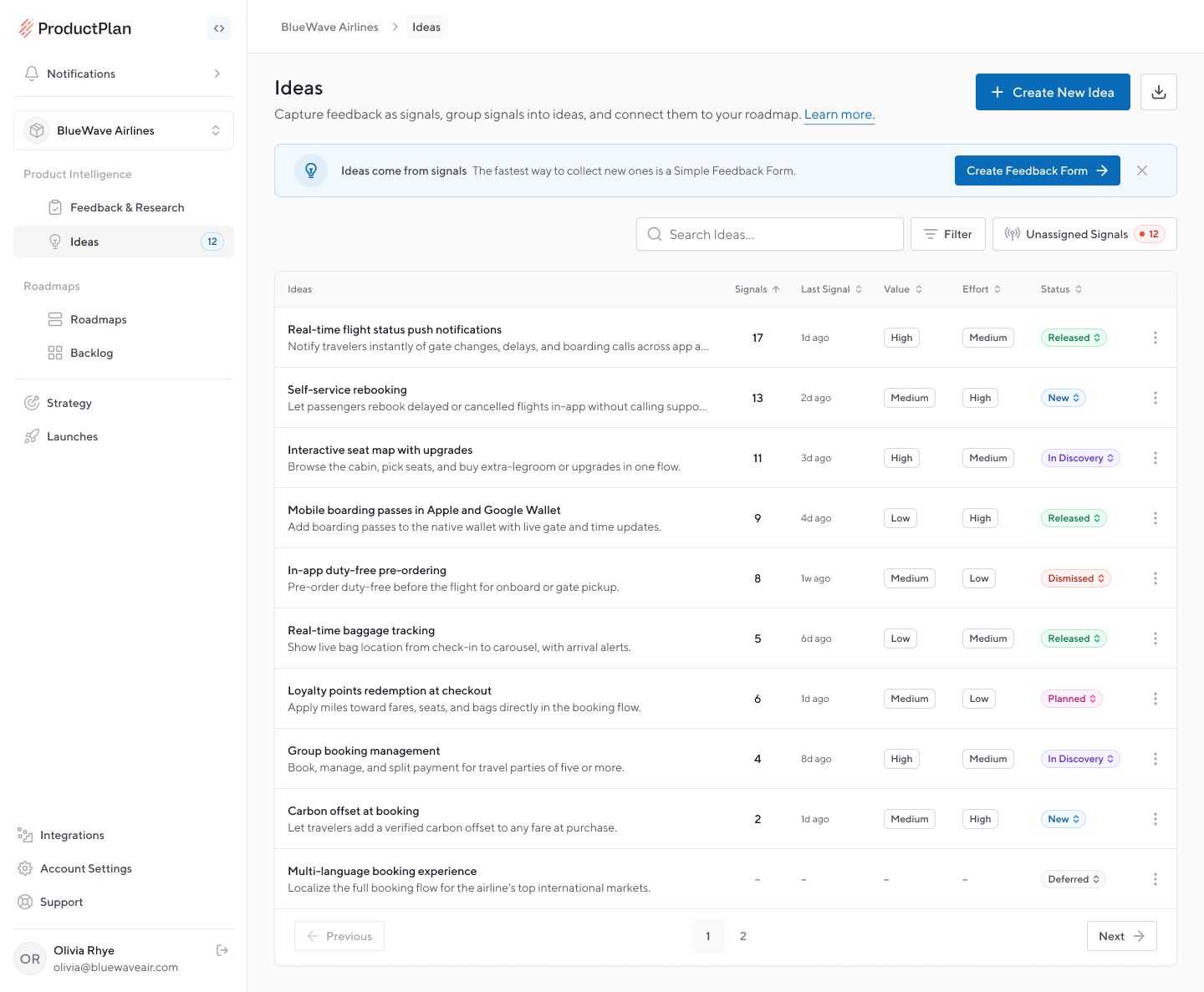
The Ideas page is a scannable table with sortable columns, fuzzy search across titles and descriptions, filtering, and pagination, so it stays calm and fast even when a product holds hundreds or thousands of ideas. Each row gives you the data you need at a glance:
- The title and description.
- The count of signals behind the idea, so you can feel the weight of evidence supporting it.
- The date of the most recent signal, so you can see how current an idea is.
- An inline status you can update right from the row.
- The product, shown in the All Products view.
This matters at real scale. Many of our enterprise customers receive one thousand or more idea submissions, and some span hundreds of ideas over more than fifty products. We understood we needed to build a solution that can remove the administrative burden of managing such scale in feedback volume and complexity, so we built the ability to filter to Active or Archived ideas, narrow by reporter or status, and sort any column, so finding the idea you need feels effortless.
Can I manage ideas by product and see my portfolio themes?
Yes. Ideas live under each product inside Product Intelligence and are scoped to the product you are working in, following the same product segmentation and permissions your team already uses, so the right people have the right level of view and edit access. This keeps each product's ideas focused and relevant to the team that owns them.
When you want the wider view, the All Products view brings every idea you have permission to see into one place, with a product column and product filtering, so you can spot the macro themes emerging across your whole portfolio. You can still act on ideas and update status in any product you can edit, giving leaders a clear read on where demand is gathering across the organization.
How does the evidence follow an idea onto the roadmap?
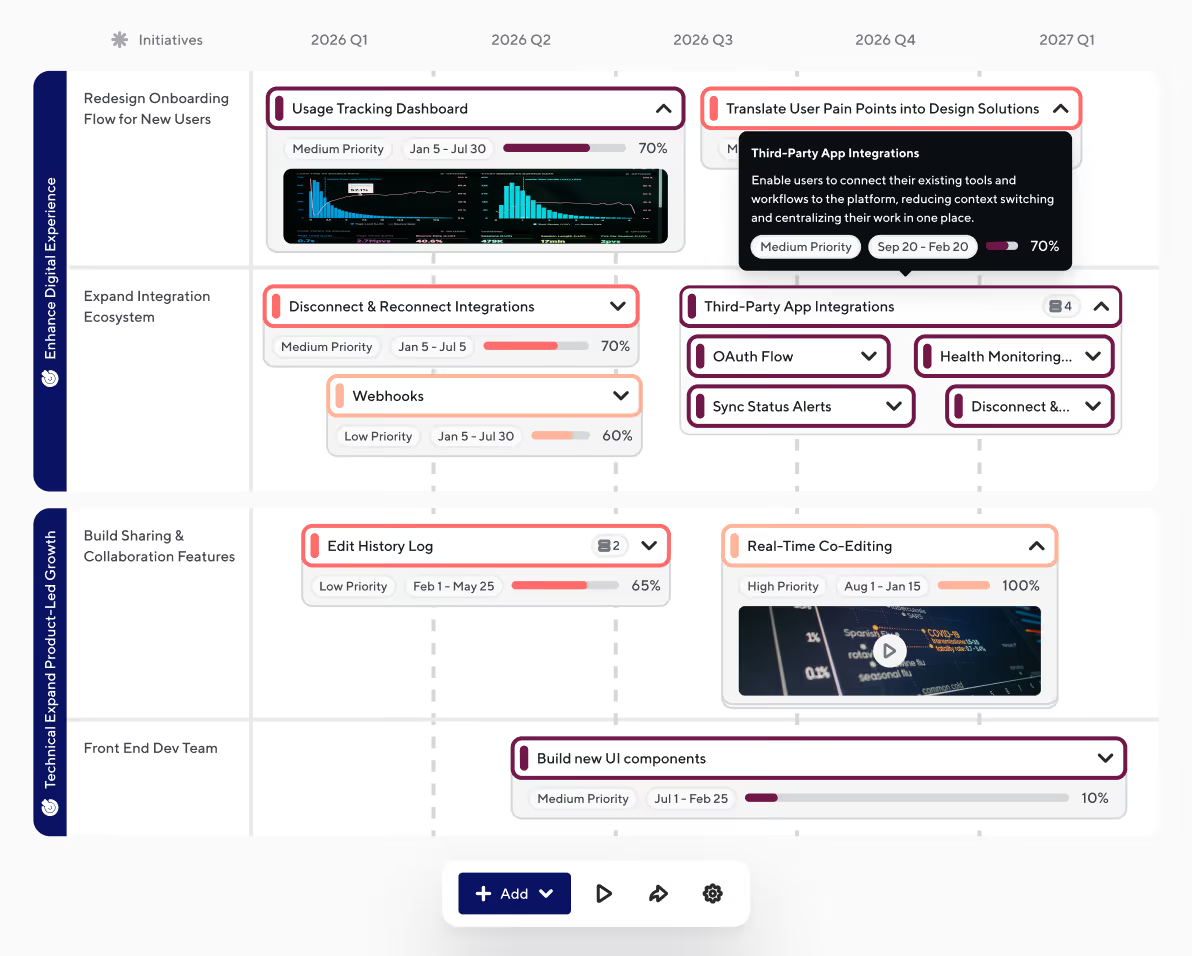
Coming soon, this is where decision certainty will pay off. In the future, when an idea earns its place, you promote it straight to the roadmap, and its signals, scores, and full history travel with it. Six months later, anyone can open a roadmap item and trace it back to the exact customers and quotes that inspired it, so the reasoning behind every commitment stays clear and defensible in front of any stakeholder.
It also lets you close the loop with the people who care most. Because every signal remembers who asked, you can follow up with the customers and stakeholders behind a feature the moment it ships, turning their feedback into a moment of delight and deepening the relationship that produced it.
How will this help me prioritize with confidence?
It gives every idea a visible, countable case, so your prioritization rests on evidence and data. Each idea shows how many signals support it, who they came from, and how recently new evidence arrived, so you can read the momentum behind an idea at a glance.
We know many teams have shaped their own internal naming conventions and prioritization approaches over the years, and that hard-won methodology deserves respect. So ProductPlan meets you where you already work:
- Today in our platform, RICE and value versus effort come pre-populated, the two frameworks product teams reach for most.
- Today you can also move an idea through New, In Discovery, Validated, Deferred, and Dismissed to keep everyone aligned on where it stands.
- In the near future, teams can rename dimensions to match your team's language and prioritization methodologies, and adjust the scoring and weighting to fit how your organization thinks.
The result is a methodology you architect yourself, working exactly the way your team already thinks, with the confidence of evidence behind every score.
Is it built for enterprise trust and governance?
Yes, and this is central to the design. Many of the teams adopting the new experience work in banking, healthcare, government, and education, where structure, security, and data privacy are not optional. The product segmentation and permissions model gives you clear control over who can view and edit each product's ideas, so governance is built into the everyday workflow.
The same principle guides how AI will show up soon in the experience. As intelligent assistance rolls out, it will work with a visible approval layer, offer suggestions with clear reasoning and confidence levels while you stay firmly in the driver's seat. You will get the speed of automation with the control your organization requires.
What is coming next in the ideas capture and management experience at ProductPlan?
This launch is the first release in a staged rollout, with a great deal arriving through the year:
- Direct moving and splitting of signals between ideas, making an already easy workflow even smoother.
- AI that routes and groups incoming signals into the right ideas, each suggestion carrying a confidence level and clear reasoning for you to approve.
- AI that drafts idea titles and summaries, so a raw pile of feedback becomes a well-formed idea in moments.
- In the future, we’ll have AI-assisted scoring that suggests a first-pass prioritization from the context in your signals, ready for you to adjust.
- We’ll also have new signal sources, so evidence from customer discovery transcripts and support systems flows in alongside your forms.
- A public ideas board to share what is in discovery and gather fresh input directly from your users; in the future this will include rich media and prototypes that feed new signals back into your ideas.
The clearest path from feedback to decision
We are genuinely excited to introduce the market's newest and most modern ideas capture and management experience, built for the AI era, where speed, structure, and decision clarity define the teams that win. As AI accelerates how fast products get built, the deciding question becomes what to build next, and the teams who answer it with evidence will lead their categories. ProductPlan brings that whole journey together, from a single piece of feedback to a confident, defensible place on your roadmap, in one connected home your team will want to return to every week.
If you are ready to feel that certainty for yourself, we would love to show you. See the reimagined Ideas experience in a live demo, and discover how much clearer deciding what to build next can feel. You can also preview the new capabilities here in our Summer 2026 webinar series.
Frequently Asked Questions
The first release works beautifully on your own judgment, and AI that helps route new signals, merge existing ideas or draft new ideas, is following close behind, always with your approval.
Your subscription stays the same, with more value included.
Your next roadmap starts here.


.svg)