
ProductPlan's New Roadmap: Easier to Use. Always Current. Better Stakeholder Engagement.
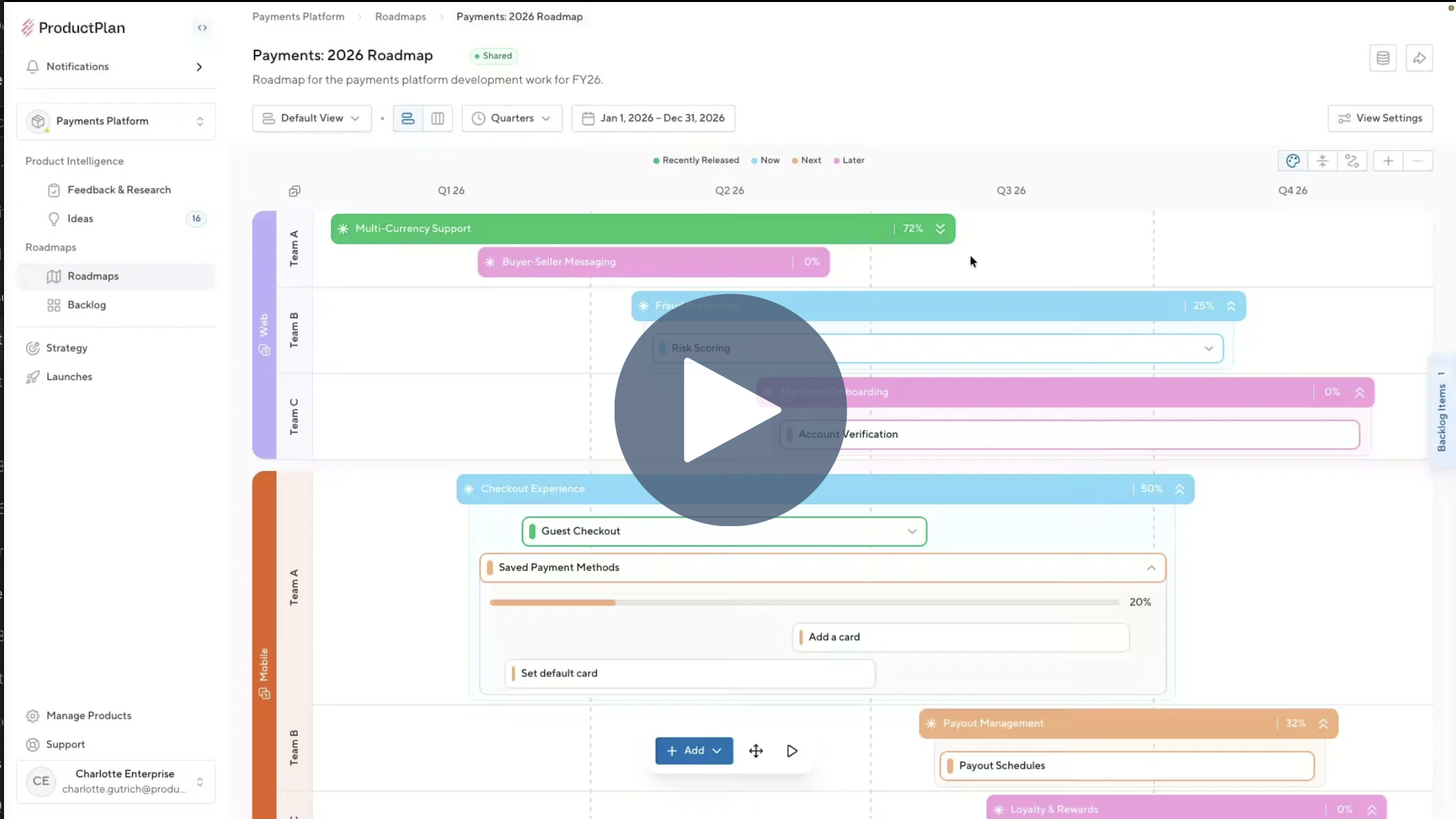
As we have been sharing over the past several months, we are reimagining the roadmap and DevOps integrations. Everything that we have done with the new roadmap has been focused on three core principles:
- Faster time to value. Streamlined UX makes it easier to create and update roadmaps.
- More stakeholder engagement. Easier for stakeholders to consume = less back and forth with stakeholders.
- Always in sync. Bi-directional, real time sync with your DevOps tool = less work to maintain.
See it in action:
Timeline: The reimagined roadmap experience is available now for new accounts. Existing customers can switch today. Just contact us. In the meantime, we are being very thoughtful on the migration. Nothing is changing for you today. No data is being moved or deleted. We will migrate existing accounts in cohorts over the next few months and reach out directly before your team is moved over.
How This Helps Your Team
A roadmap in the reimagined experience is one living thing. The backlog your team refines, the roadmap your stakeholders read, and the work moving through Jira are the same items, so the roadmap shows what's actually happening without anyone restating it.
- Product Managers: spend less time copying and reconciling. One editing experience across roadmaps and portfolios, one backlog per product, real-time two-way sync with development, and the freedom to pivot a view instead of rebuilding it.
- Product Leaders / CPOs: a cross-product portfolio view you can trust to be current, because it reads from the same items your teams are editing.
- Product Operations: governance that holds. A standard permissions structure across products, roadmaps private until shared, and Jira setup done once per project instead of per user per roadmap.
- Engineering Partners: Jira stays the source of truth. You set sync direction per field, and initiative, epic, and story relationships are preserved across products.
- Stakeholders (Sales, CS, Execs): what reaches you is shared on purpose. The Board layout and presentation mode are built for audiences who don't think about dates.
1. Faster time to value. Less time maintaining roadmaps, more time deciding what goes on them
How do we dramatically reduce the time it takes to create and maintain a roadmap? That was a driving question for our rebuild.
The old way of updating a roadmap: You make an update on one roadmap, then make it again on the next one, and the next. Before long there are three versions of the same epic, and nobody knows which one is right. Keeping roadmaps up to date turns into a second job.
The new way: Initiatives, epics, and stories now belong to a product, not to a single roadmap. Each product has one backlog holding every item in its hierarchy, so your team has one place to look. Put the same item on as many roadmaps as you need, edit it anywhere, and it updates everywhere it appears. Less time maintaining roadmaps, more time deciding what goes on them.
The New Features Behind the Benefits:
- A backlog for every product: every initiative, epic, and story in one place, replacing the old Parked/Planned split.
- Edit once, update everywhere: the same item can live on any number of roadmaps, and one edit updates them all.
- One roadmap type: roadmaps, portfolios, and strategic portfolios are now one flexible roadmap.
- Custom fields, set up once: Your team gets one consistent way to describe work.
2. Easier for stakeholders to consume = less back and forth with stakeholders.
Your executives want the big picture. Your team needs the quarter-by-quarter plan. Sales wants something without dates. We got you.
One Roadmap. Every Audience. No Rebuilding.
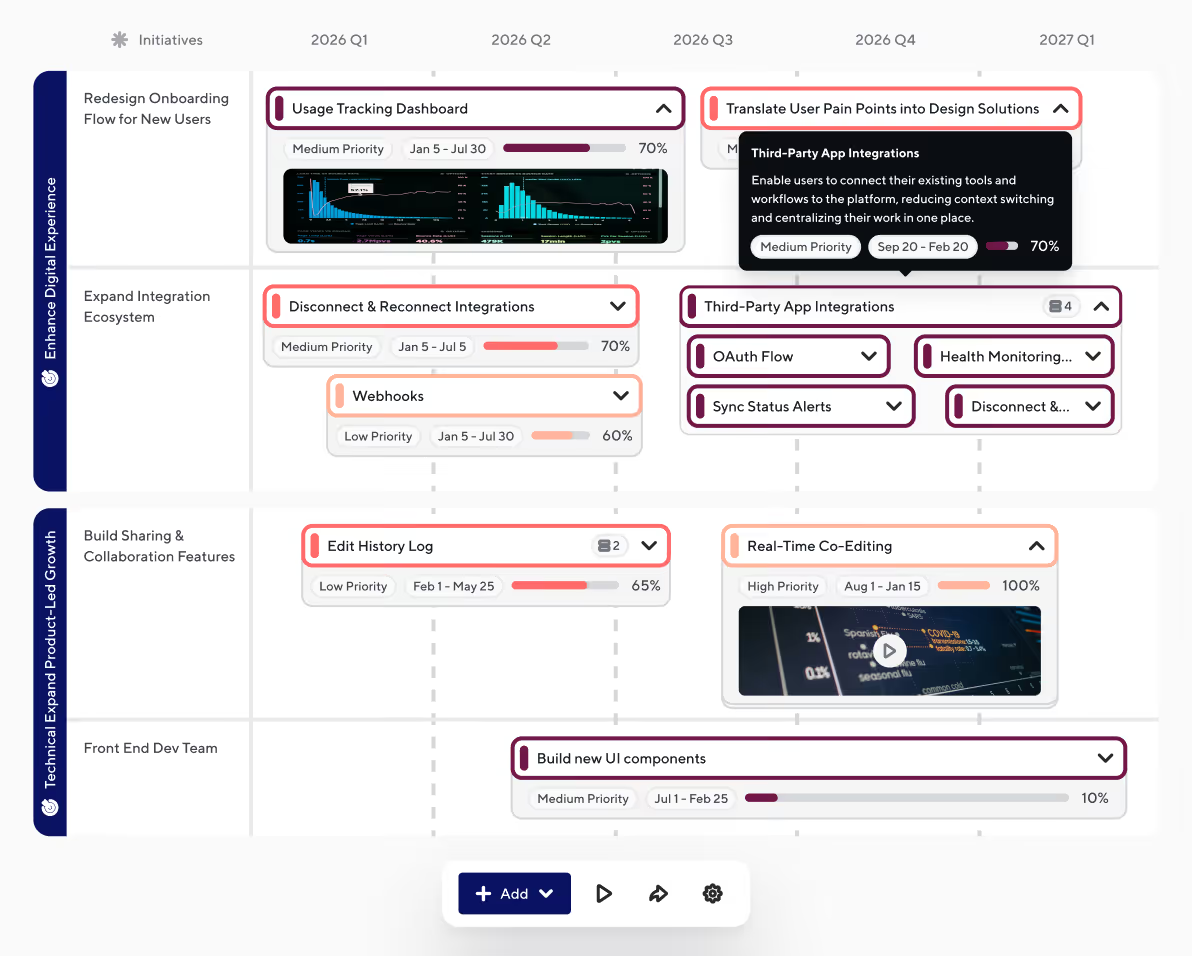
The Now/Next/Later view your executives want and the quarter-by-quarter view your team works from are the same roadmap, pivoted. Switch between Timeline and Board, regroup by product, objective, or any dropdown field, and change the color coding, all without rebuilding anything. Walk into any meeting with the right roadmap for that room, and let it lead the conversation instead of scrambling to prepare it.
The New Features Behind the Benefits:
- Timeline and Board layouts: switch between them on any roadmap.
- Primary and secondary groupings: group by product, objective, or any dropdown field, with an optional second level.
- Start from a blank page, or from work you've already done: Build from Scratch gives you an empty canvas with your own lanes. Build from Existing pulls from your backlog and filters by objectives or fields.
- Presentation mode: built for the meeting itself.
- Coming soon: Embeddable rich content (videos and images) to help stakeholders learn more about roadmap items before (or hopefully instead of) a meeting. This feature is being released shortly after the initial release.
3. A Roadmap That Keeps Itself Current.
When updating a roadmap means copying data over from Jira by hand, the roadmap falls behind. Stakeholders stop trusting it, and teams stop opening it.
The rebuilt Jira Cloud integration fixes that. Setup is now a one-time job for your admin. You choose, field by field, whether data comes in from Jira or stays in sync both ways, and two-way fields update automatically in real time. Jira stays the source of truth, so engineering data is never overwritten. The roadmap your stakeholders see matches what's actually happening in development, so people trust it and keep coming back. Azure Dev Ops integration is being released soon, as is Jira On-prem and both will work as described above.
The New Features Behind the Benefits:
- Admin setup, once per project: your account admin connects Jira and maps fields per project, instead of each person setting it up roadmap by roadmap.
- Sync direction per field: each mapped field is either Jira → ProductPlan only or two-way.
- Live two-way sync: two-way fields update in real time, not in a nightly batch and not with a manual push.
- Jira stays the source of truth: Jira's own fields, like Status and Assignee, only come in from Jira.
- Automatic backlog import: describe the work you want in your product backlog to set up an automatic query import.
- Hierarchy stays intact: initiative, epic, and story relationships come through from Jira.
4. Tell your story: From Strategy to Delivery in one view.
The old way: Strategy lives in one place, delivery in another, and the connection between them gets lost. Leaders can't see how today's work moves the goals forward, and teams can't see why their work matters.
The new roadmap: Initiatives, epics, and stories now mean the same thing across every product and roadmap: an initiative holds epics, and an epic holds stories. Place an initiative on your roadmap, open it, edit it, and watch its children roll up. Group by objective and each goal becomes its own lane, so the work is organized around what it's meant to achieve. Everyone sees the full story, from the goal to the work that delivers it, which makes it easier to get buy-in, defend priorities, and keep everyone moving in the same direction.
The New Features Behind the Benefits:
- Three-level hierarchy: initiatives are now native roadmap items, shown with epics and stories on one timeline or board.
- Detail control: expand or limit how deep each view goes, so every audience sees what matters to them.
- Objectives on the roadmap: group or subgroup by objective, and drag new objectives onto the roadmap from the toolbar.
- Objective summary: open an objective to see a read-only summary, with a link to Strategy, where key results, owner, dates, and risk level are edited.
- Dependencies you can see: link items that depend on each other and see the relationships drawn on the timeline, so high-risk dependencies are visible and tracked across teams.
NOTE: This is the first release of the reimagined experience. We have a lot of exciting features coming soon that will only enhance the benefits described above.
The next wave is already underway: Azure DevOps alongside Jira, prioritization scoring, comments and notifications on roadmap items, rich content in ideas and the roadmap, a direct connection between ideas and roadmap which shows evidence supporting the decision and much more. Everything we build from here points the same direction: a roadmap that takes minutes to put together, stays current on its own, and earns the attention of everyone you share it with.
What's Next:
Moving your team over, with plenty of notice. Every existing ProductPlan account moves to the reimagined experience in time. We're starting with a small group of customers, working through the move with them live, and using what we learn to make each one smoother than the last. Your CSM will be in touch well before your date, but if you want to transition to this new product experience now, please reach out here.
Ready to build with confidence?


.svg)