
Learn
Why Prioritization is So Critical… and Why You Need a Framework to Do It Well

Product teams that let everyone do their own thing think they’re facilitating creativity, flexibility, and independence. But in reality, a lack of consistency and standardization creates more work, extra confusion, and worse results.We know that left to our own devices, humans usually figure out a way to get things done. But we’ll often take very different approaches to the same situation based on our individual experiences.While this isn’t much of an issue in our personal lives, it’s often problematic in a larger group setting. Inconsistency breeds inefficiency, confusion, and uneven outputs. This prevents bigger organizations from running like a well-oiled machine.There’s a reason assembly lines replaced artisans. While the flourishes and unique idiosyncrasies of a handmade item are desirable, they have their place and time. The same variances clash with the rapid, repeatable nature a mature business relies on.Standardizing everyday tasks across an organization brings predictability and routine, which humans crave. When everyone follows the same process, we’re less likely to resist and find fault in that process or question its results. Over time, we get better at following it until it becomes a habit. We shift focus on the actual content versus the frameworks, steps, and procedures.For product teams, standardization is essential. We do so many different things from one day to the next, and many of those activities involve participants from across the entire company.A consistent approach to each activity means our colleagues have more explicit expectations and understand how to engage. Compared to learning a new method or process every time someone from the product team pulls them into a meeting.Standardizing also frees up mental space for the product team itself as they won’t waste time trying to reinvent the wheel every time. This creates more time and opportunity to tackle other tasks and sink your teeth into product management fun parts.Five signs you’re doing extra work and how to fix itWith so much on their plates, product teams don’t always have the headspace and spare moments to take a step back to identify opportunities for standardized processes. But here are some common scenarios where routine can come to the rescue.
You can’t quickly check on the status of a customer request
Customer feedback is the lifeblood of product management. Their ideas, suggestions, and complaints are welcome. Feedback is often solicited proactively to drive product planning and prioritization.Not every idea requires implementation. Yet it’s product management’s job to capture that feedback and close the loop with customers who take the time and initiative to provide it. But it’s a lot easier to receive that input than keep track of it.If everyone on the team has their system for keeping tabs on these items, then there’s no central location where it’s all available and organized. This leads to a few inefficient and undesirable outcomes:
- Similar or identical issues get logged many times. These ideas create duplicate work and lead to an implementation that only solves the core problem if developers don’t have the full requirement in a single location or sprint.
- Customers don’t get closure and can’t easily find out the status of their request.
- Lots of extra and unnecessary internal emails and messages trying to figure out where things stand.
A single repository for everything under consideration can solve this problem. A standard operating procedure for logging new requests and when and how to update the requesting party. The process can capture all relevant information before anything is formally entered into the feedback management system.
You can’t agree with your peers and other stakeholders on what’s most important
One of the most essential functions of product management is figuring out what to do next, what’s in the queue, and what’s off the table. This prioritization is pivotal for the product’s success. It has a slew of downstream ramifications impacting many other company departments.But making these judgment calls requires more than gut instincts and personal preferences. Turning broad strategies into a specific rank ordering of features, functionality, and themes is a grind. Which is why there are so many prioritization frameworks available.Getting the whole team to use a handful of these frameworks consistently is one way to speed thing things up and limit confusion. The more familiar stakeholders get with a framework, the less time it will take to run a bunch of backlog items through it.“It would probably take me five months to gather all the information to figure out which features and functionality we’re building that would impact a strategic goal and now it takes me seconds. ” said Courtney Freitag, senior product manager for AMN Healthcare. “Strategy is doing the right thing in the right order and ProductPlan has helped give us the visibility to do that.”Additionally, the underlying drivers for prioritization should also be consistent across the team. If one person thinks revenue is a major objective while someone else believes the main goal is growth you’ll get conflicting results even when using the same model.
You’re not sure which metrics matter
With a glut of instrumentation and analytics packages, there’s no shortage of data that can be sliced and diced until the cows come home. The tricky part is figuring out which measures are meaningful and deserving of attention. If you’re worried about the wrong ones it can really impact your happiness.For larger teams with many products under their umbrella, things get even more complicated. Each product manager may focus on their own set of metrics. After all, individual products might have their own particular target KPIs, creating a disconnected analytical outlook.Settling on a consistent set of metrics for the entire suite of products would be optimal as that creates an apples-to-apples view of the world. But depending on their purpose and target personas, there may be a place for some product-specific metrics as well.Either way, if there’s a mishmash of measurements thrown around by the product team, it’s time to hit the reset button and decide which metrics matter. The not-so-secret trick is to tie them all back to the corporate goals the management team cares about. If the product isn’t moving those needles, it doesn’t matter if it’s pushing any other ones.With agreement across the team on objectives, the measurement is consolidated and simplified. Thus freeing up time for teammates tasked with tabulating and sharing them. Additionally, product roadmaps are more powerful when each theme or item is linked to a measurable outcome the executives are pushing and tracking.
You spend lots of time on status reports and communicating updates.
People need to know when things change and if they’re on track. There’s nothing wrong with that, and it should be easy for stakeholders to see the status of essential and interesting initiatives.Keeping everyone up to date on the items they care about or are impacted by can be an onerous, thankless task. One that must be repeated ad nauseam since things are constantly changing. But product management has better things to do with their time than tailoring information updates for each stakeholder.Additionally, larger organizations with multiple product management professionals spend even more aggregate time on this activity. Stakeholders get bombarded with numerous, often overlapping communications using inconsistent formats and cadences. This is another area where standardization and automation can be a game-changer.Ideally, many updates are automatically updated from the tools in your product stack. For many of these products, stakeholders can sign up or opt-in to receive notifications when they care about it. While excluding any unnecessary communication.For example, when using ProductPlan, stakeholders can be alerted when the status changes for items based on how they’re tagged then delivered via email or using asynchronous messaging platforms such as Slack or Microsoft Teams. Up status updates can flow through to other tools such as Jira, Trello, and GitHub.When it comes to larger, more strategic status updates, creating templates, setting a cadence, and consolidating those reports across the entire product team means less time authoring those missives and a higher likelihood of using their time to act.
You spend lots of time creating custom roadmaps for different audiences
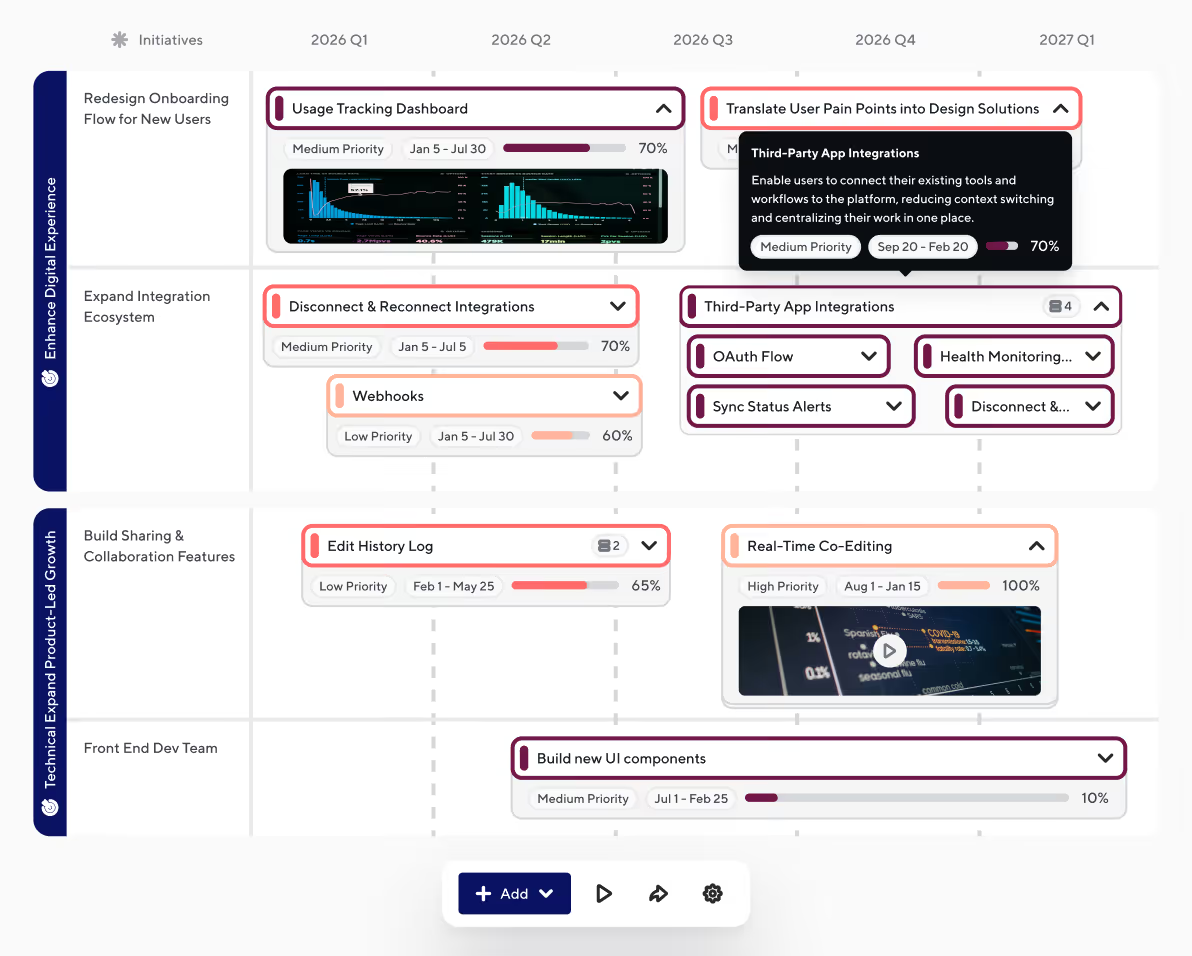
Countless hours of research, prioritization, and consensus-building should create a product roadmap. When done well, this visual guide to how the product strategy will transform into an objective-obtaining product is a self-explanatory tool tailored for its target audience.But there are so many audiences all caring about different things. Developers want specifics. Executives want outcomes. Marketing needs it to craft its messaging. Sales want to know what they can sell.Add in customers, press, analysts, investors, board members, and strategic partners, and you’ve got a diverse crowd eagerly awaiting the latest version. Plus, in a larger setting with multiple products, there’s also often a need for consolidated roadmaps showing the entire portfolio in one picture.Churning out audience-specific versions of manually-created roadmaps in slide decks or spreadsheets can consume a considerable portion of a product manager’s week. AMN Healthcare’s Freitag said it would take her weeks to create a five-year roadmap in a spreadsheet before switching to ProductPlan.Even if the product team uses a roadmapping tool they still need to be careful. If they’re not using it the same way, it limits the benefits while adding extra work when creating a master view.Standardizing is key to success. Being consistent with a roadmapping tool and template along with a universal tagging nomenclature can shave away many hours of labor. Consistency allows the turnaround time on pushing out new product roadmap versions a snap. The product team can simply select which tags are visible for each viewer. Thus ensuring stakeholders see what they need without any extraneous distractions.As a bonus, a cloud-based roadmapping tool eliminates version control worries that can again turn into a time suck. Everyone always sees the latest-and-greatest edition, preventing outdated versions from creating confusion or drama.
Process as a plus
It’s natural to bristle at the thought of adding processes and procedures to your day-to-day life, even if you know it’s good for you. But creating consistency doesn’t necessarily require a heavy-handed, all-encompassing rulebook for every aspect of the job.Even instituting some lightweight processes can make a big dent in duplicative work. Those processes can form a scaffolding that empowers product management to do bigger things as they know those processes ensure all the boxes get checked. Stakeholders will be confident in the rigorous way decisions were reached.NEED CTA
Turn strategy into a roadmap faster with ProductPlan's AI-powered roadmapping. Book a Demo
Ready to build with confidence?
See how ProductPlan gives product teams the intelligence to pick the right thing — and the proof to stand behind it.

4.3/5 on G2

.svg)