
How to Get the Most Out of UX Research With AI
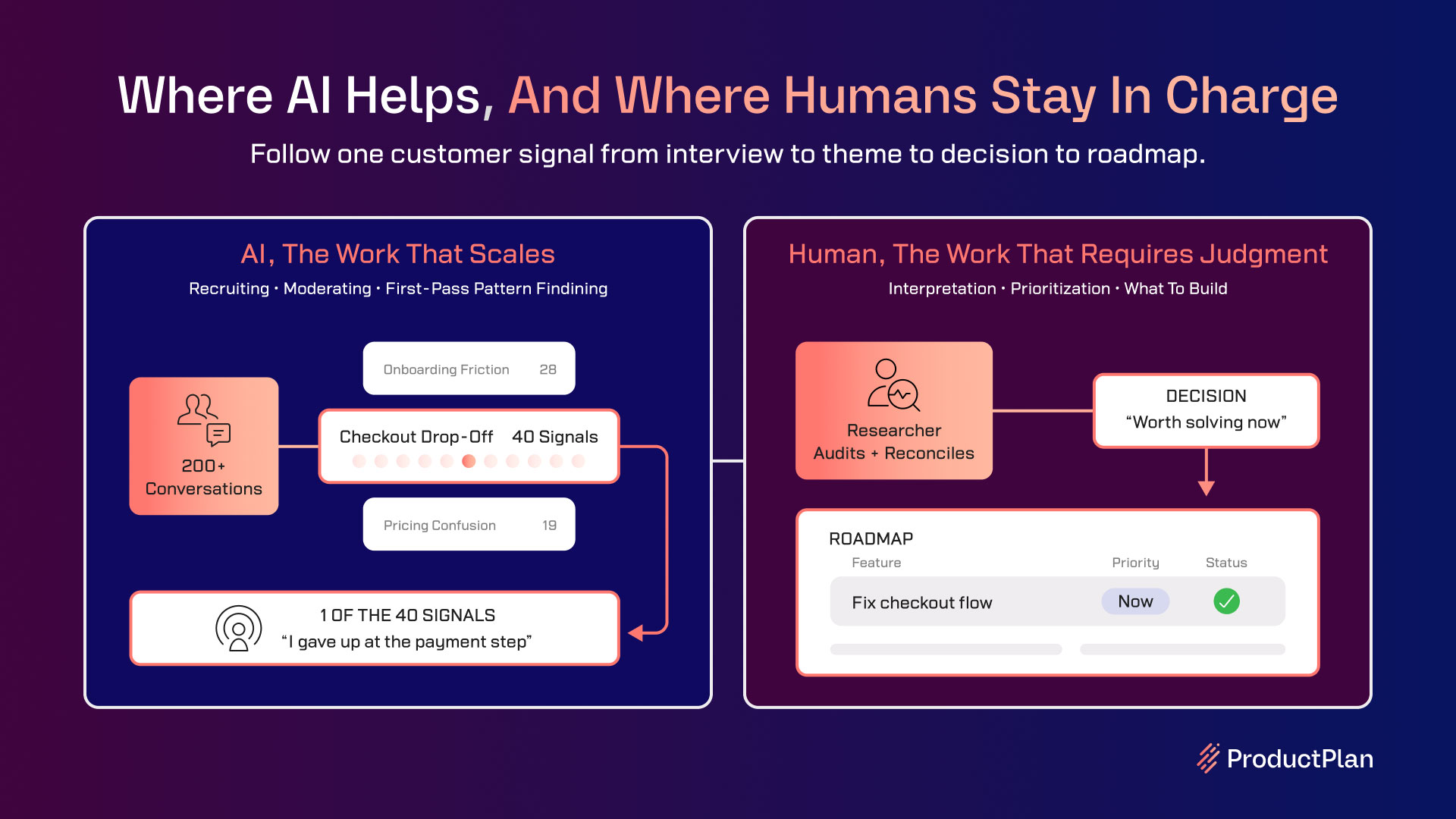
Speed and trust have always felt like a trade-off in UX research. You can move fast and risk shallow findings, or go deep and watch a study stretch across a quarter. AI promised to dissolve that tension, and in some ways it has: a small team can now recruit, moderate, and synthesize at a scale that was impossible to reach by hand. But it introduced a new worry in its place. When an AI tool hands you a confident summary of two hundred interviews, how do you know it is right? In 2026, with most teams still early in their AI adoption and buyers skeptical of anything that smells like hype, that question is the whole game.
Getting the most out of UX research with AI means using it to amplify human judgment, not replace it: let AI cover the ground that scales, recruiting, moderating, and surfacing patterns across many conversations, while keeping humans in charge of what the findings actually mean. The single discipline that separates trustworthy AI research from impressive-looking guesswork is traceability: every insight should lead back to a real source you can check, like a specific customer quote. This guide walks through where AI genuinely helps, where humans must stay in charge, how to keep synthesis trustworthy, and how to manage the real risks along the way.
Key Takeaways
- Getting the most from AI in UX research means using it to recruit, moderate, and synthesize at scale, while keeping human judgment in charge of what the findings mean.
- AI is strongest at surfacing patterns across many conversations; humans are strongest at deciding what matters and why.
- The trustworthy way to use AI is to keep every insight traceable to a real source, such as a customer quote, so claims can be verified rather than taken on faith.
- In ProductPlan's 2026 research, most teams are still early with AI, with roughly 37% using it for limited workflows and 32% experimenting, so disciplined practices now are a real competitive edge.
- Pairing AI synthesis with human reconciliation closes the gap between research volume and research understanding, which is where most teams actually struggle.
How can AI improve UX research?
AI improves UX research by removing the manual bottlenecks at each stage of the research lifecycle: it speeds up participant recruiting, helps moderate interviews and surveys at scale, and synthesizes large volumes of qualitative data into patterns far faster than hand-coding allows. The result is that a small team can cover far more ground, and keep research running continuously rather than in occasional bursts.
The biggest gain is at the synthesis stage, because that is where research has always bottlenecked. Capturing customer signal was never the hard part. Making sense of a stack of transcripts, tickets, and survey responses is the work that eats weeks, and it is exactly the work AI is good at: reading across hundreds of conversations and clustering them into themes a human can then evaluate. Here is where AI earns its place across the lifecycle.
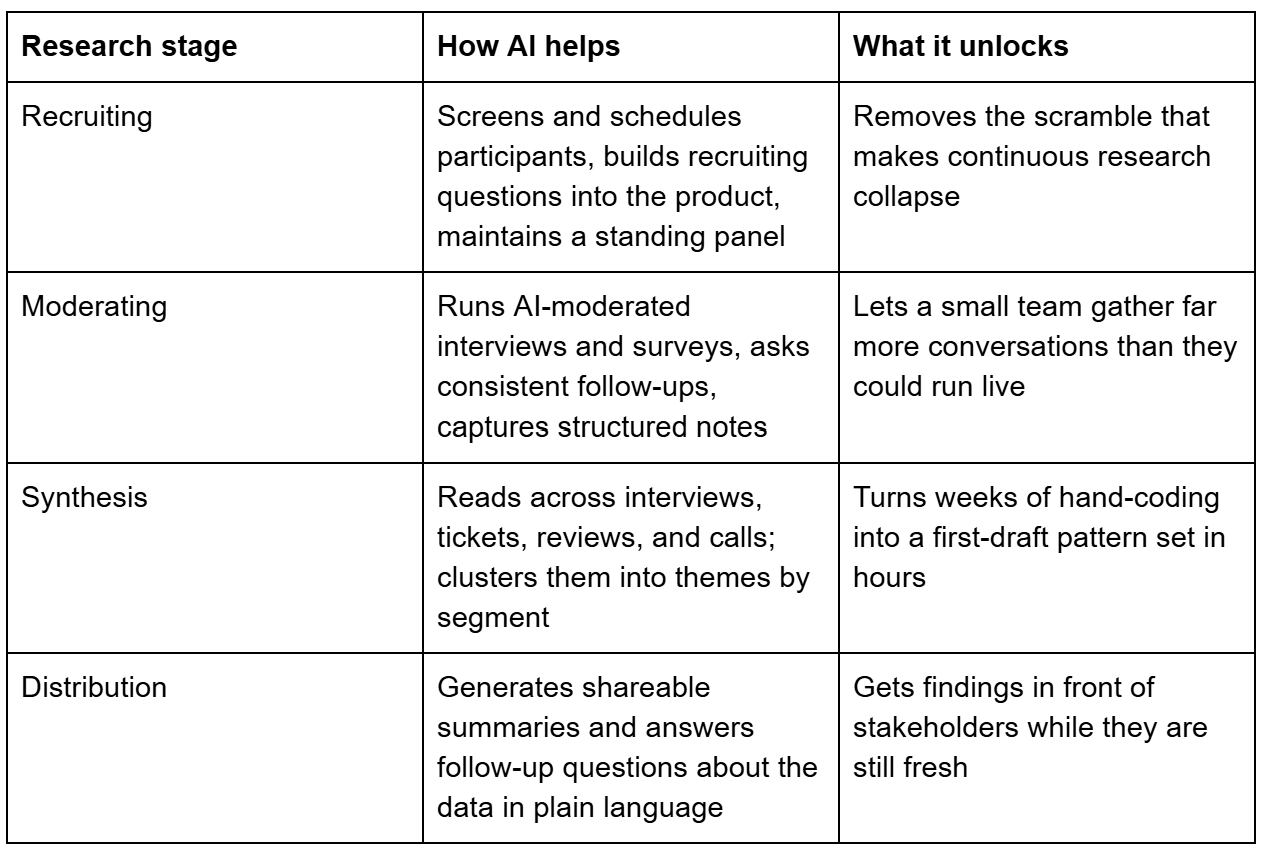
Notice that none of these stages is "decide what to build." AI accelerates the gathering and the first pass at sense-making. The interpretation, the judgment about which pattern matters and what to do about it, stays human, which is the subject of the next section.
Where should AI help, and where should humans stay in charge?
AI should own the work that scales with volume, and humans should own the work that requires judgment. Put plainly: let AI handle recruiting logistics, moderation at scale, and the first pass of pattern-finding, and keep humans in charge of interpretation, context, prioritization, and the decision about what the research means for the product. The division is not about distrust of AI, it is about playing each to its strength.
This matters because the part AI cannot do is the part that creates value. Melissa Perri has made the point sharply with data from her Product Institute's State of AI in Product 2026 research: engineering teams got dramatically faster with AI, yet in most teams the decision about what to build moves at the same speed it did three years ago (Melissa Perri). Generating output got cheap. Deciding what is worth building did not, because that still depends on human judgment about context, trade-offs, and what a finding actually implies. UX research sits right at that seam. AI can tell you that forty users mentioned friction at checkout; only a person can weigh whether that friction is the real problem or a symptom of something deeper, and whether it is worth solving now.
A simple way to hold the line:
- Give AI the scale work. Recruiting, scheduling, moderating routine sessions, transcribing, and producing a first-draft synthesis across a large corpus. This is where speed compounds and the risk of error is low and checkable.
- Keep humans on the meaning work. Deciding which themes are signal versus noise, supplying the context AI lacks, reconciling contradictory findings, and connecting an insight to a product decision. This is where a wrong call is expensive and judgment is irreplaceable.
- Make the handoff explicit. Treat AI's output as a draft to interrogate, not an answer to accept. The researcher's job shifts from doing all the coding to auditing and reconciling what the AI surfaced.
Nielsen Norman Group makes a compatible case from the research-craft side: in their analysis of AI in research, they find it most useful in the planning and analysis stages but argue it should assist rather than lead, because the interpretation that turns observations into trustworthy findings still depends on human rigor (NN/g, Accelerating Research with AI). The teams that win with AI are not the ones that hand over judgment. They are the ones that use AI to buy back the time to judge well.
How do you use AI for synthesis without losing trust?
You keep AI synthesis trustworthy by insisting on traceability: every theme, every claim, every summary the AI produces should link back to the specific source it came from, so a person can verify it rather than take it on faith. The moment an insight floats free of its evidence, it becomes a confident assertion you cannot check, which is precisely the failure mode buyers have learned to distrust.
This is the difference between AI that earns trust and AI that erodes it. A tool that tells you "users find onboarding confusing" is making a claim. A tool that tells you "users find onboarding confusing" and links each instance to the exact interview moment and quote behind it is showing its work. The first you have to believe; the second you can audit. In a research context, where a wrong synthesis can send a roadmap in the wrong direction, that auditability is not a nicety, it is the whole basis of trust.
Traceability also fixes a quieter problem: scattered evidence. ProductPlan's 2026 research found that 40% of teams say their strategy, discovery, roadmap, and launch plans live across multiple tools with limited or no integration (State of Product Management 2026). When the interview lives in one tool, the synthesis in another, and the roadmap in a third, the chain from a customer's words to a product decision snaps, and so does anyone's ability to verify why a decision was made. The same report notes that confidence in measuring business impact averages just 3 out of 5, a gap that untraceable insights only widen. Keeping evidence connected is what lets a team trust its own conclusions.
This is the gap ProductPlan is built to close, and it is worth being concrete about how. In January 2026, ProductPlan acquired Winware.ai, an AI-native customer and market research platform built from the ground up with agentic and generative AI, and made it the intelligence layer of its Product Intelligence Platform. With Winware AI, teams can run continuous, high-quality research and have interviews, tickets, sales calls, and reviews distilled into clear, themed patterns by segment, with each pattern still tied to the first-party voice-of-customer evidence behind it, and carried straight into prioritization on the roadmap. The point is not the automation for its own sake; it is that the synthesis stays connected to its sources and to the decision, so the thread from a customer's words to what gets built never breaks. That is what traceable, evidence-grounded synthesis looks like in practice, and it is the standard any AI research tool should be held to, ProductPlan's included.
What does traceable, evidence-grounded AI research look like?
Traceable AI research is research where you can follow any conclusion back to its origin in one step. A theme links to the quotes that formed it; a quote links to the interview it came from; the interview links to the participant and the question that prompted it. Nothing is asserted that cannot be traced, and nothing important is decided on evidence no one can locate.
In day-to-day practice, that discipline shows up as a few habits:
- Insist on citations from your tools. If an AI synthesis cannot show you the source behind a claim, treat the claim as unverified. The best tools make every insight clickable down to the quote.
- Preserve the raw alongside the summary. Keep transcripts and recordings connected to the synthesis, so a surprising finding can be checked against what was actually said, not just how the AI paraphrased it.
- Reconcile, do not just accept. When the AI surfaces a pattern, a human checks a sample of the underlying evidence before acting on it. This catches the confident-but-wrong summaries before they reach a decision.
- Carry the evidence into the decision. When a roadmap item is justified by research, keep the link to the supporting quotes attached, so the reasoning stays legible to stakeholders later.
This standard is not just a preference, it is what the evidence supports. A peer-reviewed comparison of AI and human thematic analysis found that AI matched a majority of the themes human analysts identified and ran in a fraction of the time, but that the coding agreement between AI and humans was only fair to moderate, leading the researchers to conclude that hybrid human-and-AI approaches are necessary (Journal of Medical Internet Research, 2024). In other words, AI gets you most of the way at remarkable speed, and the human is what closes the gap between "mostly right" and "trustworthy." Research-methods voices like MeasuringU have long held that a finding is only as good as the evidence you can produce for it, and AI does not change that standard, it just makes it easier to either honor or ignore at scale. Teams that build traceability in get AI's speed without surrendering the rigor that makes research worth trusting.
What are the risks of AI in research, and how do you manage them?
The main risks of AI in UX research are confident but shallow findings, lost nuance, and untraceable claims, and all three are managed the same way: by grounding insights in real, checkable evidence and keeping humans in charge of interpretation. The technology does not remove the need for judgment; it raises the stakes on having it.
Each risk has a practical countermeasure:
- Confident shallowness. AI will summarize fluently even when it is wrong, and fluency reads as authority. Manage it by spot-checking AI conclusions against source evidence before acting, so polish never substitutes for accuracy.
- Lost nuance. Clustering can flatten the outlier that mattered, the one user whose problem was the real opportunity. Manage it by keeping a human reading a sample of raw transcripts, not only the AI's themes.
- Untraceable claims. An insight with no visible source cannot be defended in a roadmap review or trusted in a decision. Manage it by requiring traceability as a hard standard, not a feature you sometimes use.
- Over-reliance. The most subtle risk is letting AI's speed pull the team back into a feature factory, shipping fast on thin understanding. Manage it by remembering that the goal is better decisions, not just faster summaries.
There is a timing reason to get this discipline right now. ProductPlan's 2026 research found that most teams are still in the early stages with AI, roughly 37% using it for limited workflows and about 32% still experimenting (State of Product Management 2026). The practice of pairing AI synthesis with human reconciliation is still being established, which means the teams that build the disciplined, traceable habit early have a genuine edge over those who either avoid AI or trust it blindly. The thinking from communities like Mind the Product points the same direction: their 2026 guidance urges teams to treat AI as a powerful but expensive raw material to be managed with discipline, not as a magic trick (Mind the Product).
It is worth being honest about where AI synthesis is the wrong tool, too. For a small, high-stakes study, five deep interviews about a sensitive workflow, a handful of conversations with your most strategic accounts, the volume that makes AI valuable simply is not there, and the nuance AI tends to flatten is the entire point. In those cases a researcher reading every transcript closely will out-perform any clustering algorithm, and reaching for AI adds risk without adding speed worth having. AI synthesis earns its place when scale is the bottleneck. When depth on a few conversations is the bottleneck, trust the human first.
Frequently asked questions
How can AI help with UX research?
AI can speed up participant recruiting, help moderate interviews and surveys, and synthesize large volumes of qualitative data into patterns, which lets small teams cover far more ground than manual analysis allows. Its biggest contribution is at the synthesis stage, where research has always bottlenecked.
Should AI replace UX researchers?
No. AI works best alongside researchers, handling scale and pattern-finding while humans provide the judgment, context, and decisions that give findings meaning. The researcher's role shifts from doing all the coding to auditing and reconciling what the AI surfaces.
How do you keep AI research trustworthy?
Keep every AI-generated insight traceable to its source, such as a specific customer quote, so claims can be verified rather than taken on faith. If a tool cannot show the evidence behind a conclusion, treat the conclusion as unverified.
What are the risks of using AI in UX research?
The main risks are confident but shallow findings, lost nuance, and untraceable claims. All are managed by grounding insights in real evidence, keeping a human reading a sample of the raw data, and requiring traceability as a hard standard.
Does AI make UX research faster or better?
Both, but only if used well. AI reliably makes research faster by removing manual bottlenecks. It makes research better only when paired with human judgment and traceable evidence, so the added speed produces sound decisions rather than confident guesses.
Use AI to amplify judgment, not replace it
The teams that get the most out of AI in UX research are not the ones that hand over the thinking. They are the ones that let AI do the work that scales, recruiting, moderating, and surfacing patterns, and reinvest the time they save into the judgment that AI cannot supply: deciding what the findings mean and what to do about them. The connective tissue that makes it trustworthy is traceability, every insight leading back to a real source you can check.
That is the standard ProductPlan is built around: with Winware AI as its intelligence layer, research stays connected to its evidence and carried straight into the roadmap, so speed never costs you trust. See how product teams turn AI-assisted research into decisions they can stand behind. Book a demo.
Related reading
- ProductPlan's State of Product Management report
- 9 Tips for Better Customer Validation Interviews
- Continuous Discovery in Product Management
Ready to build with confidence?


.svg)