
Intellectual Property in Product Development: What Your Team Needs to Know
When you're focused on hitting milestones and shipping features, intellectual property isn't usually top of mind. But underneath every line of code, UI design, and feature set sits your intellectual property (IP). For modern product teams—especially services firms packaging their expertise into software—protecting your IP isn't just a legal chore, but a core product discipline that secures the actual value of what you're building.
Side Note: This guide is educational and helps teams understand IP mechanics. It isn't legal advice and shouldn't replace qualified legal counsel.
Key Takeaways
- Intellectual property in product development covers the patents, copyrights, trademarks, and trade secrets that protect what a product team creates, along with the contracts that determine who owns it.
- The most important step for any team is clarifying ownership in writing before significant product work begins with employees, contractors, and partners alike.
- For services firms and consultancies now building their own software, legacy client contracts deserve careful attention to ensure you aren't accidentally reusing proprietary methods.
- AI-generated work adds a layer of uncertainty because under current U.S. law, works created without meaningful human authorship aren't eligible for copyright protection.
- While copyright attaches automatically upon creation, formal registration with the U.S. Copyright Office is required before you can actually file a lawsuit to enforce your rights.
What is intellectual property in product development?
Intellectual property (IP) in product development is the set of legal protections covering the original work your team creates, alongside the agreements that determine who owns and can use it.
The concept is straightforward: original creations have value, and the law protects that value by giving organizations exclusive rights over what they've made. For a product team, IP isn't just paperwork. It's a material asset—the code, design, brand, data, and knowledge embedded in your product—that can be licensed, sold, or lost if it's not properly documented and protected.
When does IP become urgent?
IP becomes urgent the moment there’s a breakdown in ownership, which threatens your product’s value—typically during an acquisition, a client dispute, or a contractor departure.
While many teams assume contracts can catch up later, these risks usually materialize when you least expect them.
For example, reality often hits when:
- A contractor who built a core module suddenly goes quiet.
- A client asks whether the tool your team built during an engagement belongs to them.
- A prospective acquirer asks for a clean IP chain of title, and the answer is far more complicated than you thought.
In 2026, these conversations are happening sooner and more often because of a massive shift in how companies build. A trend called Services-as-Software is exploding as consulting firms package repeatable expertise into software products, driving a convergence of services and products toward an estimated $1.5 trillion market.
Because of this rapid transition, more services businesses are suddenly launching products without established IP frameworks in place. Compounding the issue, generative AI tools are introducing complex questions about ownership and authorship that the law is still scrambling to sort out.
The four types of IP that matter most for product teams
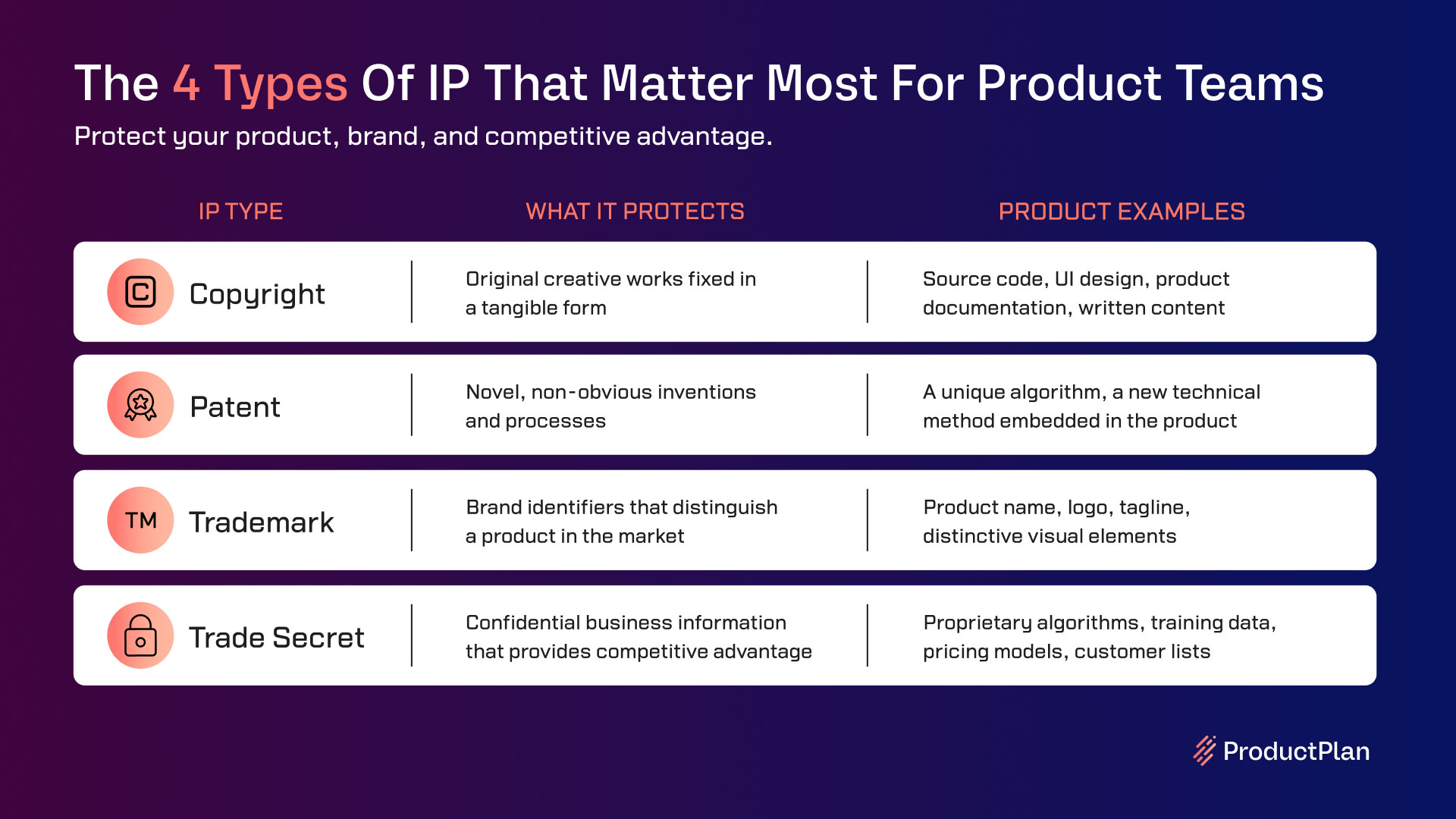
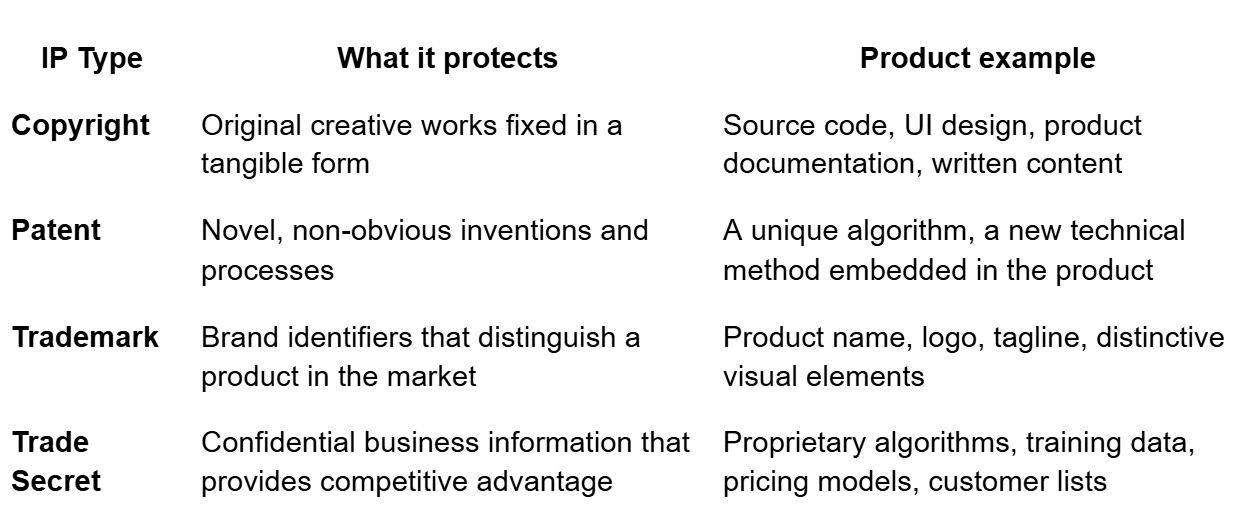
Not all intellectual property is the same. To protect your product effectively, you need to understand the four distinct mechanisms that safeguard software, branding, and proprietary systems:
Copyright: Your baseline software defense
Copyright is the most immediately relevant type for software teams because it attaches automatically the moment you create code, designs, or documentation.
You don't need a formal registration to be protected, though registering does strengthen your enforcement rights if you ever have to go to court. The critical detail to remember is that ownership defaults to the creator unless an agreement states otherwise.
Patents: High protection, high friction
Patents protect inventions and technical processes, but software patents must meet a very high bar for novelty and non-obviousness. These don't happen automatically; the pursuit is active, expensive, and time-consuming.
For most early-stage teams, it's usually wiser to rely on trade secrets while you evaluate if a formal patent application makes financial sense.
Trademarks: Protecting your brand equity
Trademarks secure your product’s identity in the market. You should clear and register your product name, logo, or tagline before you spend time and money building brand equity.
Finding out six months after launch that your name conflicts with an existing mark is both an expensive legal headache and a branding nightmare.
Trade Secrets: Protection through locking down data
Trade secrets protect proprietary algorithms, training data, or business processes indefinitely—but only if you take active, reasonable steps to keep them secret.
This means implementing strict non-disclosure agreements (NDAs), access controls, and internal security policies. The moment a trade secret leaks publicly, even by accident, its legal protection vanishes.
Who owns the IP your team creates?
Ownership is where most product IP problems actually begin. It depends almost entirely on the written agreements you have in place, not on who actually sat down and did the work.
Here’s the breakdown of ownership over IP:
Employees: The baseline default
In most jurisdictions, work created by an employee within the scope of their job is automatically owned by the employer. In U.S. copyright law, this is called the "work-made-for-hire" doctrine.
While standard employment agreements usually include explicit IP assignment clauses, you should still audit your contracts. If your existing agreements don't explicitly address product IP ownership, updating them is an immediate priority.
Contractors and freelancers: The danger zone
This is where the most common ownership surprises happen. Unlike employees, contractors retain ownership of the work they create unless a written agreement explicitly transfers it to you.
Additionally, a contract that states a contractor "will assign" ownership later isn't the same as an agreement that executes a present assignment of rights. U.S. courts have strictly enforced this distinction, leaving some companies without the legal rights to code they fully paid for. Therefore, your contracts must state clearly that all work product is assigned to your organization automatically upon creation.
Partners: Navigating co-development
When two organizations build something together, figuring out who owns the resulting IP, who can license it, and what happens if the relationship ends gets messy fast.
Never try to untangle shared IP after the fact. Sign a joint development agreement that clearly answers these questions before the first line of code is written.
Open source components: Hidden dependencies
Almost every software product relies on open source libraries. Each of these components carries its own license with distinct rules about how it can be used, modified, and shared.
Crucially, some "copyleft" licenses require any software built on top of them to be made open source too. Run a basic open source license audit before a commercial launch or an acquisition talk to ensure you aren't accidentally compromising your proprietary code.
How AI-generated work affects IP ownership in 2026
Most product teams aren't asking the right questions about AI and IP yet. Here's the plain reality: under current U.S. law, copyright requires a human author.
In early 2026, the U.S. Supreme Court declined to hear a challenge to lower court rulings on this issue, cementing the standard that works generated entirely by AI without meaningful human authorship aren't eligible for copyright protection.
If your team uses AI tools to generate code, UI designs, or copy, this creates a massive commercial vulnerability: if the output can't be copyrighted, competitors can legally copy it. Furthermore, because AI can't sign a contract, the traditional "work-made-for-hire" protection doesn't apply. The USPTO has applied this same logic to patents, ruling that any patentable concept must be tied directly to a human inventor.
The Risk: If your core product features or assets are generated entirely by AI, you may not actually own them under copyright law, leaving you with zero legal recourse if a competitor duplicates them.
Best practices for protecting AI-assisted product work
To protect what you build using AI tools, implement these guardrails immediately:
- Document human involvement: Track how your engineering and design teams prompt, select, edit, and structurally shape AI outputs. The more a human directs the final expression, the stronger your case for copyright protection.
- Review enterprise vendor terms: Read the fine print in your enterprise AI contracts. Vendor terms vary wildly regarding who owns the input data and the resulting output.
- Rely on trade secrets: If copyright eligibility for a proprietary AI-generated algorithm or model is uncertain, secure it as a trade secret instead. Keep the underlying logic confidential and strictly control internal access.
The legal landscape is shifting fast. Working with qualified counsel to evaluate your specific AI usage isn't an option—it's a requirement.
Which services should firms clarify before building a product?
For professional services firms, agencies, and consultancies launching their first software product, the biggest IP risks usually sit in blind spots the team isn't even looking at.
Here’s how to clarify those services to avoid any blind spots:
Client contracts from past delivery work
If your software product incorporates methods, frameworks, or code originally developed during a client project, check those old contracts. Many professional services agreements grant the client broad ownership rights over everything created during the engagement.
Before reusing any of that work in a commercial product, review those past agreements with legal counsel.
The firm’s own accumulated assets
A consulting or services firm often has more protectable IP than it realizes. Over years of client work, you've likely developed proprietary frameworks, methodologies, benchmarks, scoring models, and unique datasets.
Take a formal inventory of what your firm already owns so you know what can be safely packaged into a scalable software asset.
Legacy employment agreements
If your existing team is building the new software, look closely at their employment agreements. Contracts written for a service delivery role often don't properly cover IP assignment in a commercial product development context.
The same applies to new contractors brought on to build the app—their agreements need explicit, bulletproof IP assignment language.
Product positioning vs. custom solutions
Positioning expert April Dunford highlights a classic trap for services firms transitioning to product: the instinct is to build a tool that solves the specific problem your last client had, rather than a broad problem the market faces.
That same distinction applies to your legal strategy. What you're building, who it's for, and how it's differentiated directly dictate what's worth legally protecting.
What to clarify before significant product work begins: a practical checklist
You don't need a massive legal team to protect your product, but you do need to establish clear organizational habits early. Addressing a few foundational questions before you write significant code protects your asset value and prevents costly cleanups later.
Work through this practical checklist with your counsel as you plan your development cycles:
- Employment agreements: Do existing agreements include clear IP assignment language covering work created in a product context? Have they been updated recently?
- Contractor agreements: Does every contractor working on the product have a signed agreement with an explicit, present assignment of IP? Has counsel confirmed the language is effective?
- Open source audit: Do you have a current list of open source dependencies and their licenses? Has someone reviewed whether any license terms affect your commercial use?
- Client contract review: If any product work draws on methods or materials from past client engagements, have those client contracts been reviewed for IP implications?
- AI use documentation: Does your team have an internal policy covering AI tools used in product development? Are you documenting human contribution in AI-assisted work?
- Brand clearance: Has the product name been cleared for trademark conflicts in the jurisdictions where you plan to operate?
- Trade secret controls: Is confidential product information protected by appropriate NDAs, access controls, and internal policies?
Pro Tip: Before auditing your IP, make sure you’re building the right things by prioritizing features that actually scale.
None of this requires a large legal budget at the outset. A few hours with a qualified IP attorney early in the product development process is far less expensive than trying to clean up ownership questions when a deal or a dispute makes them urgent.
Why product intellectual property requires product discipline
IP health and product discipline are deeply connected. The same rigor that makes a roadmap defensible—traceable decisions, clear documentation, and explicit ownership—is exactly what keeps your IP clean.
Maintaining a clear record of what you built, when, and on what evidence gives your team an undisputed audit trail when an acquirer, client, or lawyer asks hard questions.
Interestingly enough, ProductPlan's 2026 State of Product Management report found that 40% of teams leave their strategy, discovery, and roadmaps scattered across disconnected tools. For services firms building software for the first time, this fragmentation easily leaks into the legal layer—contracts live in one place, product decisions in another, and AI usage goes undocumented.
Building your product discipline and your IP framework at the exact same time is not only the safer route, but it’s also the most efficient path to scaling.
Be deliberate when safeguarding your product intellectual property
The teams with the cleanest IP stories aren't the ones that never faced hard questions. They're the ones that asked those questions early, documented the answers, and treated their product's legal foundation with the same care they gave their features.
If your firm is transitioning from service delivery to a productized model, launching an internal tool, or starting a fresh SaaS offering, the best time to lock down your IP layer is before your first feature ships.
ProductPlan helps teams build the roadmap discipline that makes these conversations easier with clear, centralized documentation of what you're building, why, and on what evidence. Book a demo to see how product-led teams structure the work that protects what they build.
Frequently asked questions about IP in product development
Does registering software copyright actually matter if protection is automatic?
Yes. While copyright attaches automatically upon creation, formal registration with the U.S. Copyright Office is required before you can file a lawsuit to enforce your rights.
Registering your code within three months of publication also qualifies you for statutory damages and attorney’s fees, making a lawsuit financially viable if a competitor steals your code.
Can an NDA fully protect my software before I get a patent or trademark?
An NDA only protects your trade secrets—the confidential information shared between specific parties who signed the contract. It cannot prevent a third party who has never signed an agreement with you from independently inventing a similar process or using a similar brand name.
How often should a product team audit its open source dependencies?
You should integrate automated license scanning directly into your continuous integration (CI/CD) deployment pipeline. This ensures that every time a developer introduces a new library, the system automatically flags restrictive "copyleft" licenses before the code ever hits production or an acquisition audit.
What happens to our IP if a contractor refuses to sign an assignment agreement after the work is done?
If a contractor refuses to sign after the fact, they legally own the copyright to that code, even if you paid them in full. Your only default legal right is an implied license to use that specific code within your business, but you cannot stop them from selling it to competitors, and you cannot sell or transfer the IP during an acquisition.
External sources cited
- ProductPlan, 2026 State of Product Management Report
- HFS Research, Services-as-Software
- WIPO, World Intangible Investment Highlights 2025
- U.S. Copyright Office, Copyright and Artificial Intelligence, Part 2: Copyrightability (Jan 2025)
- U.S. Supreme Court, Thaler v. Perlmutter, No. 25-449, cert. denied (Mar. 2, 2026) , affirming that works without human authorship aren't eligible for copyright under current U.S. law.
- Willcox Savage, "Use the Magic Words" (Dec 2025)
- ClarkeModet, "Six IP Trends That Will Shape How Companies Protect Innovation in 2026" (Jan 2026) , AI and intangible-asset trends.
- April Dunford , positioning discipline for services-to-product transitions. (Link a specific Dunford piece if citing a particular claim; her book/blog is at aprildunford.com.)
Ready to build with confidence?


.svg)