
How to Ensure Compliance in Digital Banking Software Development Without Losing Velocity

Ship fast enough to stay competitive, but never be the team that introduces regulatory exposure. That is the bind product leaders at regional banks, credit unions, and fintechs are managing this year, and the two halves of it feel like they pull in opposite directions. In 2026 both have intensified. AI is now embedded somewhere in nearly every financial institution, the scrutiny on what each release returns is sharp, and when an AI-driven system goes wrong, supervisors increasingly look to the regulated institution itself to answer for it rather than its vendor or its model.
The good news is that speed and compliance are not actually opposites. The teams that move fastest in regulated banking are the ones that build regulatory, security, and audit requirements into the product lifecycle from discovery onward, so those requirements shape the work instead of blocking it at the end. This guide lays out what compliance means in digital banking software development, why the tension feels real, where to place your checkpoints across the lifecycle, and how to keep an audit trail without slowing your team down.
Key Takeaways
- Compliance in digital banking software development means building regulatory, security, and audit requirements into the product lifecycle from discovery onward, so they accelerate delivery rather than gate it at the end.
- The fastest compliant teams treat requirements as design inputs, not late-stage reviews, because catching a control gap during discovery costs a fraction of catching it in pre-release sign-off.
- Evidence and traceability are the connective tissue: when every decision links to a documented rationale, audits get faster and escalations get rarer.
- In ProductPlan's 2026 State of Product Management report, over 60% of teams said leadership escalations or new directives are the top reason priorities change, a pattern that compliance ambiguity makes worse.
- A single connected view of strategy, signal, and roadmap reduces the rework that quietly destroys velocity in regulated environments.
What does compliance mean in digital banking software development?
Compliance in digital banking software development is the practice of building regulatory, security, and audit requirements into every stage of the product lifecycle, so the software meets standards like data protection, financial regulation, and auditability by design rather than by late inspection. It spans the rules you must follow, the security controls that enforce them, and the evidence that proves you did.
In practice that covers a wide surface: data privacy and protection obligations, anti-money-laundering and know-your-customer requirements, consumer protection and fair-lending rules, model governance for any AI in the decision path, and the security controls that underpin all of it. What unites them is that each one is verifiable. A regulator or auditor can ask you to show that a control existed, that a decision had a rationale, and that the evidence was captured at the time, not reconstructed afterward.
The shift that separates fast teams from slow ones is treating these as design inputs. When a privacy obligation or an audit requirement enters the conversation during discovery, it becomes one more constraint the solution is shaped around, the same way you would treat a performance target or a platform limitation. When it arrives at the end as a review gate, it becomes a source of rework, and rework is where velocity goes to die.
Why do compliance and velocity feel like opposites, and how do strong teams reconcile them?
They feel like opposites because most teams experience compliance as a late gate rather than an early input. When requirements surface only at a pre-release review, the team has already committed to a design, so every gap means rework under deadline pressure. Strong teams dissolve the tension by moving the requirements forward, so compliance shapes the work while it is still cheap to change.
The 2026 environment has sharpened the bind in a specific way. AI has made it possible to generate working code faster than ever, and that same speed is precisely what makes traditional, manual review harder to rely on. Research from the Cambridge Centre for Alternative Finance found that in software engineering, the volume and velocity of AI-generated code increasingly outpaces what manual review can catch, even as software engineering has become the financial industry's most mature AI application (Cambridge Centre for Alternative Finance, 2026). The same report notes a governance gap behind the speed, with many institutions running AI in isolated pilots without the oversight to match. Faster building without stronger discipline does not create velocity. It creates risk that surfaces later, at the worst possible moment.
This is where the product leader's instinct matters. Rich Mironov tells a story that lands hard in this context: a team skipped discovery on a patient-record integration, delivered exactly what was asked for exactly on time, and then watched Compliance shut it down because it was not HIPAA compliant and relied on an outdated API, when a few weeks of digging in beforehand would have caught it (Rich Mironov). Swap healthcare for banking and the lesson is identical: in regulated software, delivering the requested thing on time is not the same as delivering the right thing, and the gap is where the expensive failures live. The teams that internalize compliance as part of good product work, rather than an external tax, are the ones that hold speed and safety at once.
Where should compliance checkpoints live across the product lifecycle?
Compliance checkpoints should be distributed across the lifecycle, with the heaviest lifting front-loaded into discovery and design, where changes are cheapest, and lighter verification at each later stage. The goal is a series of small, routine checks rather than one large gate before release. The table below maps where each belongs.
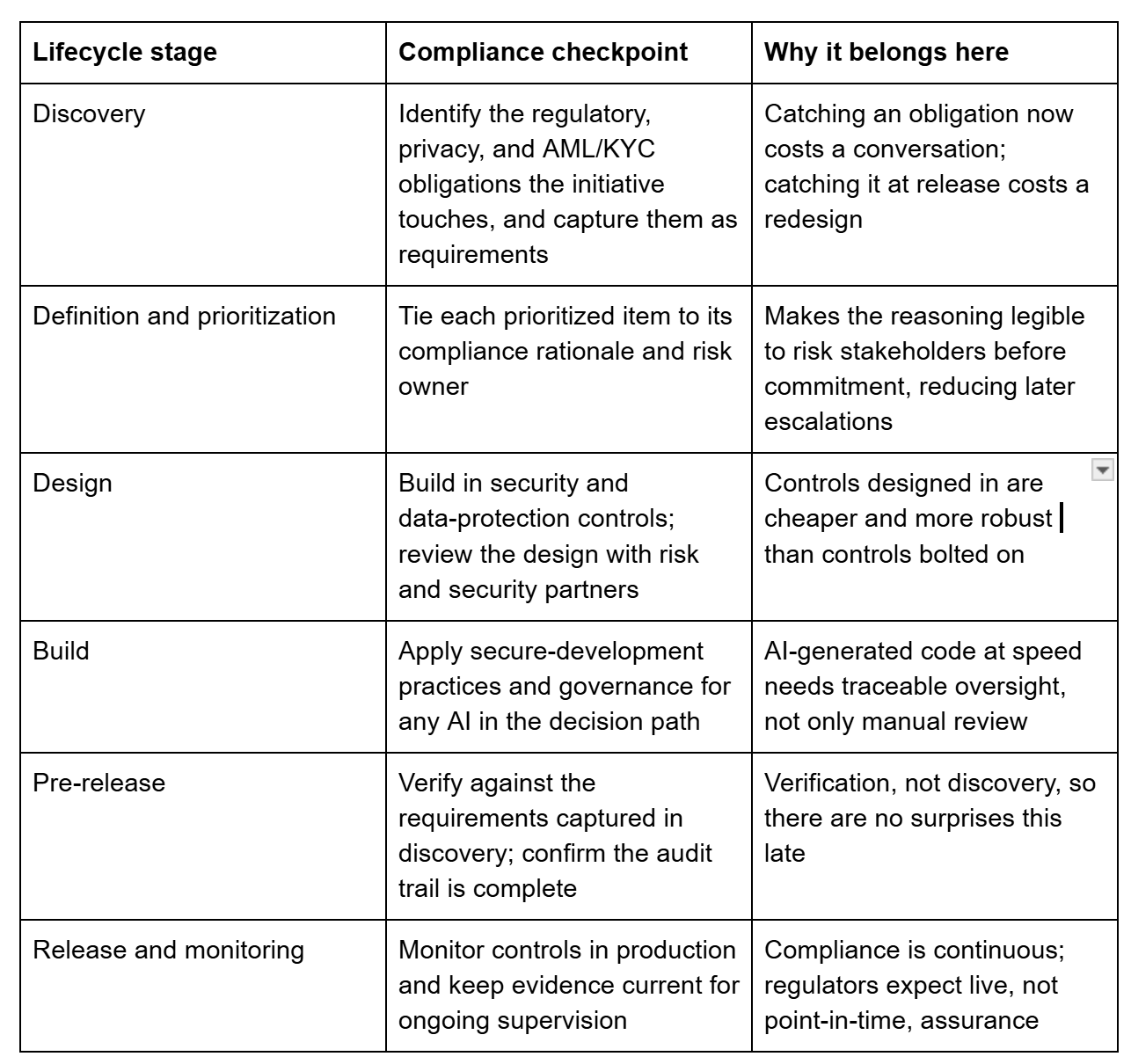
The pattern to notice is that the pre-release checkpoint is verification, not discovery. If a requirement first appears there, your checkpoints upstream were too light. A well-distributed set of checks turns the final review from a nail-biting gate into a quick confirmation.
How do you keep an audit trail without slowing the team?
You keep a lightweight audit trail by capturing the rationale for each decision at the moment you make it, in the same flow where the work happens, rather than reconstructing it later for an audit. The trick is to make documentation a byproduct of deciding, not a separate task, so traceability builds itself as the team works.
This matters more than it sounds, because traceability is the first thing to break when reasoning is scattered. ProductPlan's 2026 research found that 40% of teams say their strategy, discovery, roadmap, and launch plans live across multiple tools with limited or no integration, and only about 22% keep these in one primary system (State of Product Management 2026). When the reasoning behind a decision lives in one tool, the requirement in another, and the roadmap in a third, an auditor's simple question, why did you build it this way, turns into a week of archaeology. As our own report puts it, when reasoning is distributed across disconnected systems, traceability weakens, and when traceability weakens, judgment starts to look like guesswork even when it was not.
A few practices keep the trail light:
- Record the decision and its rationale together, in one place, when the decision is made. A short, structured note beats a perfect document written after the fact.
- Link each decision to the evidence behind it, the customer signal, the risk assessment, the requirement, so the chain is already assembled if anyone asks.
- Keep strategy, signal, and roadmap connected, so the audit trail is a view of how you already work rather than a parallel artifact you maintain for compliance.
What role does customer and stakeholder evidence play in compliant prioritization?
Evidence makes prioritization defensible. When a decision to build, defer, or change something traces back to documented customer and risk evidence, audits move faster and stakeholders escalate less, because the reasoning is already legible. In a regulated environment, "we prioritized this because the data and the risk assessment pointed here" is a far stronger position than "we prioritized this because leadership asked."
That distinction is not hypothetical. In ProductPlan's 2026 research, over 60% of teams cited leadership escalations or new directives as the main reason their priorities change frequently (State of Product Management 2026). In banking, that churn is especially costly, because every reprioritization can ripple into compliance scope, and undocumented changes are exactly what auditors flag. The same research found that 49% of teams name resource and capacity constraints as the top cause of roadmap misalignment, which means most banking product teams are trying to hold compliance and velocity together with less slack than they would like. Evidence-led prioritization is how lean teams protect both: it reduces the escalations that scramble the roadmap, and it produces the documentation an audit needs as a side effect of deciding well.
This is the point where a connected system earns its place. When customer signal, risk rationale, and the roadmap live in one view, prioritization decisions arrive with their evidence attached. ProductPlan, as a Product Intelligence Platform, is built to keep that thread intact, so the reasoning behind a banking roadmap stays legible to product, risk, and executive stakeholders alike, and the audit trail is simply a record of how the team already decided.
What common mistakes create compliance risk, and how do you avoid them?
The most common mistakes share a root cause: treating compliance as a phase rather than a property of how the team works. Each one is avoidable with a small change in where and how the work happens.
- Bolting compliance on at the end. Late gates guarantee rework. Move obligations into discovery so they shape the design while change is still cheap.
- Letting AI speed outrun governance. Generating code fast without traceable oversight is how weak governance hides until an audit. Pair AI-assisted building with documented review of anything in the decision path.
- Scattering the reasoning. When rationale lives across disconnected tools, traceability breaks and audits stall. Keep decisions, evidence, and roadmap connected.
- Prioritizing by escalation. Reacting to whoever shouts loudest produces undocumented changes that auditors flag. Anchor prioritization in evidence so the reasoning is recorded by default.
- Treating monitoring as optional. Compliance does not end at release. Keep controls and evidence live, because supervision is continuous.
Frequently asked questions
What is compliance in digital banking software development?
It is the practice of building regulatory, security, and audit requirements into every stage of the product lifecycle, so software meets standards like data protection and financial regulation by design rather than by late inspection. It covers the rules you must follow, the controls that enforce them, and the evidence that proves you did.
Can you move fast and stay compliant in banking?
Yes. When requirements are treated as early design inputs and decisions are documented as you go, compliance becomes part of the workflow rather than a gate, which protects both speed and safety. The teams that struggle are the ones that discover requirements at the end, when change is most expensive.
What slows banking product teams down most?
Rework caused by unclear requirements and shifting priorities, often triggered by late-stage escalations, is the most common drag on velocity. Front-loading compliance requirements and anchoring prioritization in documented evidence both reduce that rework.
How does evidence help with compliance?
When prioritization decisions trace back to documented customer and risk evidence, audits move faster and stakeholders escalate less, because the reasoning is already legible. Evidence turns "leadership asked" into "the data and risk assessment pointed here," which is a far stronger audit position.
Where should compliance checkpoints sit in the lifecycle?
Distribute them across the lifecycle, with the heaviest work front-loaded into discovery and design where changes are cheapest, and lighter verification at each later stage. The pre-release checkpoint should confirm requirements captured earlier, not discover new ones.
Build compliance in, and keep your velocity
The banks and fintechs that win in 2026 will not be the ones that choose speed over safety or safety over speed. They will be the ones that stop treating the two as a trade-off, by building compliance into the product lifecycle from discovery onward and keeping the evidence connected as they go. Done that way, compliance stops being the thing that slows you down and becomes part of what lets you move quickly with confidence.
That is the work ProductPlan exists to make easier, keeping strategy, customer and risk signal, and your roadmap in one connected view, so every priority carries its rationale and every audit finds a trail already in place. See how banking product teams keep velocity and compliance together. Book a demo.
Related reading:
- ProductPlan's State of Product Management report
- The Ultimate Guide to Prioritization Frameworks
- 7 Strategies to Choose the Best Features for Your Product
Sources
- ProductPlan, 2026 State of Product Management Report
- Cambridge Centre for Alternative Finance, 2026 Global AI in Financial Services Report
- Rich Mironov, "Difficult Conversations"
Ready to build with confidence?


.svg)