
The Ultimate Guide to Customer Interviews
.jpg)
Key Takeaways
- A customer interview is a structured conversation designed to uncover a customer’s real needs, behaviors, and context, so product decisions rest on evidence rather than assumption.
- The best interviews explore past behavior and specific situations the customer has actually experienced. This distinction separates useful signal from polite noise.
- In ProductPlan’s 2026 State of Product Management research, customer impact is the top basis for prioritization at 58%, which means the quality of customer interviews directly shapes the quality of roadmap decisions.
- Patterns typically emerge after 5 to 12 interviews within a tightly defined segment, according to Nielsen Norman Group research. Consistent, smaller rounds of interviews often produce better signal than infrequent large studies.
- The value of interviews is realized in synthesis, when many conversations become a few clear opportunities that are traceable to the evidence behind them and connected to the roadmap decisions they inform.
When interviews get you nowhere
Most PMs have lived through this: six weeks of customer interviews, thirty pages of notes, a synthesis deck that never got past draft two, and a roadmap that looks exactly the same as it did before the research began.
This is the bottleneck that matters most in 2026. AI tools have made continuous customer contact more accessible than ever. Scheduling, transcription, and first-pass synthesis are faster and cheaper than they were two years ago. The constraint is no longer whether a team can run interviews. It’s whether those interviews produce insights that are clear enough to change what gets built.
This guide shows how to prepare, ask better questions, run the conversation, and turn interview patterns into roadmap decisions.
What is a customer interview?
A customer interview is a structured, one-on-one conversation designed to understand a customer’s real needs, behaviors, and context. Its purpose is to give the product team evidence rather than assumptions, so the team can learn what problems people are actually experiencing and how they are currently solving them before deciding what to build.
The word “structured” matters here. An informal chat with a user can be valuable, but it is not the same as an interview. An interview has a purpose, a prepared set of questions, a discipline around not leading the respondent, and a plan for capturing and synthesizing what you learn. That structure is what makes the output useful across more than one conversation.
Customer interviews are distinct from user testing, surveys, and NPS follow-up, though all of these methods can complement one another. User testing evaluates a specific design or interaction. Surveys collect broad patterns across many respondents. NPS follow-up captures sentiment about a specific experience. Customer interviews explore the context, behaviors, and needs that should inform what you design and prioritize in the first place.
Why customer interviews matter for roadmap decisions
Customer impact is the most common basis for roadmap prioritizations, cited by 58% of teams in ProductPlan’s 2026 State of Product Management report. Business value is second at 49%. That finding has a straightforward implication: if the team’s picture of customer impact is based on assumptions, escalations, and the loudest voices in the room rather than on direct evidence, the roadmap is built on a shaky foundation.
Customer interviews build that evidence base by showing:
- What customers are actually experiencing
- Which workarounds they have tried
- How much the problem matters in context
When a PM has heard the same friction point in customers’ own words across multiple interviews, the roadmap decision carries a different level of conviction than one based on a feature request list alone. That evidence also helps teams handle customer feature requests without turning every customer conversation into an implied commitment.
Over 60% of teams in ProductPlan’s 2026 research report that leadership escalations are the primary reason their priorities change. Interviews, rigorously conducted and synthesized, are one of the most effective tools for making roadmap decisions defensible when those escalations arrive.
How to prepare for a customer interview
Good interview output is largely determined before the conversation begins. Preparation is where most of the quality is made.
Define the outcome you are trying to drive
Teresa Torres, author of Continuous Discovery Habits, recommends that product teams start every round of discovery by identifying the specific business outcome they are trying to move, not just the topic they want to explore. As she frames it, customer needs are infinite, but the outcome tells the team which needs to focus on.
An interview designed to understand “how customers manage X workflow” will generate a very different, and usually more actionable, set of insights than an interview designed to understand “what prevents customers from expanding their usage,” even if the conversations touch similar ground.
Target the right interviewees
Defining the outcome also shapes who you recruit and what you ask. If the outcome is activation, interview recent signups who did and did not convert. If the outcome is expansion, interview power users and team administrators.
Talking to the wrong customer can produce confident-sounding evidence that points in the wrong direction. Before scheduling, define the profile of the person who is experiencing the problem you are investigating. Then invite customers who match that profile, rather than relying only on whoever is available or whoever responded to a general outreach.
Make scheduling easy and immediate
A consistent interview habit is easier to maintain when scheduling doesn’t depend on manual one-off outreach every time. Torres recommends automating the recruiting process so that interviews appear on the calendar without the PM having to arrange each one manually.
The tactical version is an always-on opt-in mechanism, such as a brief invite embedded in the product, in onboarding flows, or in a post-interaction follow-up. For B2B products, short asks of 20 to 30 minutes usually work better than broad, open-ended requests.
One scheduling principle from Torres is worth internalizing: the further out you schedule an interview, the more no-shows you get. Schedule for later today or tomorrow wherever possible, and confirm with a brief personal note that names who the customer will be speaking with and what to expect. Familiarity and specificity reduce no-show rates.
Set a focused agenda
A customer interview is not a freeform conversation, a product tour, or a feature preview. It is an inquiry into the customer’s world: their problems, behaviors, and context. The agenda should reflect that.
A useful structure for a 30-minute interview looks like this:
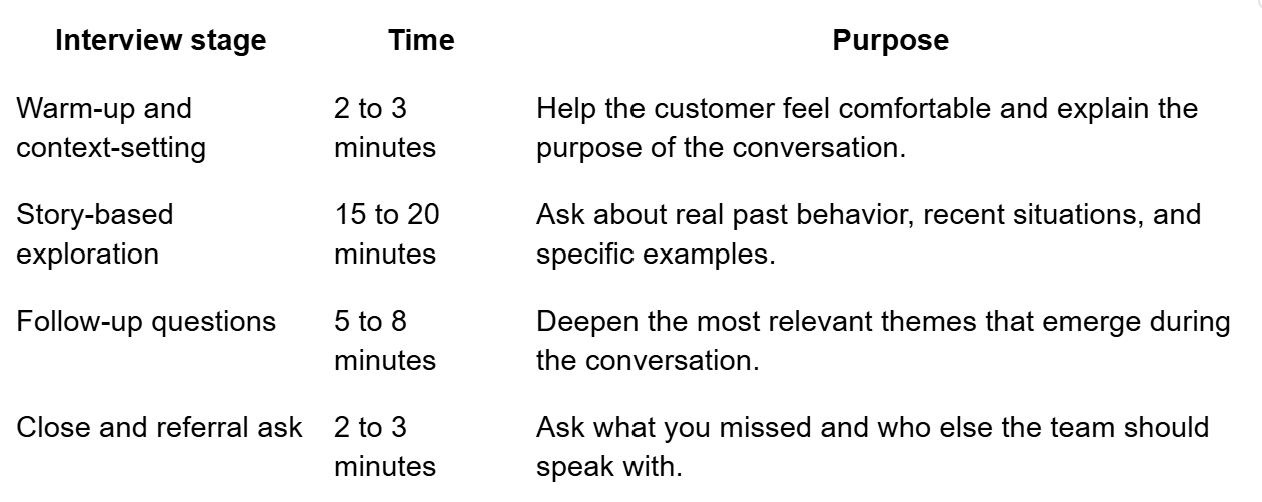
This structure also supports the story-based discovery habit Torres recommends: asking customers to walk through real situations in detail, then using follow-up questions to understand the context, consequences, and constraints around what happened.
Write your core questions in advance, but hold to them loosely. The goal is to follow the thread of what the customer says rather than march through a list. In other words, the agenda is a safety net, not a script.
What questions should you ask in a customer interview?
Customer interview questions often go wrong for understandable reasons. PMs are trained to think in solutions, so the default question is often “Would you use a feature that does X?” or “How useful would Y be to you?”
Those questions feel productive because they are about the product. However, they’re not truly productive because they ask the customer to predict their own future behavior, and that prediction is almost always unreliable.
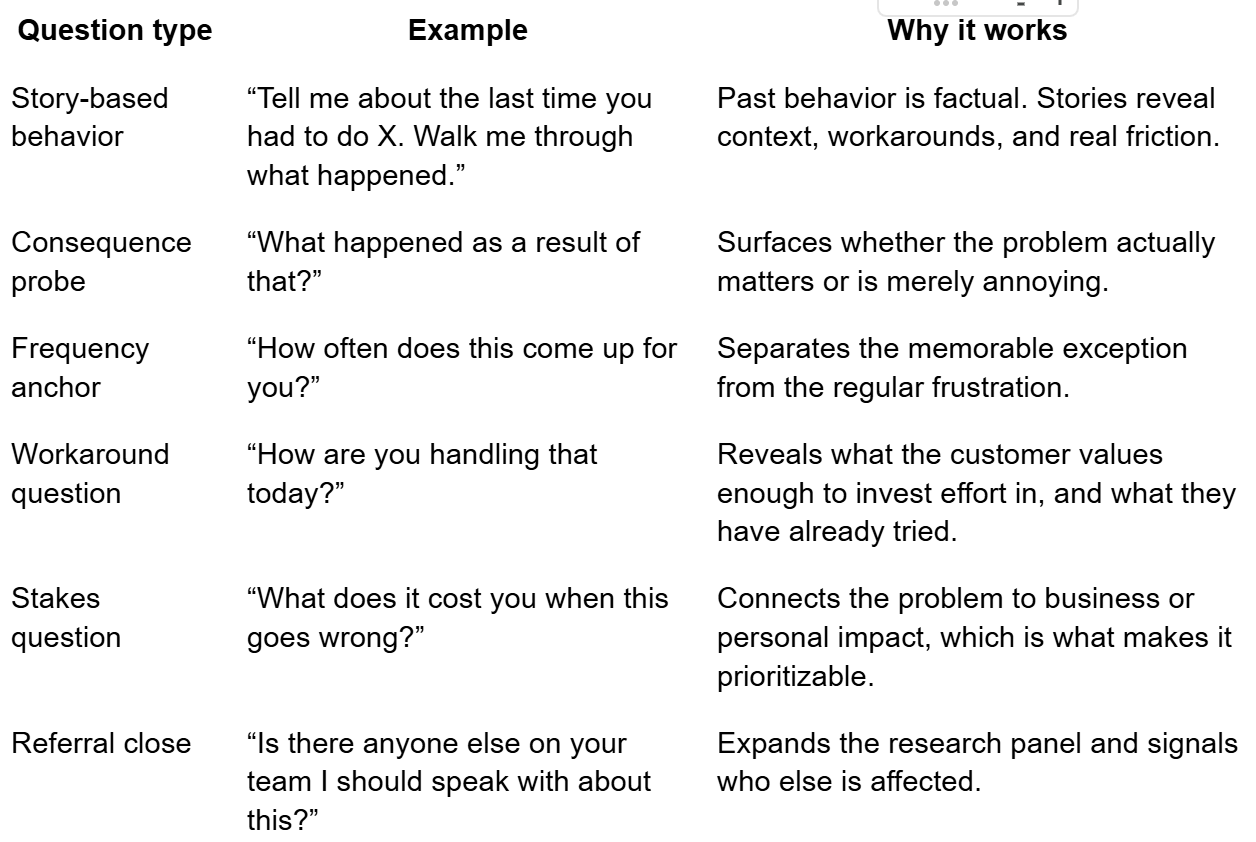
Rob Fitzpatrick, author of The Mom Test, names the central problem of customer interviews with precision: you shouldn’t ask anyone whether your business idea is a good idea, because people will usually try to be encouraging. It’s not the customer’s responsibility to tell you the truth. It’s your responsibility to find it. The solution is to ask about their life rather than your idea, and about what actually happened rather than what they think they would do.
The question types that produce real signal
The question types that generate unproductive noise
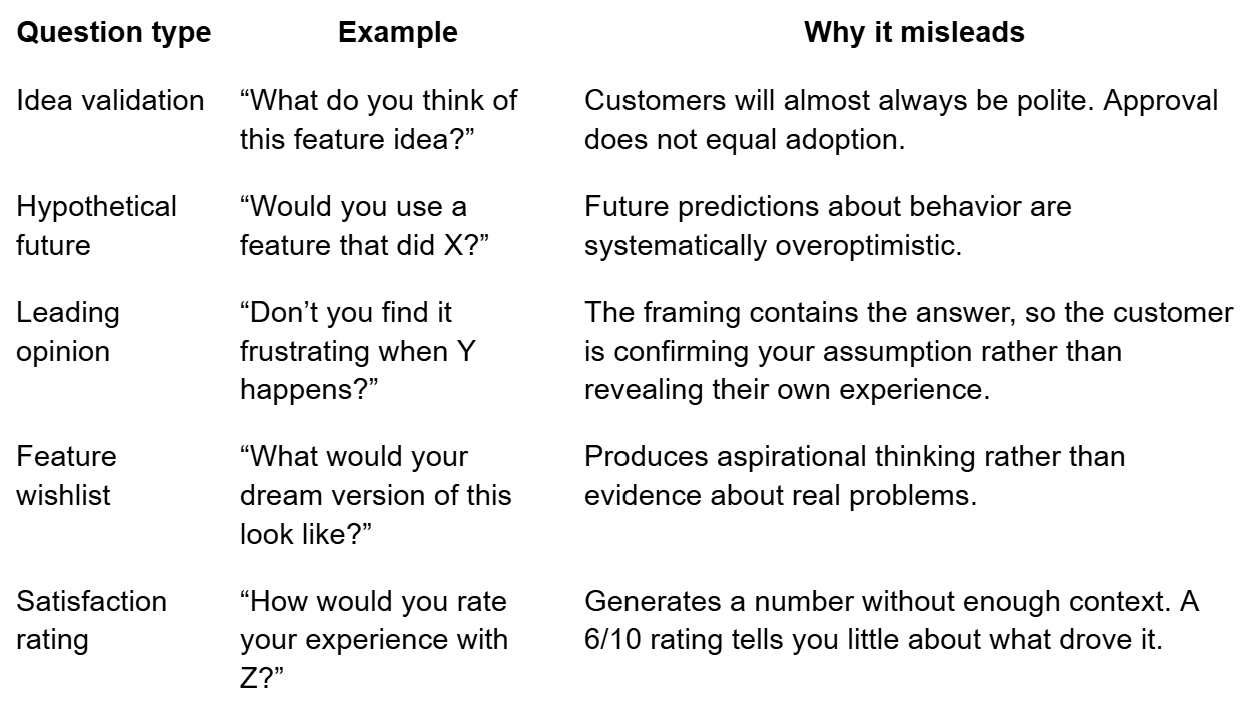
The clearest way to check a question before using it is what Fitzpatrick calls the Mom Test: if your mother could answer it without lying to protect your feelings, it is probably a good question. If she could only answer by agreeing with you, rewrite it.
Practical question starters for product teams
These opening questions reliably generate story-based responses:
- “Tell me about the last time you had to [accomplish a specific goal]. What happened?”
- “Walk me through your workflow when [a specific situation] comes up.”
- “When was the last time [a specific problem] caused you real trouble? What did you do?”
- “What did you try before the current solution? What made you switch?”
- “What part of [this workflow] takes the most time or causes the most frustration?”
- “What would have to be true for this to become a bigger problem for your team?”
How do you run the interview itself?
A strong interview depends on three habits: setting a clear frame, following the customer’s story, and closing in a way that improves the next round of research. The conversation should feel human and natural, but it still needs enough structure to keep the learning useful.
The opening: set the frame
The first two minutes of an interview determine whether the customer feels comfortable being honest. Open by explaining that you are not testing them. You are learning from them. Tell them there are no right or wrong answers and that the most useful thing they can do is be specific and honest, including about things that do not work well.
This framing matters because customers, especially satisfied ones, often feel an implicit pressure to be positive. Making it explicit that critical feedback is useful removes that pressure before the conversation begins.
The middle: follow the thread
Once the customer starts telling a story, your job is to go deeper into what they are saying rather than steer them toward the next prepared question.
A few habits help:
- Ask “why” or “what happened next” before moving on. The second and third layer of a story almost always contain more useful information than the first.
- Use silence. After a customer finishes a response, wait three to five seconds before speaking. People often fill silence, and what they say next can be more honest and specific.
- Avoid sharing your opinion or your product’s approach too early. The moment you describe what you are building, the customer shifts from describing their world to reacting to yours.
- Take notes on exact phrases and specific behaviors rather than interpretations. “The customer was frustrated about reporting” is your interpretation. “She said she spends two hours every Friday pulling numbers from three different places because there is no single view” is evidence.
The close: end with the referral
Before closing, ask two questions.
First, ask: “Is there anything about this topic that I should have asked and didn’t?” This often surfaces the most important thing in the interview, especially if the customer assumed you already knew it or was not sure it was relevant.
Second, ask: “Who else on your team or in your network deals with this? Can I reach out to them?” A well-run interview that ends with two referrals can improve research cadence without adding much recruitment effort.
How many customer interviews do you need?
For a tightly defined customer segment, it often takes six to twelve interviews to surface the most important themes. Broader segments, more diverse populations, or complex topics with high variability may require twenty to thirty interviews. The right number depends on how similar your participants are and whether new interviews are still producing new insight.
Use saturation as your guide
Saturation in an interview study is the point at which new conversations stop producing new themes, and according to Nielsen Norman Group it typically occurs later than teams expect. NN/g notes that five interviews, while useful, are usually not enough for exploratory research.
Earlier qualitative research from Greg Guest, Arwen Bunce, and Laura Johnson found that most core codes emerged within the first 12 interviews, with a large share appearing in the first six. That doesn’t mean every team can stop at six interviews. But it supports a practical pattern: tightly defined segments reach useful signal faster than broad, mixed populations.
Stop when interviews start confirming the same themes
The practical signal to watch is diminishing returns. When the last two or three interviews mostly confirm what you already heard rather than introduce new themes, you have likely reached saturation for that segment. That is the cue to synthesize and decide rather than schedule another round.
Treat continuous discovery differently
For teams following a continuous discovery cadence, the math is different. One interview per week, as Teresa Torres recommends, produces four to five interviews per month. That is enough to keep the team’s understanding current without any single round of research becoming a bottleneck.
How do you synthesize interviews into roadmap decisions?
Synthesis is a step many teams skip or treat as a summary exercise, but it is where most of the value either gets made or lost. The goal is to turn the interviews you already have into a clear map of recurring opportunities.
Move from notes to themes
Start by reviewing all interview notes for recurring patterns, including phrases, situations, and problems that appear across multiple conversations. The goal is to turn high volume, scattered customer signal into a clearer view of the opportunities worth pursuing, without letting the loudest or most recent comment dominate the roadmap.
Group related observations together into candidate themes, and give each theme a name that describes the underlying opportunity rather than the feature the customers mentioned.
For example:
- A theme is “Customers need faster access to usage data”
- A feature is “Build a dashboard”
Conflating the two produces roadmaps that solve the symptom rather than the underlying problem.
For each theme, note the evidence behind it: how many interviews mentioned it, which segments raised it, what the consequences were, and any specific quotes that make the pattern vivid.
The quotes are important. They make a synthesis compelling to stakeholders who were not in the room, and they keep the team honest when pressure to build something else arrives.
Connect themes to the opportunity solution tree
Teresa Torres’s Opportunity Solution Tree is a practical structure for connecting interview themes to product decisions. The tree serves as a map of:
Desired outcome → relevant opportunities → potential solutions
In practice, that means starting with the business metric the team is trying to move. From there, the team identifies the customer needs, problems, or desires revealed in interviews. Only then does it explore the features or experiments that might address those opportunities.
This structure makes the chain of reasoning explicit. It also prevents a common failure mode: jumping from a compelling customer story directly to a specific feature without considering whether there are other opportunities with higher potential impact or multiple ways to address the same opportunity. Once those opportunities are clear, teams still need a consistent way to choose the best features from the possible solutions in front of them.
Trace decisions back to evidence
For every theme that earns a place on the roadmap, there should be a traceable chain from the decision back to the customer evidence that supports it. That chain should make three things clear:
- Which customers raised the problem
- What they said, specifically
- How the problem connects to the outcome the team is trying to drive
Use evidence to make priorities defensible
Traceability is what makes a roadmap defensible when leadership asks why something is prioritized. It also keeps the team honest when a new escalation arrives that seems more urgent. If the evidence for the existing priority is strong and current, the new escalation can be evaluated against the same standard rather than winning by default.
Keep the evidence connected to the roadmap
ProductPlan’s 2026 research found that 40% of teams say strategy, discovery, and roadmaps live across disconnected tools. That is the structural condition that breaks traceability. When interview notes live in one system, synthesis happens in a spreadsheet, and the roadmap is built in a third tool, the chain from evidence to decision exists only in the PM’s memory.
A more consistent approach to managing and tracking feature requests helps teams preserve that chain as customer signal moves from interview notes into prioritization and planning.
ProductPlan and its Winware AI integration address this directly. Customer quotes and themes captured during synthesis connect to prioritization and roadmap decisions in a single system, so the reasoning behind every roadmap item is visible and current rather than reconstructed after the fact.
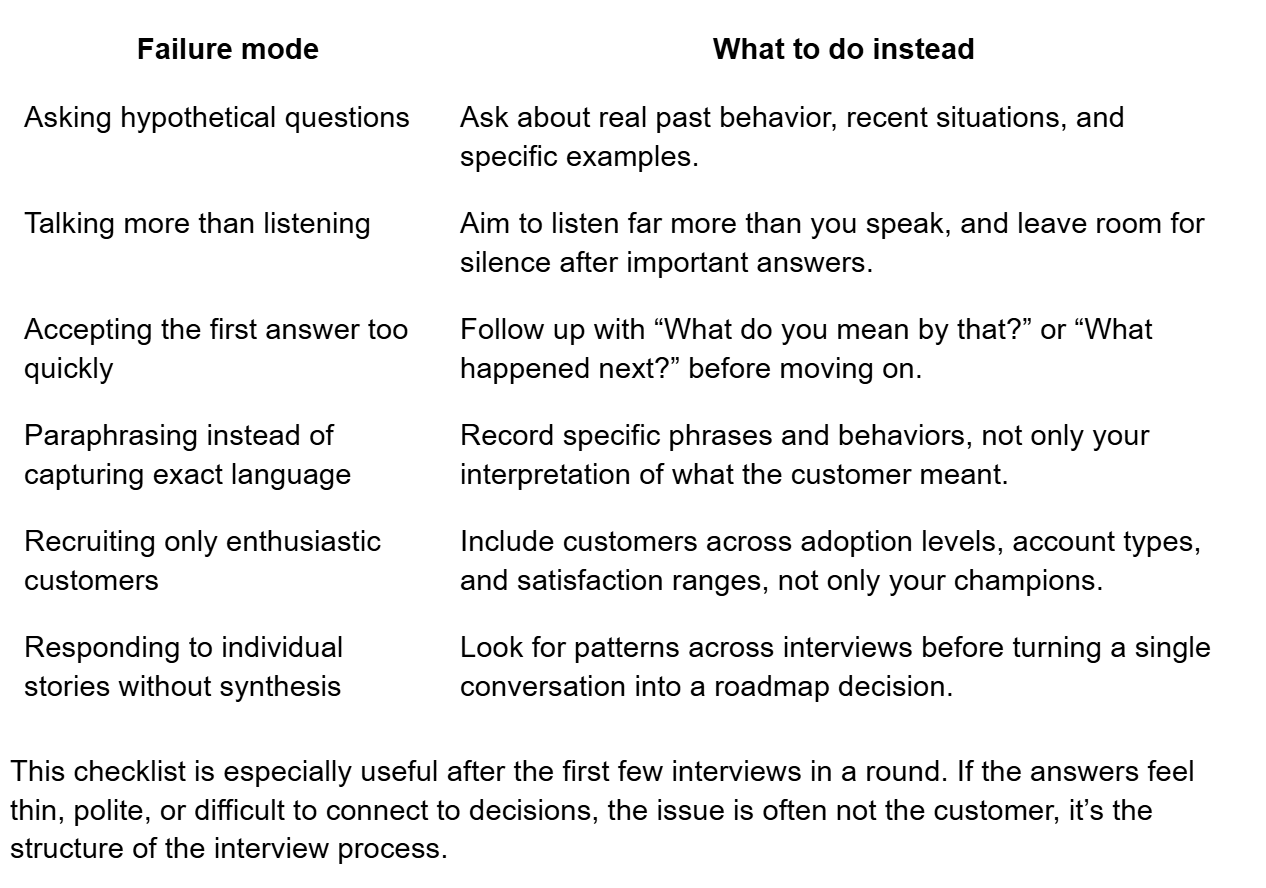
Checklist: how to avoid customer interviews that achieve nothing
Before you leave the interview process, check for the failure modes that make interviews less useful. Each one weakens the chain from conversation to evidence to roadmap decision.
Who should conduct customer interviews?
Customer interviews are strongest when the people making product decisions stay close to the evidence. A dedicated researcher or PM can lead the conversation, especially when the team needs consistency and research rigor, but the learning should not stop with the person who ran the session.
Bring the product trio closer to the evidence
Teresa Torres argues for the product trio model: a cross-functional team of PM, designer, and engineer who participate in discovery together, including in interviews. Each person brings a different frame to the same conversation. The engineer may notice technical implications the PM missed, while the designer may notice interaction patterns that shape how the problem should be understood.
The practical value is shared exposure. When PMs, designers, engineers, and researchers hear the customer’s words directly, they can synthesize faster and make decisions from a common understanding of the evidence.
Where dedicated research resources exist, the strongest approach is collaborative. Researchers can lead sessions with PM observers, or researchers and PMs can co-facilitate. What matters is that the people shaping the roadmap remain connected to the customer evidence behind it.
What is the role of AI in customer interviews in 2026?
AI has changed the logistics of customer interviews more than it has changed the discipline of them.
- Transcription is now instant and inexpensive
- First-pass synthesis across a large set of transcripts is faster than manual coding
- Scheduling and recruitment automation maintain a steady pipeline of willing participants with less PM overhead
What AI has not changed is the importance of human judgment. Someone still has to determine what a pattern means, whether a theme is worth pursuing, and how an opportunity connects to a strategic outcome.
Nielsen Norman Group’s 2026 guidance is that AI interviewers can conduct sessions and generate themes at scale, but they are no replacement for in-depth, human-led semistructured interviews. The interpretive work still matters: knowing when to follow a thread, hearing what is not being said, and building the trust that produces honest answers.
As Torres has said, AI should be additive to discovery, not a replacement for it. If you are building a product used by humans, you probably need to be talking to those humans.
So while AI can speed up transcription, coding, quote retrieval, and pattern detection, human judgment remains responsible for deciding which themes matter, how they connect to the team’s goals, and what they imply for the roadmap.
Frequently asked questions
What is a customer interview?
A customer interview is a structured, one-on-one conversation that helps product teams understand a customer’s needs, behaviors, workarounds, and context. Unlike user testing, surveys, or NPS follow-up, it explores the problem space before the team decides what to build or validate.
What questions should you ask in a customer interview?
Ask about real past behavior and specific situations the customer has actually faced. Useful prompts include “Tell me about the last time you had to do X” or “Walk me through what happened when Y occurred.” Avoid hypothetical future questions like “Would you use a feature that did X?” because customers often overestimate how much they would use something that does not yet exist.
How many customer interviews do you need?
For a tightly defined customer segment, six to twelve interviews often surface the most important themes. Broader segments or more complex topics may require more. The practical signal is diminishing returns: when recent interviews mostly confirm existing themes, it is time to synthesize.
How do you turn customer interviews into product decisions?
Synthesize findings across interviews into recurring themes, grouping related observations by the underlying problem rather than the feature name. Connect those themes to a desired business outcome to determine which opportunities are most worth pursuing. Then link each roadmap decision back to the customer evidence that supports it, so the reasoning is traceable when it is later questioned.
How is a customer interview different from a user test?
A customer interview explores a customer’s needs, behaviors, and context to inform what to build. A user test evaluates a specific design, prototype, or interaction to determine whether it works as intended. Interviews help define the problem space, while user tests help evaluate a proposed solution.
What is the Mom Test in customer interviews?
The Mom Test is Rob Fitzpatrick’s discipline for asking questions that produce honest answers, even from people who want to be supportive. In customer interviews, it means asking about real past behavior and specific situations rather than your idea, your feature, or a hypothetical future choice.
Closing: Interviews that prove their worth
The interviews that improve the roadmap are those that produce clear, evidence-backed insights connected directly to the outcome the team is trying to drive. The playbook is simple: talk to customers regularly, ask about what actually happened, and connect recurring evidence to the roadmap decisions it supports.
Teams that do this well build customer learning into their regular rhythm. Small, frequent conversations keep the problems worth solving visible, and clear synthesis keeps the reasoning behind each roadmap priority easy to understand.
If you want to see how ProductPlan connects customer insight, synthesis, and roadmap decisions in one traceable system, book a demo and we’ll show you what it looks like in practice.
Internal links
- ProductPlan's 2026 State of Product Management Report
- How to Field Customer Feature Requests Without Overpromising
- Managing and Tracking Feature Requests
- 7 Strategies to Choose the Best Features for Your Product
- How to Make Sense of the Firehose of Ideas for Your Product
External sources cited
- ProductPlan's 2026 State of Product Management Report — proprietary first-party research, ~250 product professionals, late 2025. Source for 58% customer impact stat, 49% business value stat, 60%+ escalation stat, 40% disconnected tools stat.
- Teresa Torres, Continuous Discovery Habits (Product Talk Academy, 2021) and producttalk.org — weekly discovery cadence, story-based interviewing, outcome-first discovery, the product trio model, Opportunity Solution Tree, AI as additive not replacement.
- Rob Fitzpatrick, The Mom Test (revised and expanded edition, Simon & Schuster, 2025) — past-behavior question discipline, the danger of hypothetical future questions, the three bad data types (compliments, hypothetical fluff, wishlists).
- Nielsen Norman Group, "How Many Participants for a UX Interview?" (Maria Rosala, 2024) — saturation guidance, 5-interview limitation for exploratory research, 6-12 interview range for defined segments.
- Nielsen Norman Group, 2026 guidance on AI interviewers — AI interviews as supplement, not replacement, for human-led semistructured interviews.
- Greg Guest, Arwen Bunce, and Laura Johnson — 97% of codes emerged in 12 interviews, 94% in the first 6; saturation guidance for qualitative research.
Ready to build with confidence?


.svg)