
How to Build a Weekly Continuous Discovery Habit You Can Defend

If you are a product manager or director in 2026, you likely believe in talking to customers regularly. You may even have it on the calendar. The pressure you are feeling, though, is not really about belief. It is about a leaner team, headcount that is flat to frozen, and a finance leader asking every function to show what its spending actually returns. When the week gets hard, discovery is the first thing that slips, because it is the easiest thing to defer and the hardest thing to defend. The customer conversations get pushed to next week, and next week quietly becomes next quarter.
Continuous discovery is the practice of talking to customers regularly, often weekly, by the team building the product, and feeding what you learn directly into product decisions, rather than researching only in occasional bursts. The hard part is rarely understanding why it matters. The hard part is keeping it running when capacity is tight, and then turning a steady stream of conversations into decisions your roadmap, and your CFO, can actually defend. This guide is about both.
Key Takeaways
- Continuous discovery is the habit of engaging customers regularly, often through weekly interviews and ongoing signal, and connecting what you learn directly to product decisions, instead of researching only in occasional projects.
- Small, steady touchpoints beat large, infrequent research pushes, because a weekly rhythm keeps insight fresh and lets you disprove one idea and start on the next within days.
- Discovery only pays off when it is paired with synthesis: turning a stream of conversations into clear, recurring patterns that point to what to build.
- In a 2026 budget climate where every spend gets a second look, the way to protect discovery is to frame it as risk reduction, the cheapest insurance against the expensive mistake of shipping the wrong thing.
- In ProductPlan's 2026 State of Product Management report, 49% of teams named resource and capacity constraints as the top cause of roadmap misalignment, which is exactly what makes consistent discovery so hard to protect.
- The teams that learn continuously are the ones that keep the loop from signal to decision running, rather than the ones that simply collect the most feedback.
What is continuous discovery in product management?
Continuous discovery is a sustainable rhythm of small research activities, run weekly by the team building the product, in pursuit of a clear outcome. Instead of one large study before a launch, you maintain a steady cadence of customer touchpoints so you always have recent evidence on hand when a decision arrives.
The term is closely associated with Teresa Torres, whose book Continuous Discovery Habits defines the practice as weekly touchpoints with customers, by the team building the product, where they conduct small research activities in pursuit of a desired outcome. Torres is clear about three conditions that make discovery genuinely continuous: the people building the product talk to customers directly rather than reading research reports, the activities stay small enough to fit alongside design and engineering work, and the whole effort stays anchored to an outcome rather than a feature list (Product Talk). The book reached its fifth anniversary in 2026, and Torres marked it by inviting the community to read it together again, a sign of how durable the idea has become.
Nielsen Norman Group frames the same shift a useful way: discovery does not have to be a single upfront phase, it can be woven through the entire product cycle. Their guidance for agile teams is memorable, scale discovery rather than skip it, keeping each activity narrow and tied to a specific question rather than stopping delivery to run something exhaustive (NN/g).
Why is continuous discovery better than periodic research?
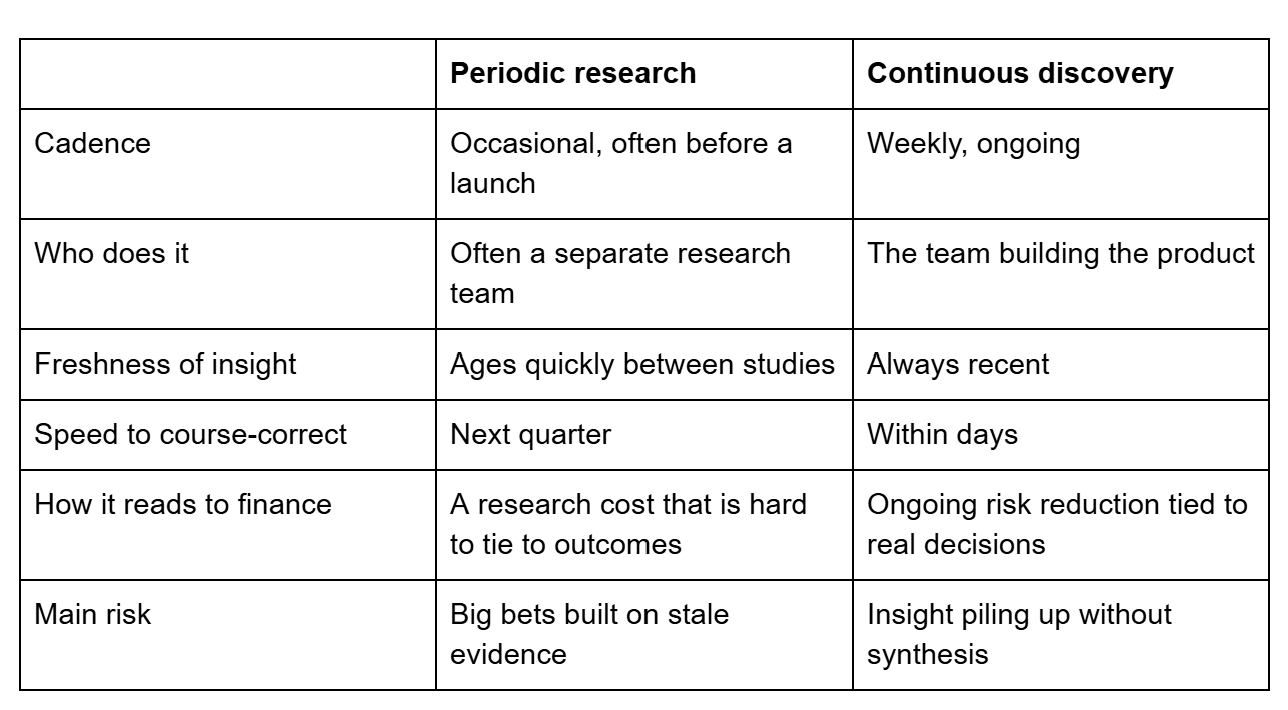
Periodic research happens in occasional bursts, often a big study before a major bet, while continuous discovery maintains a steady rhythm of smaller touchpoints. The continuous approach keeps you closer to changing customer needs and gives you multiple recent data points whenever a decision lands, which is when you actually need them.
The deeper advantage is agility. When you interview every week, you can disprove one opportunity and begin gathering evidence on the next within a few days, rather than waiting for the next quarterly cycle to course-correct. A weekly habit is also simply easier to sustain than an on-demand one, because deciding when you "need" discovery is a judgment most teams get wrong, especially early on.
There is a timely reason this matters more in 2026 than it did a few years ago. As AI accelerates building, the temptation is to skip straight from an idea to a working prototype. Janna Bastow, co-founder of ProdPad and Mind the Product, has warned about exactly this pattern: the teams that were already building the wrong things are now building them faster, with AI multiplying motion and motion getting mistaken for progress (ProdPad). Torres has made a similar point, that faster delivery tempts teams to revert to a feature factory and forget their discovery fundamentals. Continuous discovery is the discipline that keeps speed pointed at the right problems.
How do you build a sustainable discovery cadence?
A sustainable cadence is one that survives a bad week. The goal is to make interviewing easier to do than to skip, so the rhythm holds even when a release goes wrong or a key teammate is out. These five steps build that durability.
- Commit to a weekly touchpoint, not a perfect one. Put a recurring customer conversation on the calendar and protect it. A small, imperfect interview every week beats an ambitious study that never happens, because consistency is what keeps insight fresh.
- Automate recruiting so you never have to hustle. This is the single highest-leverage move on the list. Torres is emphatic that if you have to scramble to find someone each week, you will eventually stop. Build a recruiting question into your product, enlist customer-facing colleagues, or stand up a small customer advisory board so an interview lands on your calendar automatically, without anyone having to chase it.
- Interview as a team, not a solo act. Having the people who build the product hear customers directly, together, prevents the misalignment that comes from everyone working off a different set of information. It also spreads the load so discovery does not rest on one person.
- Keep each activity small and outcome-anchored. Tie every conversation to the outcome you are pursuing and ask about specific past behavior rather than hypotheticals. Following NN/g's advice, scope each activity narrowly to a real question instead of trying to learn everything at once.
- Write down what you learned, every time. A one-page recap after each activity, what you learned, what it implies, and what is next, turns scattered conversations into something the team can build on. This is the bridge from discovery into synthesis.
How do you turn ongoing conversations into decisions?
You turn conversations into decisions by synthesizing the stream into recurring patterns and opportunities, then connecting those patterns directly to prioritization. Collecting feedback without synthesizing it is the most common way discovery fails: the interviews happen, the notes pile up, and nothing reaches the roadmap. The teams that win are the ones that keep the loop running from signal all the way through to a decision the roadmap reflects.
This is the step most teams underestimate. As Torres has observed, more teams than ever are interviewing customers, which is the good news, and many of them get stuck on what comes next, the move from a stack of notes to a clear pattern. It is not feasible to hand colleagues pages of raw notes and expect them to do the work of synthesis, so synthesis has to be a deliberate, lightweight habit rather than an afterthought.
This is also where capturing feedback and acting on it diverge. Capturing customer signal has become easy. Synthesizing it into a decision you can defend is the hard part, and it is the work that actually moves a roadmap. ProductPlan's own research underlines why the synthesis step is so fragile in practice: 40% of teams say their strategy, discovery, roadmap, and launch plans live across multiple tools with limited or no integration, and only about 22% have everything in one primary system (State of Product Management 2026). When the reasoning behind an insight lives in one tool and the roadmap lives in another, the thread from a customer's words to a prioritized decision breaks, and so does your ability to show anyone why a decision was made.
This is the problem ProductPlan is built to close. As a Product Intelligence Platform, ProductPlan brings always-on customer signal and the roadmap into one place, so the synthesis that turns conversations into decisions does not get lost between tools. With Winware AI, ProductPlan's intelligence layer, teams can run continuous, high-quality research and distill interviews, tickets, sales calls, and reviews into clear, themed patterns by segment, then carry those patterns straight into prioritization. As one ProductPlan product leader describes it in our 2026 research, the aim is "discovery synthesis into a live customer truth" that continuously distills the noise into something a team can decide on. That is the loop continuous discovery is supposed to complete, made durable.
How do you defend discovery to your CFO?
You defend discovery by reframing it in the language finance actually rewards: revenue, cost, and risk. To a CFO, "we talk to customers every week" sounds like an activity and a cost. "We run a standing process that catches bad bets before they consume a quarter of engineering" sounds like risk management. Same habit, but only the second framing survives a budget review.
The climate makes this skill non-optional. Technology budgets are still rising for most finance leaders, 75% expect to increase them in 2026, yet headcount growth expectations have collapsed, falling from 6% in 2025 to just 2% in 2026, with only 21% of CFOs planning staff increases of 4% to 9%, down from 31% the year before (Gartner 2026 Budget Priorities, Feb 2026). AI is no longer waved through as a special category, either. Finance leaders now ask the same hard questions of it as everything else, and careful tracking of project ROI has become standard. The pattern is not that CFOs single out discovery for cuts. It is that every line item gets a second look, and the spending that cannot explain where it lands in the P&L or the risk register is the spending that gets trimmed.
That is precisely the case continuous discovery should make, because the economics now run in its favor. When building is cheap and fast with AI, the expensive mistake is no longer slow delivery. It is shipping the wrong thing at speed. A competitor's widely cited 2026 research captures the anxiety this creates: Atlassian's first State of Product report found that 84% of product teams worry the products they are currently building will not succeed in the market (Atlassian State of Product 2026). Continuous discovery is the cheapest insurance against that exact failure. It is the standing process that turns "we think customers want this" into "we have recent evidence they do," before the engineering hours are spent. Framed that way, a weekly discovery habit is not research overhead. It is the lowest-cost risk reduction on the roadmap, and that is a sentence a CFO will fund.
How do you keep discovery going when capacity is tight?
You protect discovery under pressure by making it small, shared, and automatic, so it does not depend on a quiet week that never comes. Scale the work down rather than cancelling it, distribute it across the team and customer-facing colleagues, and lean on automated recruiting so the habit survives the weeks when everything is on fire.
Capacity is the real constraint, not motivation. In ProductPlan's 2026 research, 49% of teams named resource and capacity constraints as the top cause of roadmap misalignment, more than any other factor (State of Product Management 2026). When teams are this stretched, discovery is the easiest thing to defer, and that is precisely why it needs structural protection rather than good intentions.
NN/g's research describes how fragile a research habit can be: one financial-services team had regular research sprints embedded in every release, until a leadership change refocused the organization on speed and cost, and discovery quietly regressed into a reactive afterthought (NN/g). The lesson is that discovery sustains itself only when the system around it is built to reinforce the habit. A few practical safeguards help:
- Shrink the unit of work. A single five-minute conversation or one assumption test counts. Momentum matters more than scale.
- Recruit ahead of need. A standing panel or advisory board means the interview is already booked when the week falls apart.
- Make the loop short. The faster a customer insight reaches the roadmap, the less likely it is to be lost when priorities shift again.
It also helps that most teams are still early with AI, which means the teams that build a disciplined, signal-to-decision habit now have a real edge. ProductPlan's 2026 research found roughly 37% of teams using AI for limited workflows and about 32% still experimenting, so the practice of pairing continuous discovery with AI-assisted synthesis is far from settled. Customer impact remains the single most common basis for prioritization, cited by 58% of teams, which is only possible if customer signal is actually reaching the decision.
Is continuous discovery right for your team?
Continuous discovery fits most teams building a product with real users, but the honest answer is that it is sometimes the wrong investment, and a credible decision aid has to say so. Match the intensity to the risk and the reversibility of the decision in front of you.
- Worth a weekly habit: you are making consequential, hard-to-reverse bets, your market is shifting underneath you, or you have already felt the sting of building something nobody used. Here the cost of being wrong dwarfs the cost of a weekly interview. Start with one weekly touchpoint and one synthesis habit.
- Where it is overkill: the change is low-risk, cheap to reverse, and already well understood, a password-reset flow, a copy tweak, a fast-follow on a feature you have strong recent evidence for. Forcing weekly interviews onto work like this is discovery theater. Spend the time where a wrong call actually costs you.
- Fix the foundation first: if your discovery insights and your roadmap live in disconnected tools, more interviews will not help, because the new signal will leak away before it reaches a decision. Tighten that loop first, or you will be collecting evidence you cannot defend later.
Frequently asked questions
What is continuous discovery?
Continuous discovery is the habit of engaging customers regularly, often through weekly interviews and ongoing signal, and connecting those learnings directly to product decisions, instead of researching only in occasional projects. The people building the product do the talking, the activities stay small, and everything is anchored to an outcome.
How is continuous discovery different from traditional research?
Traditional research happens in periodic bursts, often a single study before a big decision, while continuous discovery maintains a steady rhythm of small touchpoints. The continuous approach keeps the team closer to changing customer needs and provides recent evidence whenever a decision arrives.
How often should you do customer discovery?
Many teams aim for weekly customer touchpoints, because a regular cadence keeps insight fresh and decisions grounded without the cost and lag of large quarterly studies. The exact frequency can flex with risk, but weekly is the rhythm most associated with the practice.
How do you justify continuous discovery to a CFO?
Frame it as risk reduction rather than research cost. A weekly discovery habit is a standing process that catches bad bets before they consume engineering time, which is the cheapest insurance against the expensive mistake of shipping the wrong thing. Speak in revenue, cost, and risk, and tie each conversation to a decision you can point to.
How do you turn continuous discovery into decisions?
Synthesize the ongoing stream of conversations into recurring patterns and opportunities, then connect those patterns directly to prioritization, so learning consistently shapes the roadmap. Writing a short recap after each activity and keeping insight and roadmap in one place keeps that loop from breaking.
How do you keep discovery going when capacity is tight?
Make it small, shared, and automatic. Scale each activity down rather than cancelling it, distribute interviewing across the team and customer-facing colleagues, and automate recruiting so a conversation is already booked when a chaotic week hits.
Keep customer signal flowing into your roadmap
Continuous discovery is, in the end, a promise you make to your customers and to your roadmap: that you will keep listening, keep finding the patterns, and keep letting what you learn shape what you build, even when the week is hard. The teams that hold that promise are not the ones with the most time. They are the ones who made the loop small enough, shared enough, and connected enough to survive a tough quarter, and to defend when someone asks what it returns.
That is the work ProductPlan exists to make easier, keeping customer signal and your roadmap in one connected view so discovery turns into decisions you can defend. See how teams turn continuous customer signal into a roadmap their stakeholders trust. Book a demo.
Related reading
- What Product Metrics Matter?
- Your Product Outcomes Need to Impact Company KPIs
- Are North Star Metrics Leading You Astray?
- Vanity Metrics
Sources
- ProductPlan, 2026 State of Product Management report — proprietary data: confidence in measuring business impact, framework adoption, tool fragmentation; produced in partnership with the Product Led Alliance.
- Elena Verna, "Retention: The situationship of SaaS" — elenaverna.com, June 2025.
- Aakash Gupta, "The 2025 Product Strategy Playbook" — news.aakashg.com, March 2025.
- Lenny Rachitsky, highlighting Andrew Ng on product management as the new bottleneck — on X, July 2025.
- Melissa Perri, on the limits of AI in product judgment — LinkedIn, April 2025.
- Deloitte, "AI ROI: The Paradox of Rising Investment and Elusive Returns" — deloitte.com, October 2025.
- Nielsen Norman Group, "What is Mixed-Methods Research?" and "Quantitative UX Research in Practice," nngroup.com.
Ready to build with confidence?


.svg)