
Why Intelligence Platforms Are Replacing Traditional Product Management Methods
The methods you built your career on were designed for a world where building was the hard part. That world is gone. Building is now fast and inexpensive, and the constraint has moved upstream to a harder question: what deserves to be built. The teams pulling ahead are re-tooling for that question, not for speed they already have.
Key Takeaways
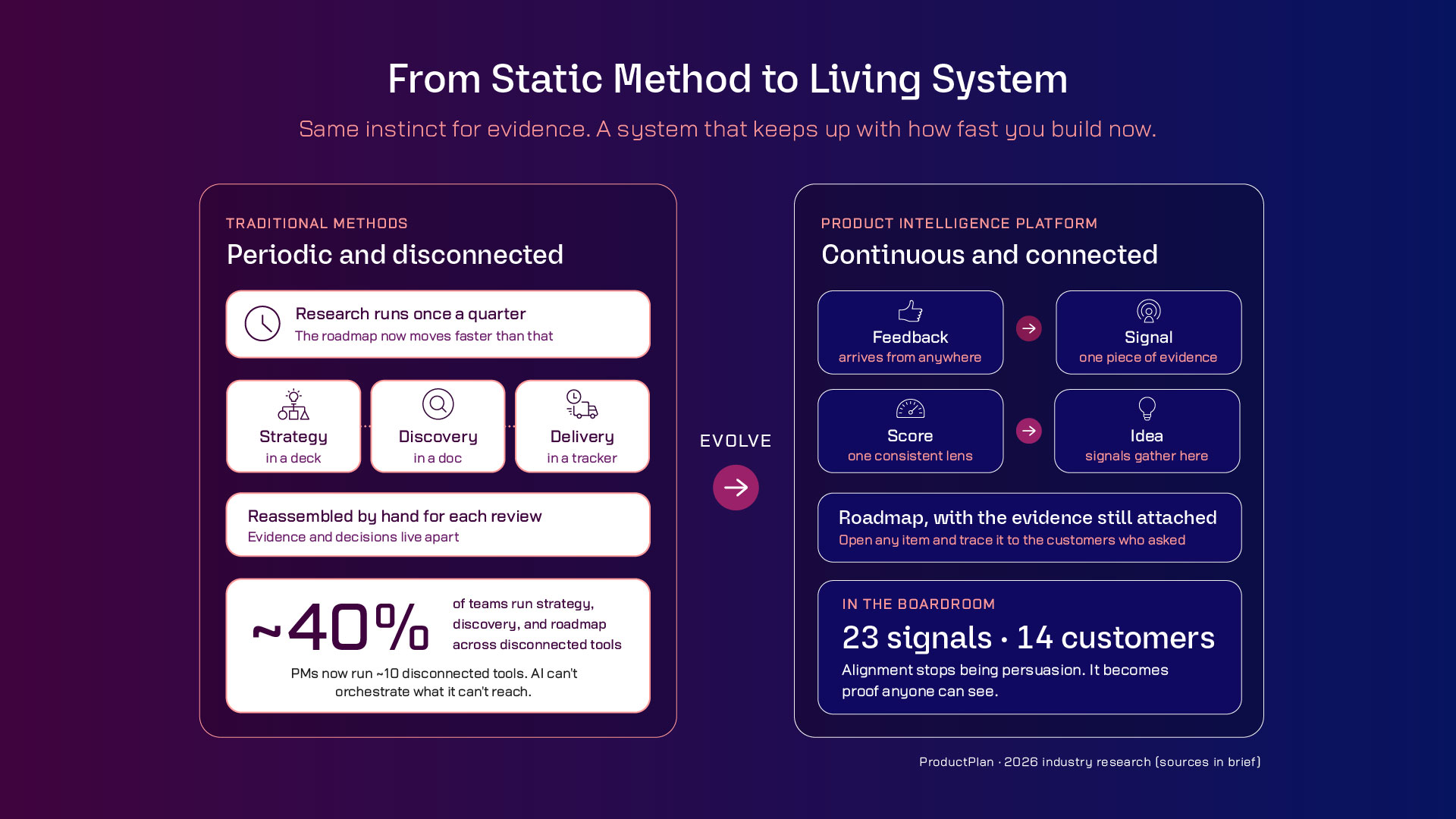
- Traditional methods, periodic research and a maintained roadmap spread across disconnected tools, were built for slow build cycles and strain when building is fast.
- The bottleneck relocated from building to deciding, and most organizations still invest in shipping faster rather than deciding better.
- A product intelligence platform is the connective tissue for decisions, turning continuous customer signal into evidence you can act on and defend.
- Point tools that only accelerate delivery can make teams worse, because speed applied to the wrong direction compounds the mistake.
- In ProductPlan’s 2026 report, about 40% of teams still run strategy, discovery, and roadmap across disconnected tools, and only 5.7% use a structured prioritization system.
What are traditional product management methods, and why are they straining?
Traditional methods are the established craft of the discipline. Research runs on a quarterly cadence. A roadmap captures the plan. Strategy sits in one tool, discovery in another, delivery in a third, and someone reassembles the picture for each review. For years this rhythm matched the pace of building, and it served teams well.
The ground beneath it shifted for one reason. AI sharply reduced the cost of building. Prototypes that took weeks now take hours, and engineering throughput has multiplied while the work of deciding what to build has not. ProductPlan’s 2026 research captures the moment through Setu Shah, Senior Director of Global Product Strategy at Oracle, who observed that execution got faster while thinking became the real differentiator. When the roadmap can change faster than a quarterly study can inform it, periodic methods start to lag the work they are meant to guide.
The 2026 CPO Insights Report from Products That Count and Mighty Capital, drawn from more than 1,500 product leaders, shows how far the role has already moved. Speed to market climbed from 14% to 22% as the top CPO concern in a single year. The CPO focus on strategy rose to 74% while time spent on roadmap development fell to 10%, and more than half of CPOs now carry profit-and-loss responsibility. The job is being pulled toward judgment and economics, which is precisely what the old tooling was never built to support.
Where did the bottleneck move?
It moved from making things to choosing them. When building was slow, execution was the constraint, and every method optimized for it. Now that building is cheap, the expensive act is selecting the right work, because a wrong choice is quick to ship and costly to have made.
Marty Cagan named this directly in his 2026 essay, The AI Productivity Paradox, quoting product leader Hilary Gridley: it has never been easier to run ten times faster in the wrong direction. Cagan’s point is that the project model was always designed to deliver output rather than outcomes, and AI simply makes that flaw more expensive. Chip Huyen, quoted in the same piece, puts the residue plainly. AI makes building easier, and the hardest part remains knowing what to build.
The market is repricing itself around that truth. ICONIQ’s 2026 State of AI, a survey of roughly 300 software executives, describes a shift from the race to experiment toward scaling AI into durable, economically sound products, and reports outcome-based pricing rising from 2% to 18% in about a year. When customers pay for outcomes, shipping speed becomes table stakes and decision quality becomes the profit line.
What is a product intelligence platform?
A product intelligence platform is software that continuously turns customer signal into evidence-backed product decisions. It connects research, prioritization, and roadmapping in one place, so the roadmap behaves like a living decision system rather than a static file that ages between updates.
The model is simple. Feedback arrives from any direction and becomes a signal, an atomic piece of real customer evidence. Signals gather into ideas, ideas are scored against a consistent lens, and the strongest carry their evidence forward onto the roadmap. Because that evidence stays attached, anyone can open a roadmap item months later and trace it back to the customers who asked for it. The platform does not replace judgment. It raises the quality and speed of judgment, which is the only leverage point left once building is cheap.
Why do point tools that only speed delivery make the problem worse?
Because they accelerate the wrong stage. A tool that helps you ship faster, applied to a decision you have not examined, gets you to the wrong place sooner. That is the paradox Cagan and Gridley describe, and it helps explain why more delivery speed alone does not necessarily improve outcomes.
There is a structural reason the deciding stage stays slow, and Productboard’s 2026 research names it. Product managers now run roughly ten tools, with feedback, strategy, usage, and delivery each living in a separate system. Productboard’s 2026 research points to the same structural problem: AI cannot orchestrate what it cannot access. As long as the evidence behind a decision is scattered, the product manager remains the human integration layer, and no amount of delivery speed fixes that. An intelligence platform closes the gap by making the inputs to a decision continuous and connected, so the deciding gets faster and better together.
How do you know you have outgrown periodic methods?
A few honest signs tend to appear together.
- Your roadmap changes faster than your research refreshes, so decisions outrun the evidence meant to inform them.
- Strategy, discovery, and delivery live in separate tools, and someone spends real hours each week stitching them into one view.
- When leadership asks why something is prioritized, the answer lives in a person’s memory rather than a system anyone can see.
- Engineering ships faster than ever, yet you feel less certain the work is the right work.
If two or three of these feel familiar, your operating model may no longer match the pace or complexity of the decisions your team is making.
Build a better decision system
As building gets faster, the quality of product decisions carries more weight. A product intelligence platform gives teams a continuous, connected evidence base for deciding what to build next and explaining why those choices deserve investment. That makes product judgment easier to support with evidence and easier to communicate across the organization.
See how ProductPlan brings research, prioritization, and roadmapping into one connected home where evidence follows every decision. Book a demo, and we will show you what a living decision system feels like in practice.
Frequently Asked Questions
They are the established practices of periodic customer research, static roadmaps, and separate tools for strategy, discovery, and delivery, which served teams well when build cycles were slower.
A product intelligence platform is software that continuously turns customer signal into evidence-backed product decisions, connecting research, prioritization, and roadmapping so the roadmap behaves like a living decision system.
Building has become fast and inexpensive while scrutiny has risen, so the hard problem is deciding what to build. Continuous, connected intelligence answers that better than periodic, fragmented workflows.
No, it raises the quality and speed of judgment by giving it continuous evidence, which is the scarce advantage now that building is cheap.
Your next roadmap starts here.


.svg)