
User Research Templates for Agile Teams
Agile teams often struggle to fit user research into short development cycles. A good template makes that easier by giving teams a repeatable structure for planning research, running interviews, synthesizing findings, and connecting what they learn to product decisions. AI can now speed up parts of that process, but teams still need to frame the right questions, evaluate the evidence, and decide what the findings mean for the roadmap.
Key Takeaways
- User research templates give agile teams reusable, lightweight structures for planning, running, and making sense of research inside sprint timelines.
- In 2026, user research templates can also help teams use AI more consistently by defining the question, the inputs, and the points where human review is required.
- AI research use has jumped to between 69% and 80% of teams, yet the amount of research produced has stayed flat, so speed was never the real constraint.
- The scarce skill has shifted from running research to framing it, which is exactly the part practitioners refuse to hand to AI.
- Templates only deliver value when findings reach decisions, so each one should end by pointing at the roadmap.
What is a user research template in 2026?
A user research template is a reusable structure for a research activity, the scaffold you fill in rather than the blank page you dread. That definition still holds, but the center of gravity has moved. Maze’s Future of User Research Report 2026 found that 69% of research professionals now use AI in at least some projects, a nineteen-point jump in a year, and that 61% of organizations equip non-researchers with tools and templates, making templates the single most common way research scales beyond specialists.
When AI can draft the synthesis, the words in the template matter less than the intent behind them. The modern template carries two things a form never did: a framing block that states the decision at stake and the assumptions AI should not quietly infer, and a checkpoint that keeps a human between the AI summary and the roadmap. The scaffold is still lightweight. What it protects is judgment.
Why did faster tools not produce more research?
Faster tools have not automatically translated into more research. User Interviews’ State of User Research 2025 found AI use climbing to 80% of teams, a twenty-four-point jump, while the median amount of research produced held flat at two mixed-method, three qualitative, and one quantitative study per researcher every six months. More tooling, the same output. The constraint sits upstream, in deciding what is worth researching and in trusting the result.
Trust is the honest tension of the moment. The same report found 91% of researchers worry about AI accuracy and hallucination, and 63% fear AI could devalue human insight. Maze adds the counterweight: even among heavy AI users, 82% say interpreting nuance and emotion still requires a human, and 76% say the same about framing the research question. Jeff Gothelf put the risk of ignoring that in one line in his 2026 essay: creating more output against unvalidated assumptions is not innovation, it is the feature factory on steroids.
The four templates every agile team needs
Four templates cover the full arc of a study, from planning and interviews through synthesis and sharing findings.
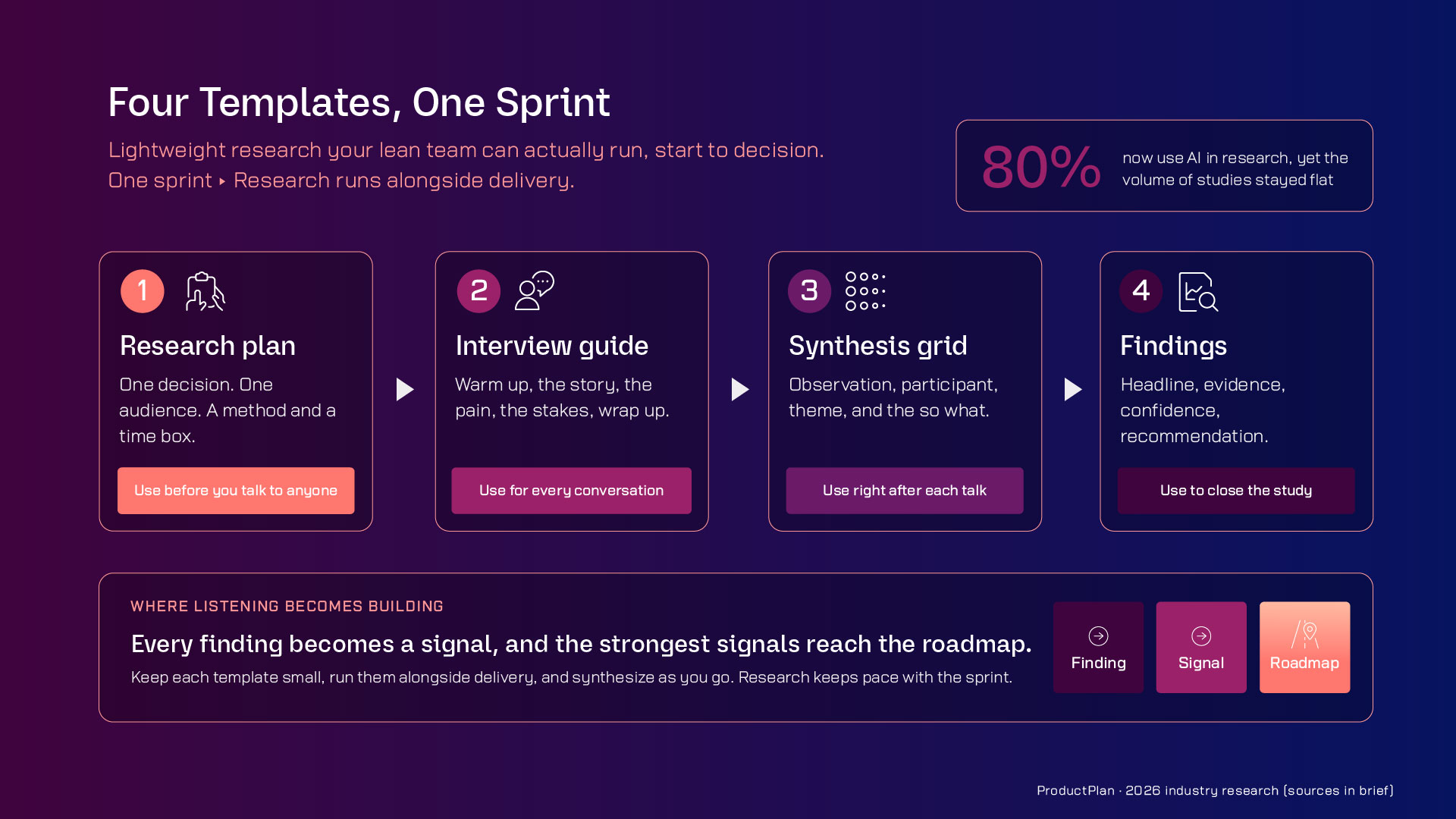
Framing note: if you cannot name the decision and the assumption, the study is not ready to run.
Framing note: record the questions AI should never answer on the participant’s behalf, so a summary cannot invent intent.
Checkpoint: let AI draft the clustering, then read three to four raw snippets per theme before you accept it.
Checkpoint: every headline traces to a named participant quote, not an AI paraphrase.
How do you keep democratized research trustworthy?
By building the human checkpoint into the template itself. Research is spreading to people who are not researchers. Maze found that 39% of research is now run by product managers, alongside market researchers and marketers, which is a good thing when the guardrails travel with the work. The checkpoint is the guardrail. AI drafts the synthesis, and a required step forces a spot-check against two or three raw transcript quotes before anything is shared. Teresa Torres, whose continuous discovery work shaped the modern practice, has long argued that humans belong in the synthesis loop, spot-checking AI summaries against the actual words customers used before acting on them. Encode that as a field, and the anxiety about AI accuracy becomes a design feature rather than a warning.
How do template findings reach the roadmap?
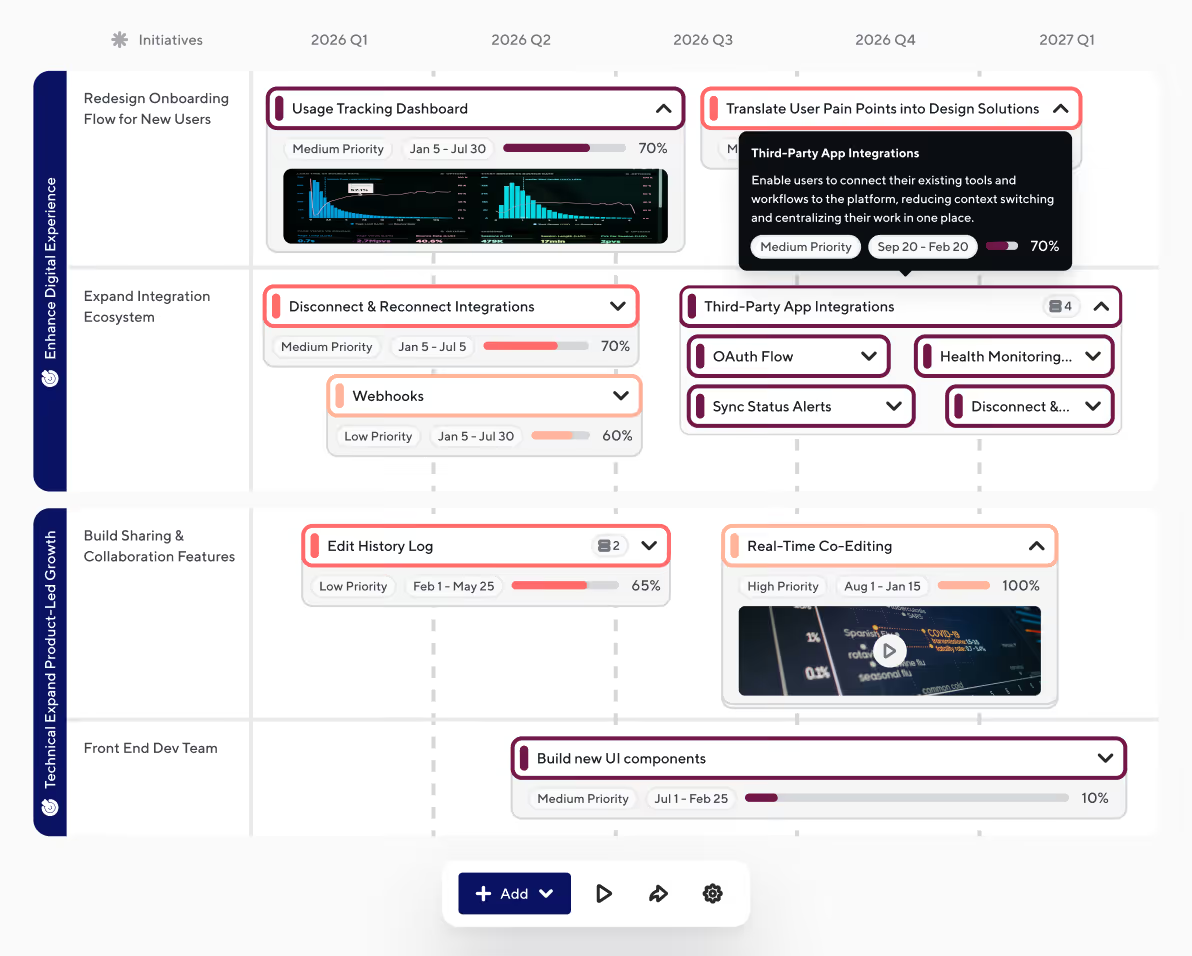
This is the step that gives the rest meaning. A completed interview guide or synthesis grid should lead straight into a prioritization conversation, and the cleanest way to hold that line is to keep the evidence attached to the idea it supports. In ProductPlan and Winware AI, each finding becomes a signal tied to a specific customer, signals gather into ideas, and the strongest carry their evidence onto the roadmap. The trip from a transcript to a scored, defensible idea takes minutes, and the human checkpoint you built into the template travels with it.
Encode the judgment, not just the fields
User research templates work best when they make good habits easier to repeat. Clear questions, consistent methods, and a deliberate review step help agile teams gather useful evidence without adding unnecessary process. When those findings stay connected to the product decisions they inform, research becomes easier to act on throughout the sprint.
See how ProductPlan and Winware AI turn research findings into signals that reach your roadmap. Book a demo, and we will walk you through it.
Frequently Asked Questions
It is a reusable structure for a research activity, such as a research plan, interview guide, or synthesis grid. In 2026 it also carries a framing block and a human checkpoint, so AI can help without deciding.
A research plan, an interview guide, a synthesis grid, and a findings summary. Together they cover planning, gathering, making sense of, and sharing insight within a single sprint.
Keep each activity small and templated, run lightweight research continuously alongside delivery, and let AI handle the drafting while a human checkpoint holds the judgment.
Each template ends by feeding its findings into prioritization, so a completed guide or grid leads directly into a roadmap conversation with its evidence attached.
Your next roadmap starts here.


.svg)