
Strategies for Cleaning Up a Bloated Product Sandbox
A bloated product sandbox can make it difficult to tell which ideas still matter. Old requests remain alongside newer ones, similar ideas accumulate, and the evidence behind each item is often uneven or outdated. Over time, that makes the sandbox harder to trust as a source for prioritization. A focused cleanup can restore that clarity by removing stale ideas, consolidating duplicates, and re-evaluating what remains against current evidence and strategy.
Key Takeaways
- Cleaning up a sandbox means pruning stale ideas, merging duplicates, and re-scoring what remains against current strategy and evidence.
- A bloated sandbox becomes difficult to prioritize when ideas lack enough evidence to distinguish promising opportunities from requests that can be archived.
- AI can accelerate parts of the cleanup process by clustering related feedback, identifying duplicate ideas, and helping teams organize large volumes of customer signal for review.
- In the 2026 State of Product Management research, teams use AI to summarize feedback far more than to prioritize it, so most have automated the wrong half of the work.
- Linking each idea to customer evidence makes the keep-or-archive call clear instead of political.
Why do product sandboxes bloat in 2026?
Because ideas have never been cheaper to create. AI drafts a PRD in minutes and spins up a prototype in hours, so sandboxes fill faster than any team can review them. The volume of raw input has outrun the time to make sense of it. Product leaders in ProductPlan’s 2026 report describe the result as being data-rich but insight-poor, drowning in tickets, calls, reviews, and usage data.
Time is the other half of the story. The same research found that 72% of product leaders spend a quarter or less of their time on strategy, which is exactly the time a cleanup requires. Janna Bastow, co-founder of ProdPad and Mind the Product, has long observed that for every hour of customer interview, a product manager can spend six or seven hours just deciphering what it contained. When capture is instant and synthesis is slow, the pile grows by default.
Why does ranking a bloated sandbox not work?
Ranking becomes less useful when the ideas being compared have little supporting evidence. ProductPlan’s 2026 research found that only 13.5% of teams consistently use a formal prioritization framework, leaving many teams without shared criteria for evaluating what belongs in the backlog. Itamar Gilad, creator of the Confidence Meter, makes the point that matters here: an idea backed only by a hunch sits at the lowest tier of evidence, and most backlog items never rise above it. When every item carries the same near-zero confidence, re-sorting them changes the order without changing what you know.
Re-ranking a bloated sandbox only changes the order of the ideas. If the evidence behind them is weak or inconsistent, the team still lacks a reliable basis for deciding what should move forward, what needs more validation, and what can be archived. Teresa Torres describes the downstream effect as the Homer Simpson car, a product stuffed with every requested feature until it serves no one well. The way out is to stop asking which idea ranks highest and start asking which idea has evidence at all.
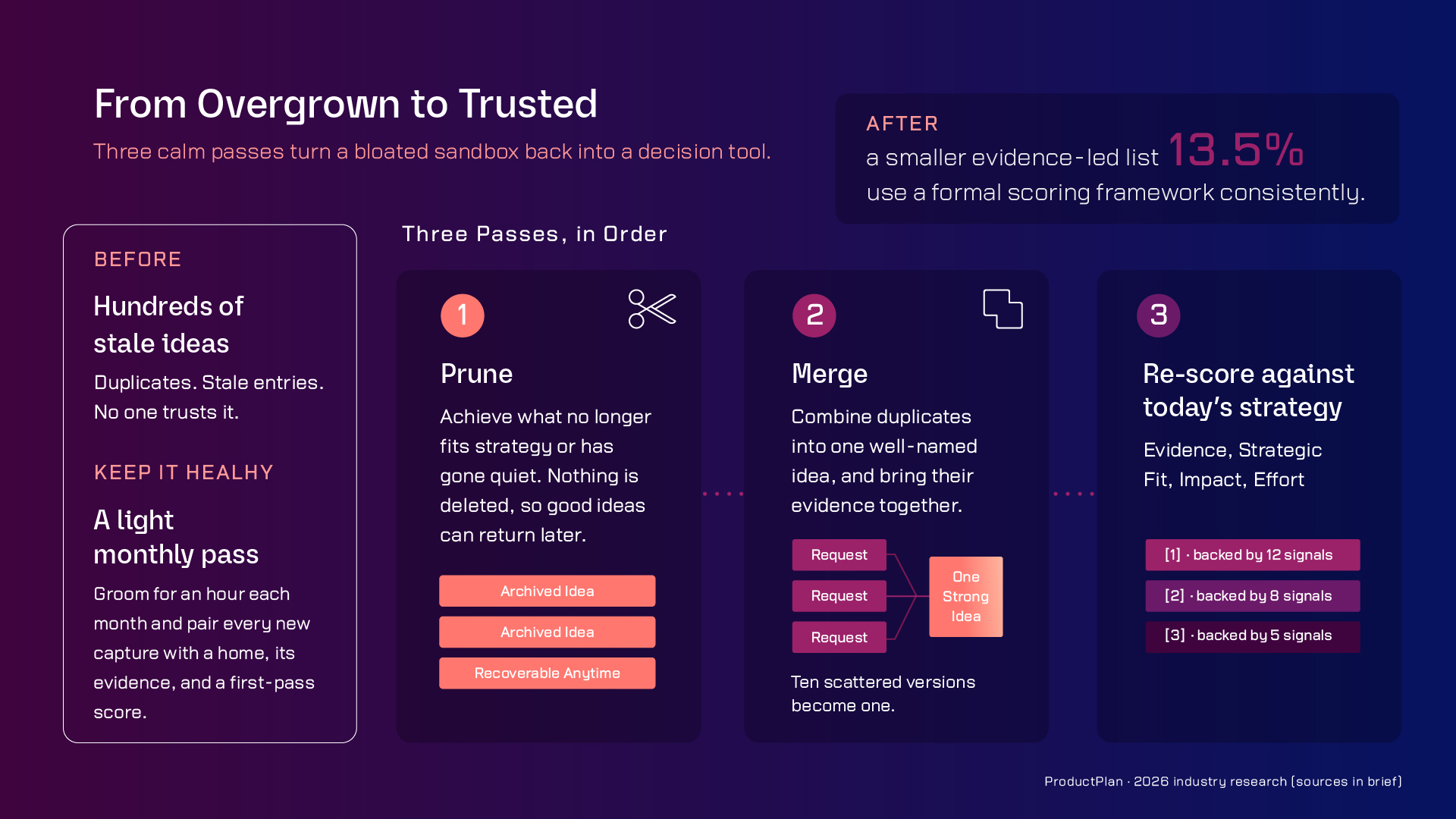
How do you clean up a sandbox by scoring evidence?
Work through it in one steady sequence, with confidence as the deciding lens.
- Prune by evidence. Archive any idea that has generated no corroborating signal after months in the sandbox. If it’s not a someday, it’s a delete. Archiving is gentle, so a good idea can return if evidence later appears.
- Merge duplicates. Combine near-identical requests into one well-named idea, and bring their signals together, so ten scattered versions become one entry that carries real weight.
- Re-score what remains. Rate the survivors on the strength of evidence behind them and their fit to where the product is heading now, not where it was heading when they arrived.
A simple lens keeps the survivors defensible.
Customer evidence carries the most weight, because it converts a keep-or-archive debate into a reading of who actually asked and how often. An idea backed by twelve signals from named customers has an obvious place. One backed by nothing does too.
What is the one move to make this week?
Put AI to work on the half of the funnel almost no one automates. Teams already use AI to summarize feedback, but far fewer use it to prioritize, which means the pile keeps growing while the culling stays manual. Reverse that. Export the last 90 days of raw feedback, support tickets, sales-call notes, reviews, and idea-board submissions, and run an AI clustering and dedupe pass to collapse it into a ranked set of recurring problem themes, each with a supporting-signal count. Then map every dormant sandbox idea against those themes. Anything with zero matching signal gets archived. Anything backed by a large, quantified cluster graduates to a validated opportunity.
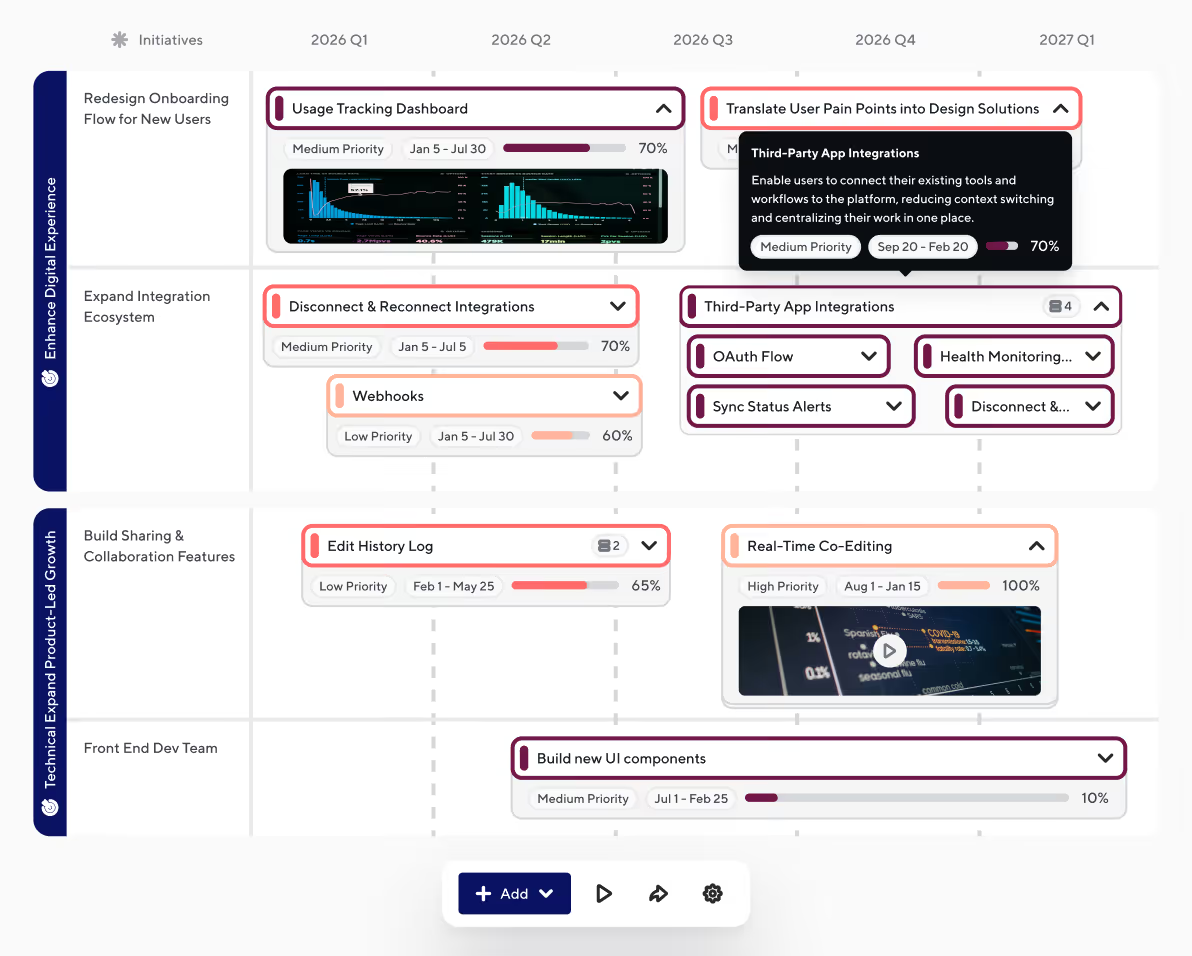
This turns a bloated list into an evidence-weighted shortlist in an afternoon. ProductPlan is built for exactly this, keeping ideas organized under each product with their signals attached, a consistent and editable scoring lens, and a clear trace from every entry back to the customers behind it. The bloat becomes a shortlist your team trusts.
How do you keep it from bloating again?
Pair every capture with a moment of triage, so ideas enter an organized system rather than an open pile. Give a new idea a home under the right product, attach the evidence behind it, and give it a first-pass confidence score. AI has already returned the time to do this, with 62% of product people reporting they save at least four hours a week from it. Spend a little of that reclaimed time on triage, and the sandbox stays a decision tool rather than a graveyard.
Aim for a smaller sandbox, not a tidier one
A bloated sandbox is a solvable problem, and the goal is smaller than it looks. Cut what has no evidence, merge the duplicates, score the survivors on the signal behind them, and let AI do the clustering it’s finally good at. What you get back is a shortlist your whole team believes in, where the best ideas are easy to find and every decision traces to a customer.
See how ProductPlan keeps ideas organized, scored, and tied to evidence. Book a demo, and we'll show you how cleanup becomes a quick, confident habit.
Frequently Asked Questions
They grow when ideas are captured continuously but evaluated rarely, and in 2026 AI has made ideas cheaper to generate than ever, so the pile fills faster while synthesis stays slow.
Prune ideas with no supporting evidence, merge duplicates, then re-score the survivors against current strategy and customer signal, leaving a smaller, evidence-weighted shortlist.
A light monthly review keeps a sandbox healthy and prevents the large cleanups that come from leaving it untouched for quarters.
Pair every capture with a triage step and a confidence score, so ideas enter an organized system, and use AI to cluster and cull, not just to summarize.
Your next roadmap starts here.


.svg)