
How to Navigate Technical Risk Management in FinTech Product Delivery
Fintech product teams are under pressure to move quickly without creating new security, resilience, or compliance risks. AI-assisted development can shorten delivery cycles, but it also raises new questions about code quality, oversight, and third-party exposure. Technical risk management gives product and engineering leaders a way to surface those risks early, assess their potential impact, and plan mitigation alongside delivery.
Key Takeaways
- Technical risk management is the continuous practice of identifying, assessing, and reducing the technical threats to a product’s delivery, performance, and security before they become costly surprises.
- AI-assisted development can introduce additional security risk when generated code isn’t reviewed and tested with the same rigor as other production code.
- DORA has applied to covered EU financial entities since January 17, 2025, increasing expectations around ICT risk management, resilience, incident reporting, and third-party oversight.
- The strongest fintech teams surface risk early and sequence it by real exposure, rather than discovering it during a release.
- In ProductPlan’s 2026 report, 49% of teams named resource and capacity constraints the top cause of misalignment, which is where unmanaged risk does its quiet damage.
What is technical risk management in product delivery?
Technical risk management is the continuous practice of identifying, assessing, and reducing the technical threats to a product, such as security gaps, integration fragility, scalability limits, and accumulated technical debt, so they are handled before they reach delivery or customers. Technical risk management works best when it stays embedded in planning and development instead of being treated as a one-time checkpoint before release.
The cost of neglecting it is now quantified. Deloitte’s 2026 Global Technology Leadership Study found that technical debt consumes 21 to 40% of organizational IT spending, and that around 60% of leaders believe a further fifth to half of their technology value sits trapped in current infrastructure. Nicolas Raynaud, a finance leader quoted in CIO.com, framed it as a capital problem: decisions to defer technology investment are now coming back to haunt teams and eating up most of the funds available for new investment. That level of technical debt has a direct effect on product investment. When more of the technology budget is absorbed by maintenance, remediation, and aging infrastructure, less remains available for new roadmap work.
Why can AI-assisted development increase technical risk?
AI-generated code can appear production-ready before it has been adequately tested for security. Veracode’s Spring 2026 GenAI Code Security report found that 45% of AI-generated code contained known vulnerabilities when the model was given no security guidance, and that while syntax correctness now exceeds 95%, the security pass rate remains stuck around 55%. As Felix Brombacher of Veracode put it, the code looks right far more often than it is safe. In a payments or lending system, that gap compounds.
The forecast is sharper still. Gartner’s Predicts 2026 research warns that AI often generates context-deficient code, syntactically correct but unaware of the broader architecture and business rules, and projects that citizen-developer, prompt-to-app work could increase software defects by 2,500% by 2028, with remediation consuming budgets previously reserved for innovation. Third-party exposure adds another layer. FINRA’s 2026 oversight report warns of rising cyberattacks and outages at vendors, where a single failure can ripple across many firms, and now advises contract language preventing sensitive data from being fed into a vendor’s open-source AI tools. The velocity is real. So is the risk it hides.
What changed the stakes in 2026?
Fintech teams entered 2026 with DORA already in force. The regulation has applied since January 17, 2025, requiring covered EU financial entities to strengthen ICT risk management, resilience testing, incident reporting, and oversight of critical technology providers. For product leaders, that means technical decisions involving resilience, security, or third-party dependencies can carry regulatory consequences alongside delivery risk.
At the same time, the EU has extended the timeline for some high-risk AI Act requirements. Under the agreement reached in May 2026, requirements for stand-alone high-risk AI systems are scheduled to apply from December 2, 2027, with a later date for certain systems embedded in regulated products. That gives fintech teams additional time to strengthen governance, documentation, and technical controls before those requirements take effect.
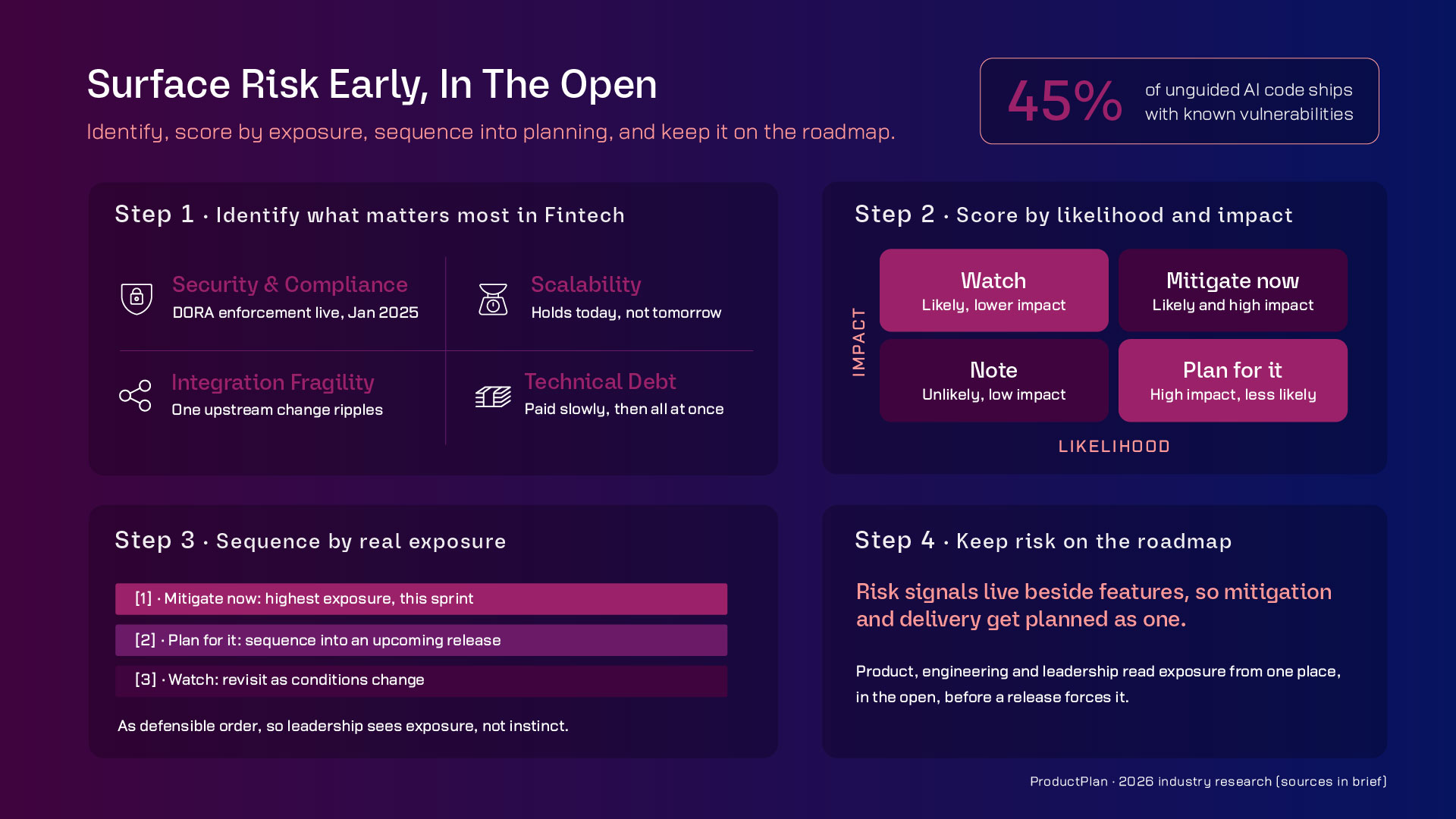
How do you assess and sequence technical risk?
Score each risk using consistent criteria such as likelihood, potential impact, regulatory exposure, and the effort required to mitigate it. That gives product and engineering teams a shared basis for deciding which risks need immediate attention, which can be monitored, and which can be addressed later. It also makes the reasoning easier to explain when leadership asks why one mitigation effort is taking priority over another.
Visibility matters just as much as scoring. Keeping significant technical risks alongside planned product work makes the capacity tradeoffs easier to see. ProductPlan’s 2026 research found that 49% of teams cite resource and capacity constraints as a leading cause of roadmap misalignment. When mitigation work is visible alongside feature commitments, teams can account for that capacity before the roadmap is overcommitted.
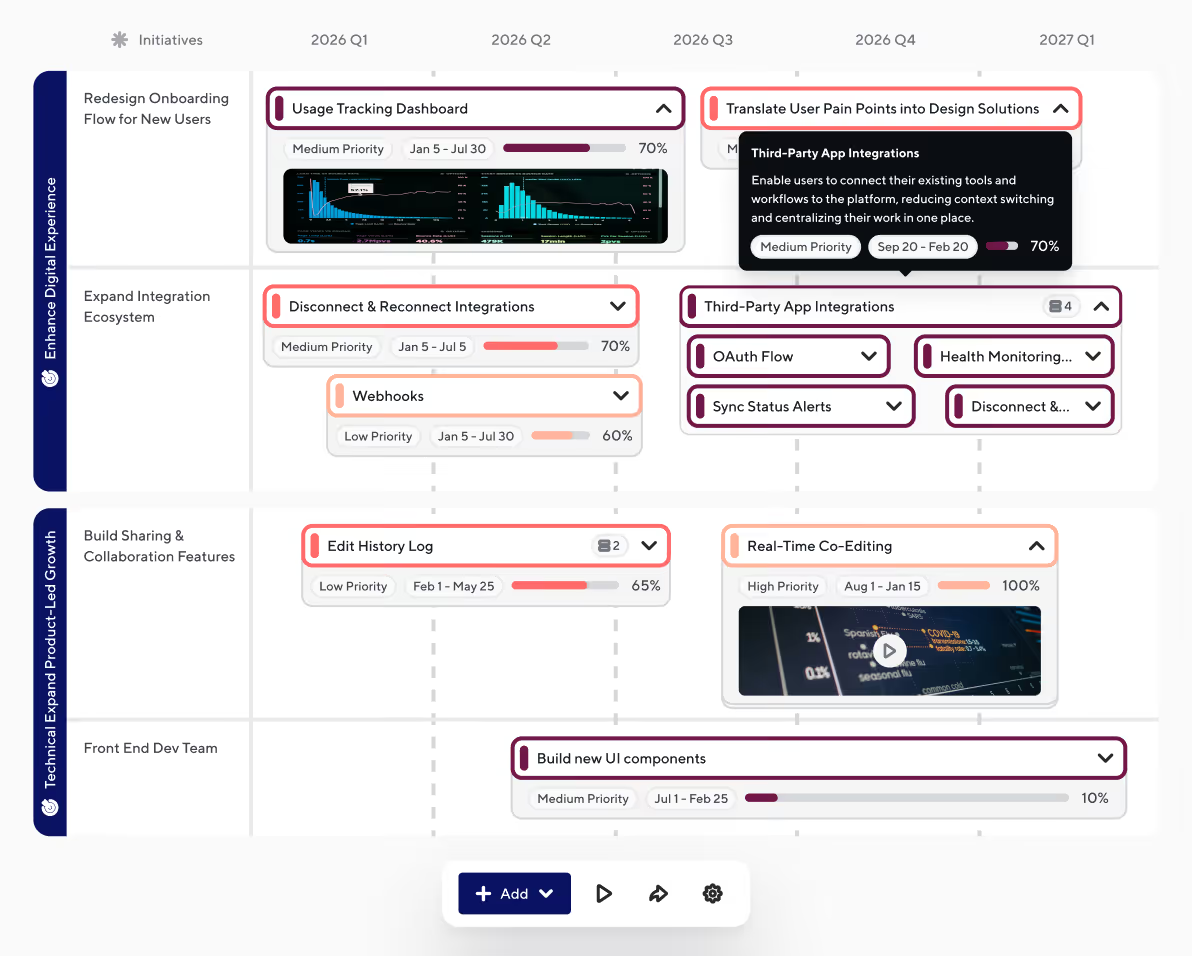
ProductPlan can support that process by keeping technical risks and product priorities visible in the same roadmap, with the reasoning behind each decision attached. That gives product, engineering, and leadership a shared view of where risk sits and how mitigation affects delivery.
What is the one move to make this week?
Add a technical-risk and AI-provenance gate to your definition of done for any story that touches payments, customer data, or a regulated third-party integration. Concretely, tag every change with whether it contains AI-generated code, require a security scan to pass before merge rather than after, and map each item to the DORA, PCI, or AI Act control it touches. That single artifact does two jobs at once. It sequences technical risk by real exposure, and it produces the kind of real-time evidence of resilience that DORA examiners now expect, which turns a compliance obligation into a prioritization tool.
Keep technical risk visible throughout delivery
Technical risk becomes easier to manage when teams identify it early, assess it consistently, and plan mitigation alongside feature work. That discipline matters even more as AI-assisted development increases delivery speed and fintech teams manage overlapping security, resilience, and regulatory requirements.
Keeping those risks visible also makes the tradeoffs around capacity easier to discuss before they affect delivery. When product, engineering, and leadership can see both feature work and mitigation priorities in the same plan, technical risk becomes part of the roadmap conversation instead of something that surfaces at the end of the process.
See how ProductPlan helps teams keep technical risks and delivery priorities visible in the same roadmap. Book a demo to learn more.
Frequently Asked Questions
It is the continuous practice of identifying, assessing, and reducing technical threats to a product, such as security gaps, scalability limits, and technical debt, so they are handled before they affect delivery or customers.
Security and compliance gaps, integration and third-party fragility, scalability under load, and accumulated technical debt, all of which now include the risk introduced by unguided AI-generated code.
Score each risk by likelihood and impact, then sequence mitigation by real exposure, so the most dangerous risks get attention first regardless of who raised them.
Make risk visible and continuous, fold mitigation into normal planning, and tie each decision to evidence, so leadership trusts the sequence and delivery keeps moving.
Your next roadmap starts here.


.svg)