
How to Handle Escalations When They Break Your Prioritization Model
Leadership escalations can disrupt even a thoughtful prioritization process, especially when the reasoning behind current priorities isn’t easy to see. ProductPlan’s 2026 research found that 60.2% of product leaders cite leadership escalations or new directives as a leading reason priorities change. A clear process for evaluating those requests against existing evidence and tradeoffs helps teams respond without abandoning the logic behind the roadmap.
Key Takeaways
- Leadership escalations are the single biggest force that overrides prioritization, named by 60.2% of product leaders in ProductPlan’s 2026 State of Product Management report, ahead of sales pressure and revenue commitments.
- An escalation is a visibility problem before it is a process problem. Leaders reach for it when the reasoning behind a priority is not legible to them.
- AI has collapsed the cost of building, so judgment is now the scarce resource. An unexamined escalation is more expensive relative to the cheap build, not less.
- Rigid frameworks do not protect a roadmap. Traceable reasoning does, because it answers the escalation before it is raised.
- Only 5.7% of teams run prioritization through a structured, evidence-based system, which is why most roadmaps sit one strong opinion away from changing.
Why do escalations override even a well-built prioritization model?
Because an escalation carries the weight of accountability, and it usually arrives without the reasoning it is reacting to. In ProductPlan’s 2026 research, 60.2% of product leaders named leadership escalations the top reason agreed priorities change, well ahead of sales and customer demands at 38.5% and revenue pressure at 38.1%. The report reads escalation precisely: it is the moment executive accountability meets incomplete traceability, a mechanism for reasserting economic alignment when the logic of the plan is not visible.
The conditions that keep that logic hidden are common. Atlassian’s State of Product 2026 found that 80% of teams do not involve engineers during ideation, problem definition, or roadmap creation, and that nearly half point to internal politics and a lack of time for strategic planning as barriers to alignment. When the thinking behind a roadmap lives in one function, or in one person’s head, leadership has no window into it, and an override becomes the only lever they hold.
Ashay Satav, Director of Product Management at eBay, points to the gap that can emerge between stated strategy and the signals teams receive through priorities, funding, OKRs, and executive reviews. When those signals drift apart, people tend to optimize for their local goals, making alignment harder to maintain.
What makes escalations more expensive in 2026?
The stakes behind each override have risen. KPMG’s Global AI Pulse Survey in March 2026 found that 74% of business leaders intend to keep AI a top investment priority even through a downturn, with a weighted-average plan of 186 million dollars in AI spend over the coming year. That capital comes with expectation, and boards increasingly evaluate roadmaps the way they evaluate any allocation of it, by the return it can demonstrate.
At the same time, AI has changed the economics of being wrong. When building was slower, a misjudged priority could consume months of engineering time before its impact became clear. As AI accelerates execution, teams can move from decision to delivery much faster, which puts more pressure on the quality of the decision itself. An escalation that changes the roadmap without the same scrutiny applied to existing priorities can send resources toward the wrong work just as quickly.
How do you evaluate an escalation on its merits?
Hold the urgent request to the same evidence your roadmap already runs on, so it earns its place rather than jumping the line. Itamar Gilad, author of Evidence-Guided, makes the sharpest case for why evidence is the deciding factor. A score built without it, he argues, is just a guess dressed as rigor, because scores based on one person’s assumptions look identical on the page to scores based on real research. The lens only protects you when evidence is attached to it.
A short, consistent triage does the work.
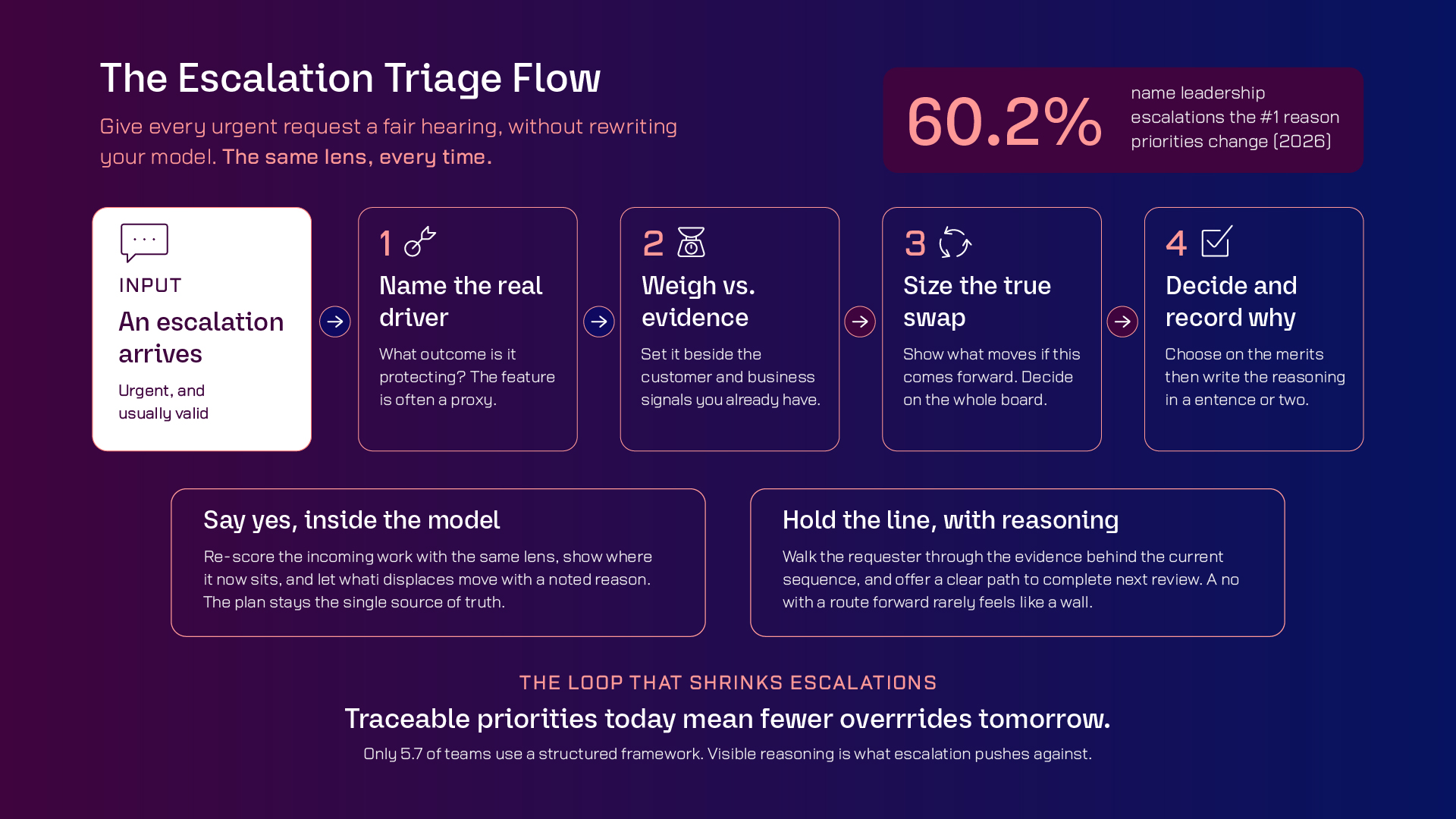
- Name the economic outcome. Ask what the escalation is protecting, whether that is retention of a specific account, a revenue commitment, or a compliance deadline. The named feature is often a proxy for the real exposure.
- Test it against your current evidence. Set the request beside the customer and business signals behind your top priorities, using the same measures you already trust.
- Size the true swap. Show what moves if this comes forward, so the decision is made against the whole roadmap rather than one item in isolation.
- Decide and record the reasoning. Choose on the merits, then write the rationale, dated, attached to the roadmap item, whether the answer is yes or no.
That last step is the one almost no team takes, and it is the one that compounds. A dated, legible decision is what turns the next escalation from a test of authority into a shared review.
How do you absorb a real escalation without weakening the model?
Sometimes the escalation is right and the plan should change. You can say yes in a way that strengthens the model rather than bending it, and the difference is legibility. Place the incoming work inside the system rather than beside it. Re-score it with the same lens, show where it now sits, and let the items it displaces move with an explicit note about why. The model stays the single source of truth, and the escalation becomes one more scored, dated, and reasoned entry within it.
Declining deserves the same discipline. When you hold the current sequence, walk the requester through the evidence behind it and offer a clear route for the work to compete at the next review. A decision that comes with reasoning and a path forward reads as fairness, not obstruction, and it keeps the relationship intact for the next conversation.
How do you reduce unnecessary escalations over time?
Making prioritization decisions easier to trace can reduce the need for leaders to reopen questions simply to understand how the team reached them. The ProductPlan report states the mechanism plainly: structured visibility reduces escalation, because much of the impulse to override comes from a visibility gap rather than genuine disagreement. The same research points to where this bites hardest. Organizations mid-transition from project-based to product-led ways of working post the highest rate of no clear decision-maker, which means scaling companies, the ones with the most at stake, feel escalation chaos most acutely.
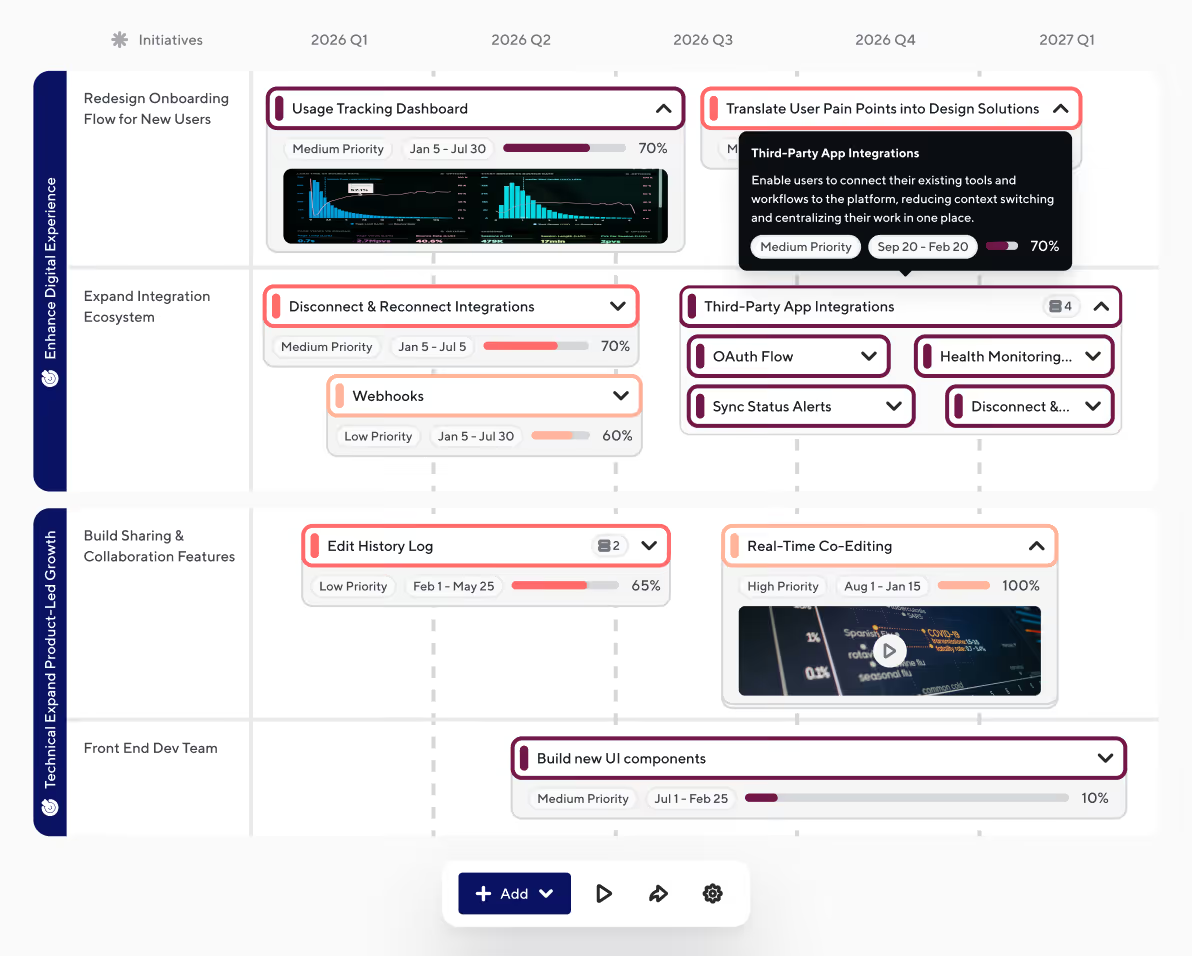
This is where a connected system earns its keep. ProductPlan keeps the evidence attached to the decision, so every priority carries the customer signals, the scores, and the history that justify it. Instead of defending the roadmap from memory, you show the reasoning, and the conversation shifts from who holds authority to what the evidence supports. You do not need a new framework to start. You need one decision made legible this week.
Make prioritization easier to defend
A prioritization model is more useful when the reasoning behind it remains visible after the decision is made. Keeping customer evidence, scoring, tradeoffs, and decision history attached to roadmap priorities gives leaders the context they need to evaluate an escalation without restarting the conversation from scratch.
See how ProductPlan keeps evidence connected to roadmap decisions so teams can evaluate changing priorities with shared context. Book a demo to learn more.
Frequently Asked Questions
It is a consistent method for deciding which work matters most, such as a scoring system or an outcome framework, so choices are deliberate and repeatable rather than made fresh under pressure each time.
They break models when each urgent request is handled as a one-off exception. Documented priorities get overridden until the plan no longer matches what the team is actually doing, and the reason is usually that the reasoning behind the plan was never visible.
Give it a fair, evidence-based hearing against the same criteria as everything else, decide on the merits, and record the reasoning, dated and attached to the roadmap. The model stays intact whether you accept the change or hold the current sequence.
Make priorities traceable to customer and business evidence. Legible reasoning gives leadership the confidence they were looking for, which removes much of the reason to override.
Your next roadmap starts here.


.svg)